In-house vs outsourced software development is rarely an either-or choice. The question that matters is which responsibilities stay with you and which you hand over. Keep in-house what only you can decide: the product direction, sign-off on the design, access to your systems and the knowledge of how it all works. Hand over what is bounded, specialised or needed fast. Most teams end up with a split, and the quality of that split matters more than the label.
In-house vs outsourced software development is easier to settle with a method. This article gives four tests for choosing, a keep-list of what must stay with you, and the points where the vendor guides we read agree, and where they sell.
In-house vs outsourced software development at a glance
| Question | In-house team | Outsourced team |
|---|---|---|
| Who they work for | Only you, every day | You and the vendor’s other clients |
| Time to start | After you recruit, hire and onboard | After scope and contract, often sooner |
| Knowledge of your business | Builds up over years and stays with you | Builds up during the engagement and can leave with the team |
| Changing size | Slow, because hiring and letting people go are both slow | Faster, within the contract terms |
| What you pay for | Salaries plus recruiting, onboarding, equipment and management, including between projects | A vendor rate that covers their management, plus your time for briefing, review and handover |
| Who manages the people | You | The vendor lead, under a scope you approved |
| Personal data | Covered by your employment terms | Needs a written contract with the vendor |
Cost sits in that table as categories on purpose. Salary against vendor rate is the comparison many guides lead with, and JetBase is right that it misleads: delay and rework are costs too, and neither shows up in a rate.
Four tests that decide in-house vs outsourced software development
- What is the software for? If it is how you win customers, such as the product itself, a proprietary process or a regulated core system, keep the center of it in-house. Innowise lists mission-critical IP, regulated environments and deep ties to business units as the cases for in-house. If it supports the business, such as an internal tool, a portal or an integration, outsourcing fits.
- How long will the work last? A product you will change for years needs people who stay. A build with an end date does not. Innowise puts it as a stable long-term roadmap on one side and exploratory or uncertain projects on the other.
- Who can lead engineers? An in-house team needs a technical lead, and you need to be able to hire one. A team of developers with no one to set direction is the failure JetBase calls scaling without technical leadership. If you have no lead, either hire one first or choose an outsourced team that brings its own.
- How soon must you start? Recruiting takes time that a contract does not. If a date is fixed, outsourcing reaches work sooner. If the date is soft, building a team is an option.
Score each test on your project. In in-house vs outsourced software development, three of four on one side usually settle it. If the answers split evenly, you are looking at a hybrid, which is the usual outcome.
What to keep in-house even when you outsource
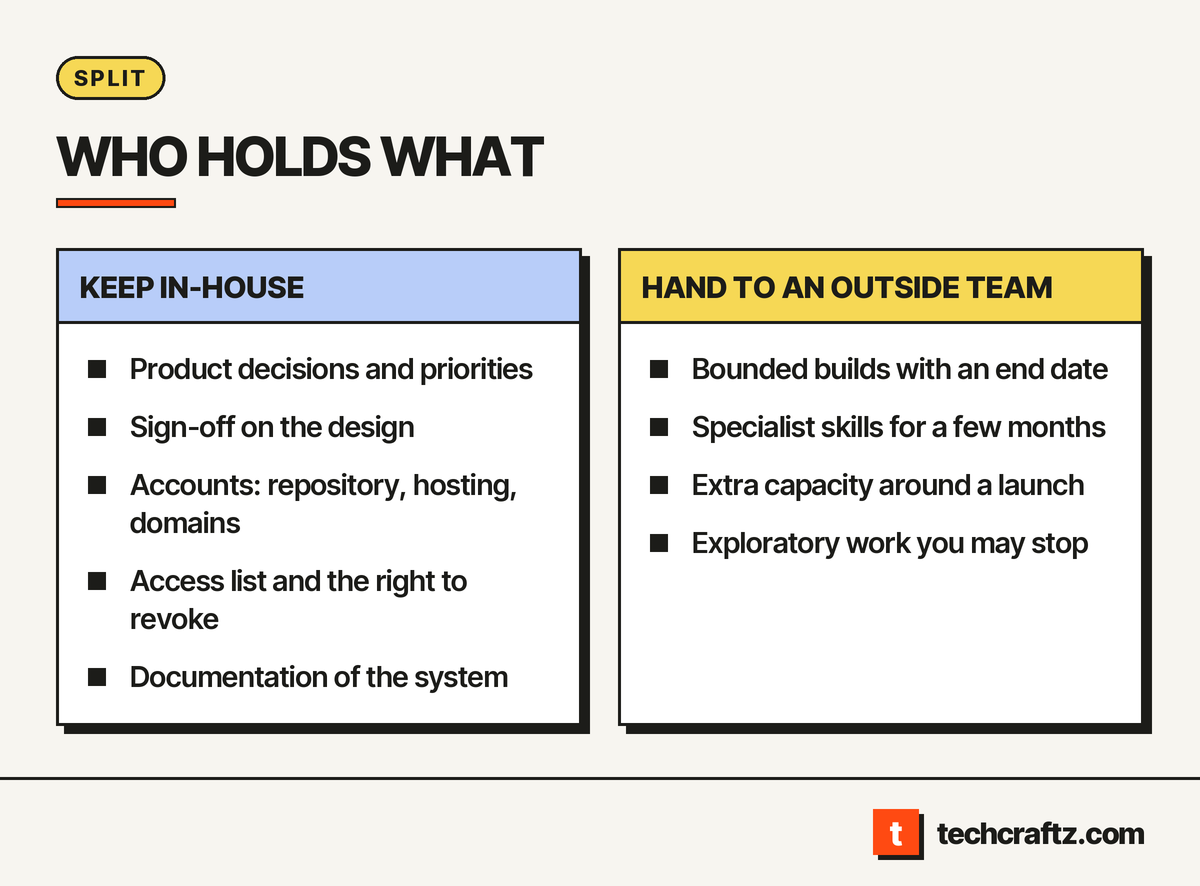
Classic Informatics describes the common pattern: a small in-house core of a product owner, a technical lead and the people who hold domain context, with an outsourced team that handles execution. HatchWorks describes the same split, with the in-house side owning architecture and product direction. We agree, and we would make the keep-list concrete:
- Product decisions. Someone on your side owns the priorities and says yes or no to scope changes.
- Sign-off on the design. An outside team proposes the architecture. You, or an adviser you trust, accept it.
- The accounts. Repository, hosting, domains, app store accounts and third-party services sit in your organization’s name from day one.
- Access. You hold the list of who can reach production and data, and you can revoke it.
- System knowledge. Documentation on how to run, test and deploy exists and is current, so another team can continue.
If a vendor wants to hold any of these for you, ask why. Our outsourcing guide covers the contract clauses that back this up, and the same logic applies to a freelancer.
Where outsourcing is the stronger choice
Outsourcing earns its place in these cases. The vendor guides name most of them, and they hold up:
- Bounded builds with a clear end, where hiring permanent staff makes no sense.
- Specialist skills you need for months, not years: a payments integration, a data pipeline, a mobile app for a web company.
- Capacity spikes around a launch or a migration.
- Exploratory work, where you expect to learn and might stop.
The model you choose also changes shape. HatchWorks lists three: staff augmentation, where outside engineers work under your leads, a dedicated team that runs its own cadence, and outcome-based work, where you define done and accept deliverables. Our article on staff augmentation vs outsourcing explains how to choose between them, and offshoring vs outsourcing covers location.
The hiring trap before you know what to build
The in-house vs outsourced software development decision is often made too early. JetBase warns against building an in-house team before product-market fit. We would add the mechanism. A team costs money in every month, including the months when you are still learning what to build, and people recruited for one idea are hard to redirect. When the hypothesis is untested, a short outsourced build with a defined end costs you less in commitment than a team. When the idea works and the roadmap stabilizes, hiring becomes sensible and the outsourced work can be handed over.
The opposite mistake is treating outsourcing as hands-off. JetBase names it as well. An external team still needs a decision-maker who answers questions within days. If nobody on your side can do that, the project waits, whichever model you picked.
Data and compliance: where in-house vs outsourced software development differ
An employee works under your employment terms and your policies. An external team that can reach personal data is a separate organization. Under the GDPR, Article 28 says that processing by a processor must be governed by a contract or another binding legal act. If your system holds personal data of people in the EU, that applies to your vendor, and it is a document to ask for before access is granted.
The vendor guides we read touch on this lightly. BairesDev says providers should follow GDPR and ISO 27001, and Innowise lists data processing agreements among its security measures. Following a standard is not the same as having the contract signed. This is general information, not legal advice. Rules differ by country and by data, so check with your own adviser.
Switching later, in either direction
The choice is not permanent, provided you hold the handover items above. Moving from outsourced to in-house is easiest when the repository and accounts were yours from the start, the documentation is current and the vendor can brief your new engineers for a short, agreed period. Moving from in-house to outsourced starts with writing down what the system does and where it is fragile, because an outside team will ask.
Write the transition terms into the first contract: how long the vendor supports a handover, what they hand over and in what form. That is cheap on day one and hard to negotiate at the end.
Three starting points
These are invented examples, to show the shape. They are not clients.
- A founder with an untested idea and no technical lead. Outsource a defined first build, with the repository and accounts in the founder’s name. Hire a lead once the idea has users.
- A mid-size company with a stable internal system and one overworked developer. Keep that developer as the technical owner and add outsourced capacity for new modules. This is staff augmentation or a dedicated team under their direction.
- A software company whose product is its core. Keep the architecture and core features in-house. Outsource peripheral work, such as integrations or a mobile client, under written interfaces.
Send the brief, get a written scope
techcraftz puts scope, milestones and the estimate in writing before the first line of code, then hands over the code, the accounts and the keys. If you are working through in-house vs outsourced software development for a real project, the next step is a written scope. If you want outside engineers working under your leads, see staff augmentation. If you want a team abroad to build against a written scope, see offshore software development. Get a written scope, or read more about techcraftz.
Last checked: October 15, 2026. Vendor guides and regulations change; verify before you sign.
Talk to us about your project
Tell us what you need. We help you scope the build, the milestones and a realistic estimate.
View services