Staff augmentation vs outsourcing comes down to two questions: who directs the work day to day, and who answers for the result. With staff augmentation, outside engineers join your team, you direct them, and delivery is yours. With outsourcing, a provider takes a defined outcome, runs its own team and answers for it. If you can manage engineers, augmentation fits. If you can write down what “done” means but cannot manage the build, outsourcing fits.
Staff augmentation vs outsourcing at a glance
The sources we opened agree on the definitions. They are written by firms that sell staffing or services, and KORE1 states plainly that it sells staff augmentation. The table below keeps the points they share.
| Factor | Staff augmentation | Outsourcing |
|---|---|---|
| Who directs the work | You: tasks, priorities, reviews | The provider’s manager |
| Who answers for delivery | You | The provider, against what the contract defines |
| Your tools and process | The augmented engineers use yours | The provider uses its own |
| Changing requirements | Handled in the daily flow | Usually needs a change request or contract amendment |
| Billing model | Time and materials | Fixed price, milestone-based or outcome-based |
| Where knowledge sits | Mostly with your team, since it watched the work | Mostly with the provider unless handed over |
| What you spend effort on | Managing, onboarding, reviewing | Specifying, accepting, overseeing the vendor |
| Fits | Skill gaps, capacity surges, work you want to steer | Defined projects with measurable acceptance |
Treat the rows as tendencies, not rules. A well-run outsourcing contract can keep knowledge with you. A badly run augmentation can leave you with nobody who understands the code.
Three questions that decide staff augmentation vs outsourcing
1. Can someone on your side direct engineers every day? Augmentation hands you the steering wheel. Humancloud warns that if your management layer is already stretched, adding people to manage may backfire. If no one on your team can set priorities, review code and unblock work, augmentation will give you idle capacity.
2. Can you write down what done looks like? Outsourcing works when the deliverable is specific enough to accept or reject: a feature list, acceptance criteria, an integration with a documented interface. Reenbit notes that a poorly defined scope can make an outsourced project much more expensive than a staffed one. If requirements still live in a founder’s head, the problem is discovery, not the engagement model.
3. Who must understand the system when the engagement ends? KORE1 calls this the dimension most comparison pages skip. With augmentation, your team reviews the work as it happens. With outsourcing, the context lives with the provider until you ask for it in writing. If the product is core to your business and you will maintain it, keep the knowledge close.
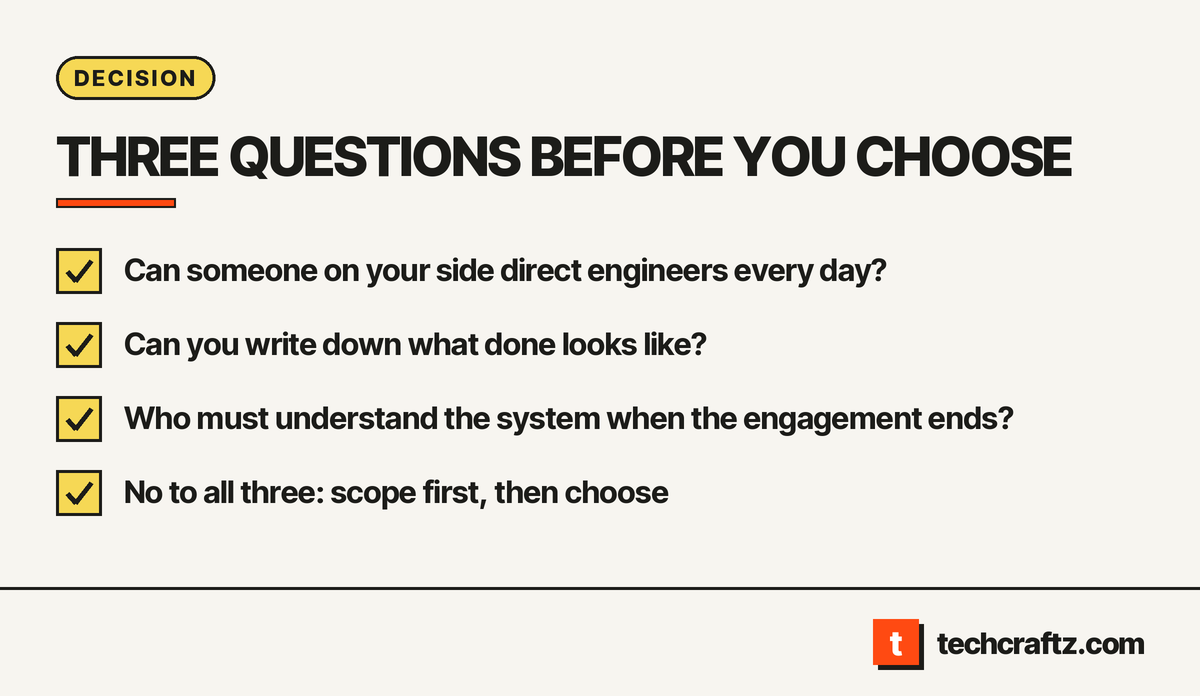
Answer the three and the choice between staff augmentation and outsourcing is usually clear. A yes to the first points to augmentation. A yes to the second and a no to the first points to outsourcing. A yes to the third pushes toward augmentation, or toward outsourcing with a written handover plan. Three noes mean you need a short scoping step before either model, because neither can fix an unclear brief.
What staff augmentation vs outsourcing leaves with you
Neither model removes work from your side. It moves the work.
With staff augmentation you still:
- Prepare a backlog the engineers can pick from.
- Onboard them: repository access, environments, conventions.
- Review their code and make architecture decisions.
- Notice when someone is blocked or underused. Latamcent lists onboarding time and keeping external staff engaged as real challenges.
With outsourcing you still:
- Write the specification and the acceptance criteria.
- Make decisions quickly when the provider asks, so milestones do not stall.
- Review demos and accept or reject each milestone.
- Manage the contract: change requests, payment milestones, handover.
Latamcent adds limited visibility, communication delays and vendor lock-in to the risks of outsourcing. Those are the costs of not being in the room.
Staff augmentation vs outsourcing by scenario
These are hypothetical situations, not client stories.
| Your situation | Lean toward | Why |
|---|---|---|
| Strong tech lead, long backlog, no time to hire | Staff augmentation | Capacity is the gap, direction is not |
| No engineers, a clear spec for a new internal tool | Outsourcing | There is no one to direct, and the spec can be accepted |
| A mobile specialist needed for one release | Staff augmentation | A skill gap in an existing team |
| Rebuilding a marketing site on a new design system | Outsourcing | Bounded work with visible acceptance |
| Early product, requirements change weekly | Augmentation, or an embedded team | Daily steering beats change orders |
| A migration with a documented interface and tests | Outsourcing | The contract surface is already defined |
| Existing system that needs steady upkeep | Neither: see managed services | An ongoing function, not a project or a gap |
The last row is a third model. Managed services hands an ongoing function to a provider under a service-level agreement. It is a different decision, with a different owner of the outcome.
Contract terms for staff augmentation vs outsourcing
The same vendor can offer both models, and the paperwork differs. Ask for these in writing before you sign.
For staff augmentation:
- Who the people are, how many hours they work, and how a replacement is handled if one leaves.
- Notice terms for ending the engagement.
- Code goes into your repository, in your accounts, with IP assigned to you.
- Working hours and the overlap with your team.
- A short handover note when the engagement winds down.
For outsourcing:
- A written scope with milestones, each with a demo and acceptance criteria.
- A change process: how new requests are estimated and approved.
- Repository, cloud accounts and domains in your name from the start, not at the end.
- Documentation and a handover session as deliverables, not courtesies.
- What happens if you part ways before the end: what you receive and when.
If the vendor resists the “your accounts, your repository” terms in either list, treat it as information.
Time zones and communication
Augmentation depends on daily contact, so overlapping working hours matter. Outsourcing depends on milestone reviews, so written updates and recorded demos matter more than shared hours. Reenbit separates onshore, nearshore and offshore outsourcing by where the provider is based, and nearshore usually means a close time zone. The location question applies to both models but bites harder in augmentation. Outsourcing is also not the same as offshoring: Wikipedia notes that offshoring relocates a process to another country and may or may not involve a third-party provider.
Combining the two
Many teams mix the models: outsource a well-defined module, and augment their own team for the part that keeps changing. KORE1 describes the same hybrid. The risk is blurred responsibility. Write down, per piece of work, who directs it and who answers for it.
Staff augmentation vs outsourcing with techcraftz
techcraftz offers both shapes. Staff augmentation adds developers to your team: you direct, the code goes in your repository. A scoped project under custom software development is the outsourcing shape: we own delivery against a written scope. A dedicated team works as a unit on your roadmap, and offshore software development covers running the whole thing from a remote team.
Tell us which of the three questions you could not answer. Get a written scope, or read about techcraftz first.
Last checked: October 14, 2026. Vendor guidance changes; verify before you sign.
Talk to us about your project
Tell us what you need. We help you scope the build, the milestones and a realistic estimate.
View services