How to manage a remote development team comes down to five mechanisms, not a list of twelve tips: a fixed overlap window, decisions written where everyone can find them, a definition of done, a review loop that spreads knowledge, and measures of delivery instead of hours. Each one needs a concrete artifact you can create this week. This guide gives them in order, with a ticket template, a weekly rhythm and a short list of failures to watch for. It applies to in-house remote staff, offshore developers and vendor teams alike.
How to manage a remote development team: fix the overlap window first
The agile principles say that the most efficient and effective way to convey information within a development team is face-to-face conversation. Atlassian points out that early agile teams were meant to sit together, and that distributed teams lose that by default. You cannot recreate it across time zones, but you can protect the part that remains.
Atlassian calls the hours when both sides are online “golden hours”. Its advice: use them for stand-ups, and where teams are far apart, pass the baton so the team coming online picks up where the other left off. Two details are worth stealing. If the overlap is painful for one side, rotate the meeting time so the burden is shared. And a stand-up does not have to be daily; meeting a few times a week and using the other days for local discussion is an option.
Our rule for how to manage a remote development team: the overlap window is for what needs a live conversation, which means decisions, unblocking and pairing. Status goes in writing. If your overlap is short, that rule is what keeps it useful.
Write decisions down where everyone can find them
Atlassian’s first advice for a united culture is to overcommunicate decisions. Decisions get made in hallway conversations, small meetings or by individuals, and remote colleagues never hear about them. Atlassian recommends a wiki rather than email, because email loses information, and notes that delays from working on outdated information cost more than sharing early.
A decision log can be one page. Each entry takes a minute to write.
| Field | Example |
|---|---|
| Decision | Use the existing payments library, no custom wrapper |
| Why | Less code to maintain, same behaviour |
| Decided by | Product owner, with the tech lead |
| Date | The day it was agreed |
| Rejected options | Custom wrapper, second provider |
When a new person joins, or a question comes up at the end of someone’s day, the log answers it without a meeting. It also makes handovers between offices boring, which is the goal.
Define done in writing
Atlassian also recommends a clear definition of done. Its example for a multi-team release is: code written, pull request created, code reviewed, tested and merged into the right branch. Without it, “done” means one thing in one office and another elsewhere, and you find out at the demo.
Put the definition into the ticket itself.
| Ticket field | What it holds |
|---|---|
| Outcome | One sentence: what a user can do after this ships |
| Acceptance criteria | Checks anyone can run, written as plain statements |
| Definition of done | The team’s standing checklist: reviewed, tested, merged, documented |
| Out of scope | What this ticket deliberately does not cover |
| Reply needed by | Who must answer open questions, and by when |
The last row prevents the most common remote stall: a developer blocked on a question that sits unanswered while their working day ends.
Onboard the first week on purpose
Newxel’s rule is to give access before tasks: repositories, documentation, project boards and chat channels ready on day one. It also recommends explaining how work gets done, namely sprint cycles, code reviews, release processes and escalation paths, and pairing a new developer with a buddy so they feel part of the team and not a distant contractor. Our addition: make the first ticket small and finish it within the overlap window, so the new person sees the whole loop from ticket to merge in the first days.
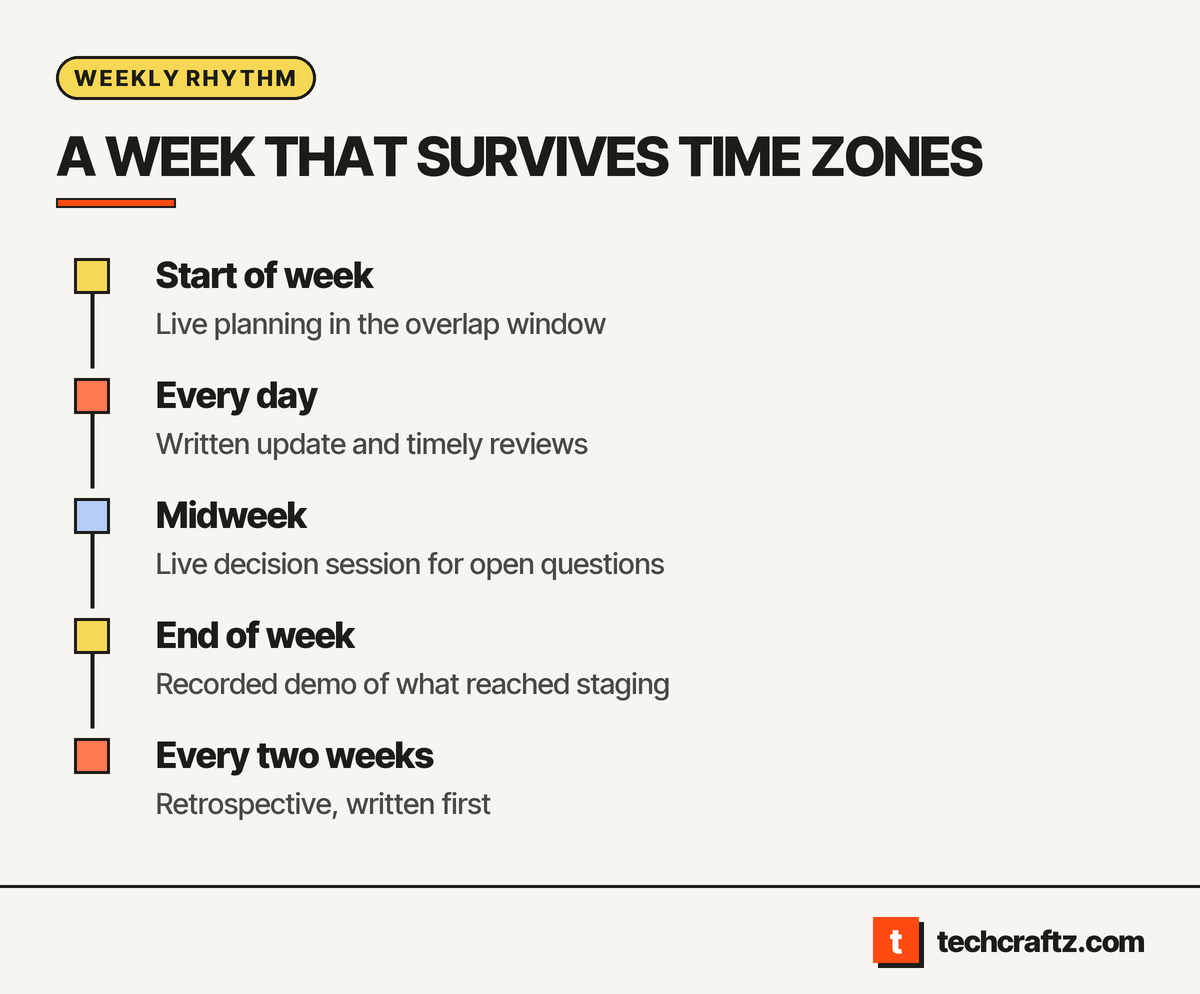
A weekly rhythm for how to manage a remote development team across time zones
This rhythm is our suggestion, not a standard. Adjust the days to your overlap.
| When | What | Where |
|---|---|---|
| Start of week | Planning: agree what ships, rank the backlog | Live, in the overlap window |
| Each working day | A short written update: done, next, blocked | Chat or board, by a fixed time |
| Each working day | Pull requests reviewed within a stated time | Code host |
| Midweek | Decision session for open questions | Live, in the overlap window |
| End of week | Recorded demo of what reached staging | Recording, watched later if needed |
| Every two weeks | Retrospective: what slowed us down | Written first, then a short live call |
Agree the review time in writing. Newxel, a staffing vendor, lists PR review time and response latency among the measures for async collaboration, which tells you how much they matter. A pull request that waits a day for review costs a day in a team that overlaps for two hours.
Use code review to spread knowledge
Atlassian describes code review as more than quality control. Because people are online at different times, spreading knowledge of the code between offices lets another office handle a production issue while the first is offline. Good automated tests help in the same way, since they let the team making a fix validate it without waiting. The aim, Atlassian says, is that no team becomes a blocker.
Another part of how to manage a remote development team is making it safe for anyone to be offline. In practice:
- Rotate reviewers so one person is never the only reader of a module.
- Keep a short “Getting started” guide and automate environment setup, as Atlassian suggests, so a new developer is productive on the first day.
- Write a short runbook for the failures that recur, so any developer can handle them.
- Give bug reports a template: steps, expected result, actual result, environment.
Measure delivery, not hours: how to manage a remote development team by outcomes
Newxel argues for managing remote developers by outcomes, not presence, and its KPIs track output and system health rather than hours worked. Pierpoint makes a similar point: give people the problem and the goal instead of tracking every move.
DORA, the DevOps Research and Assessment programme, publishes five software delivery metrics. Three measure throughput: change lead time, deployment frequency and failed deployment recovery time. Two measure instability: change fail rate and deployment rework rate. DORA’s research reports that speed and stability are not trade-offs; the metrics tend to move together.
DORA also lists pitfalls that apply to anyone working out how to manage a remote development team:
- Setting a metric as a goal. Teams will game it.
- Using one metric for everything. Pick several, with some tension between them.
- Comparing unlike systems. Compare one application against its own past, not against a different product.
- Measuring at the expense of improving. Start with conversations before building dashboards.
For a remote team, add two of your own: how long pull requests wait for review, and how long questions wait for an answer. Both expose a stall before it shows up in delivery.
Build trust without surveillance
A team that trusts its manager reports problems early, which is the real prize in how to manage a remote development team. Atlassian stresses rapport: new hires post an introduction, teammates hold regular one-to-one video calls and, where possible, people meet in person. Arc.dev, a developer marketplace, recommends hiring for communication and autonomy, and over-communicating on purpose. Treat monitoring tools as a last resort. If a team needs keystroke tracking to be trusted, the problem is upstream: the work is unclear, or the wrong people are on it.
Escalate on missed commitments, not on hours. A developer who ships what they said they would, in the order you agreed, has earned the freedom to choose when to work.
Failures to watch for, and fixes
These are the usual ways that how to manage a remote development team goes wrong, with a fix for each.
| Symptom | Likely cause | Fix |
|---|---|---|
| Developers blocked at the end of their day | Questions unanswered | A reply-by field on tickets and a named decision-maker |
| Surprises at the demo | Progress is invisible | Daily written updates, a weekly recorded demo |
| One person knows a module | No review rotation | Rotate reviewers, write runbooks |
| Meetings crowd the overlap | Status is spoken, not written | Move status to written updates |
| Decisions re-argued | No record | A decision log |
Send the brief, get a written scope
Learning how to manage a remote development team is mostly learning to write things down. techcraftz puts scope, milestones and the estimate in writing before the first line of code, then hands over the code, the accounts and the keys. We work asynchronously by default, with recorded demos and written updates. See how a stable team is structured in our guide to the dedicated development team model, or how to hire dedicated developers. Our offshore software development page explains how distributed delivery runs. When you are ready, send the brief. You can also read more about techcraftz, or look at dedicated developers.
Last checked: October 15, 2026. Vendor guidance and research programmes change; verify before you rely on them.
Talk to us about your project
Tell us what you need. We help you scope the build, the milestones and a realistic estimate.
View services