The dedicated development team model gives you a fixed team that works only on your product, billed for capacity rather than for a defined scope. You set the priorities. The vendor supplies and employs the people. That split is where most confusion starts, because the sources we read disagree on who manages the team day to day. This guide treats the model as a division of responsibilities first, then covers who sits on the team, how an engagement runs and when the model fits.
The dedicated development team model in plain terms
Lvivity, a vendor, describes it as a cooperation model in which the customer gets a team of specialists selected to match the project, focused entirely on that project, while the customer controls the working process. The vendor hires the developers and provides administrative support. According to the same source, the monthly payment follows the team you choose: the number of specialists and their skills.
The difference from time and materials is exclusivity. Blackthorn Vision, another vendor, says time-and-materials teams often split their time across clients, so context switching is common and knowledge retention is weaker. A dedicated team works on one product, which tends to build product knowledge. Both claims come from firms that sell the model, so read them as claims. The structural point stands: you are buying a stable group of people, not a deliverable.
Responsibilities in the dedicated development team model
Ask three vendors who runs the team in the dedicated development team model and you get different answers. Binariks says the client usually controls the team and manages day-to-day operations and decisions, with a project manager from the vendor side often present. Blackthorn Vision says recruitment, retention and performance management are handled externally, while product direction and prioritisation sit firmly with the client. Instinctools puts the difference from staff augmentation in the level of vendor responsibility: risk management, process setup and knowledge transfer.
The sources do not contradict each other as much as they seem to. They describe different things. Our reading splits the work like this.
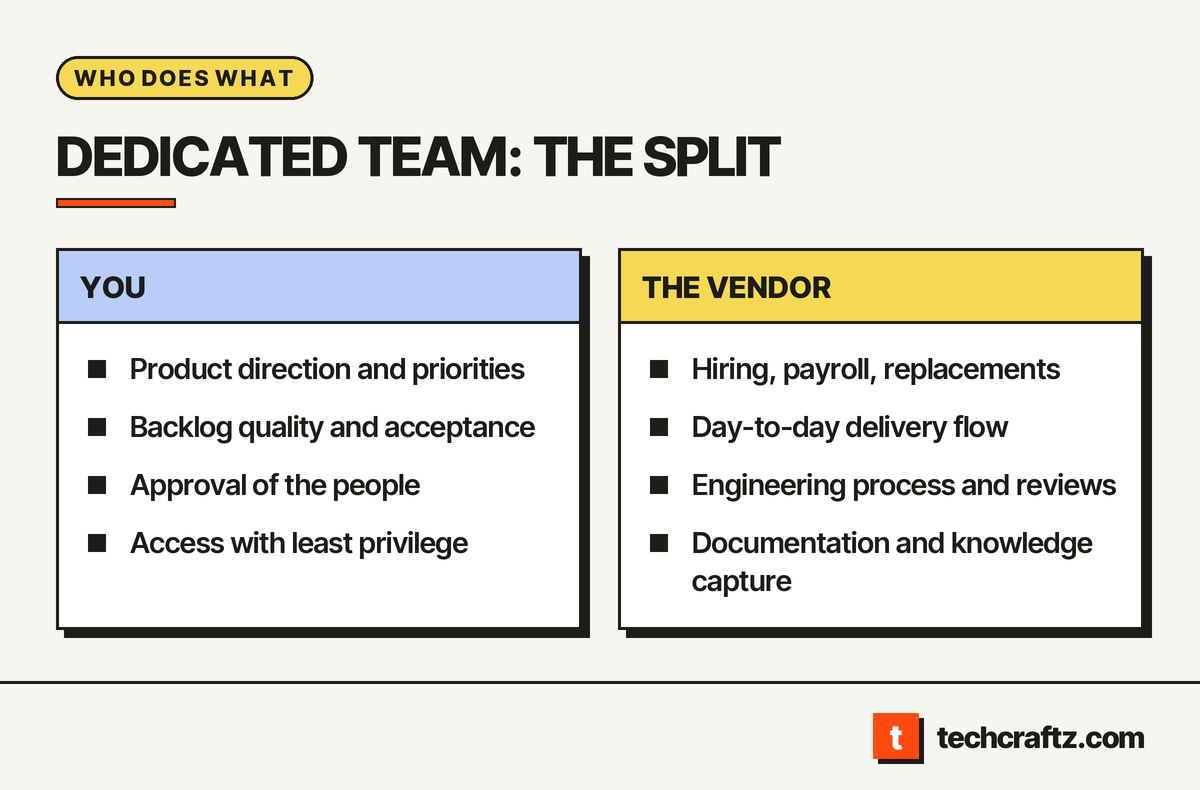
| Area | You | The vendor |
|---|---|---|
| Product direction and priorities | Decide | Advises |
| Backlog quality and acceptance | Own | Challenges and clarifies |
| Hiring, payroll, replacements | Approve people | Owns |
| Daily task flow | Sets direction | Runs delivery |
| Engineering process (reviews, tests, releases) | Agrees the standard | Operates it |
| Documentation and knowledge capture | Reviews | Produces |
| Access and security | Grants least privilege | Follows the rules |
Write this table into the agreement, with names. If two sources can describe the same model in opposite ways, your contract has to say which way yours works.
Team roles on a dedicated team
Sources list similar roles. SoftTeco names a project manager, developers, QA engineers, UI and UX designers, DevOps engineers and business analysts. Instinctools adds a software architect. Group107 centres on a project manager, a designer, back-end and front-end developers and QA.
A list of roles is not a headcount. On a small product, one person often covers several roles. A lean starting shape for the dedicated development team model is:
- developers matched to your stack,
- one QA engineer, or a clear agreement that developers write the tests,
- a delivery lead on the vendor side who owns the process and the replacement plan.
Add a designer, DevOps or an analyst when the backlog shows a recurring need, not before.
The lifecycle of a dedicated team engagement
An engagement moves through four stages. Group107 describes the first two: you outline the skills you need and the team size, and the vendor handles recruitment and vetting. The rest is our reading of how the engagement runs in practice.
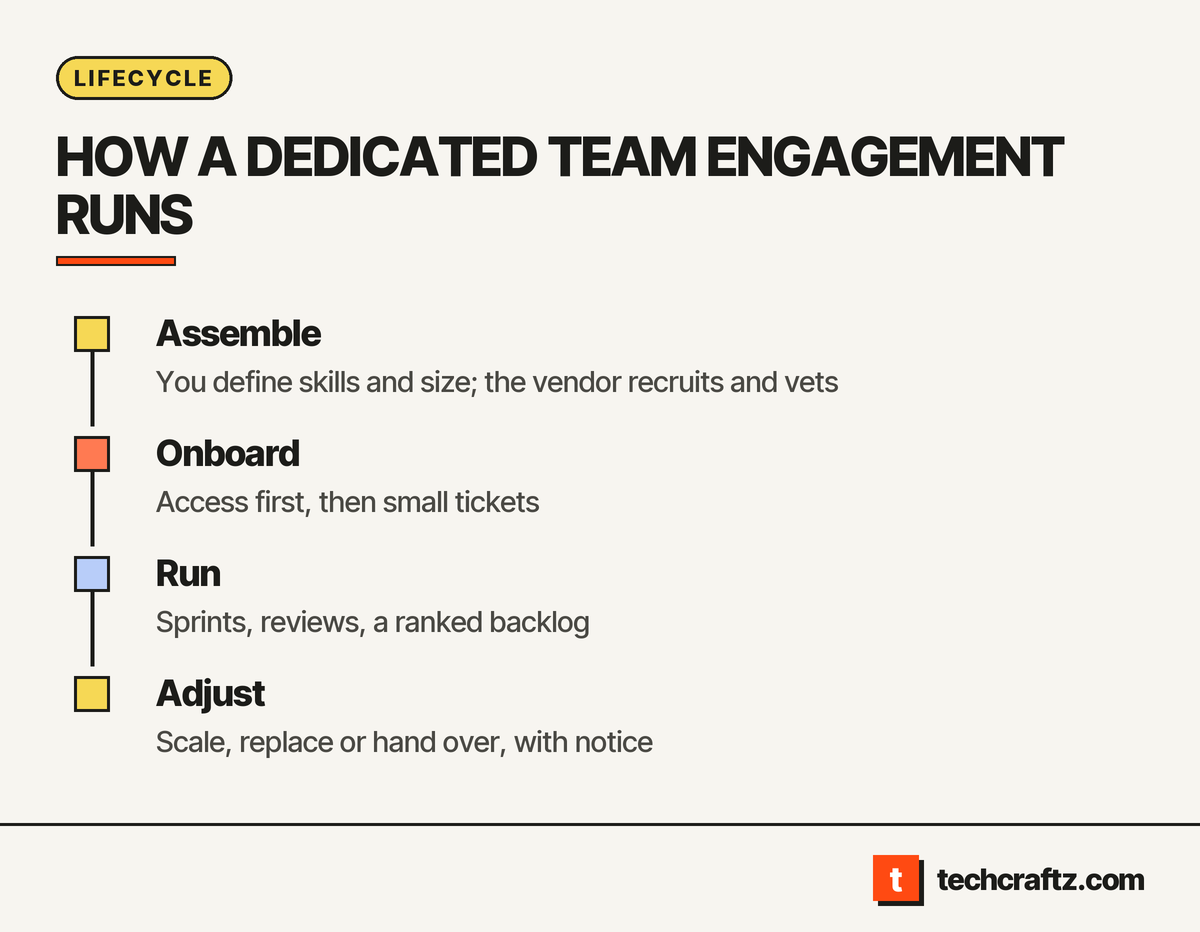
Treat the review at the end of each month as a real checkpoint. Ask: is the backlog ranked, is the team working from it, and does anything need to change in the roles? The dedicated development team model rewards short review loops, which is why it fits agile delivery, where scope is expected to move.
Neighbouring models and how they differ
The dedicated development team model gets mixed up with its neighbours. This comparison keeps the distinctions that the sources agree on.
| Model | You pay for | Who directs the work | When scope changes |
|---|---|---|---|
| Fixed price | A defined scope | The vendor | Renegotiation (Blackthorn Vision) |
| Time and materials | Effort spent | Shared; team may serve other clients | Absorbed, with oversight from you |
| Staff augmentation | Individuals added to your team | You | Handled in your daily flow |
| Extended team | Extra experts for your in-house team | Your in-house leads | Handled in your daily flow |
| Dedicated team | A stable team’s capacity | You set priorities; the vendor runs delivery | Re-ranked backlog |
Binariks makes one more distinction: an extended team supplements an in-house team and integrates into its management, while a dedicated team can stand alone and suits companies with no in-house engineers. For the contrast with outsourcing, see our guide to staff augmentation vs outsourcing.
When the dedicated development team model fits
The model fits when work is continuous and the scope is expected to change. The sources agree on these cases:
- a long-lived product with a steady stream of work,
- requirements that are vague or will change as you learn,
- no in-house engineering organization to hire from,
- a need for several skills at once (development, QA, design).
It does not fit well when the work is short or one-off, when the scope is fixed and well defined (a fixed-price project is simpler), when you need a specialist for one phase only (staff augmentation or a short contract), or when your own team already has the skills and capacity. Instinctools adds a caveat: neither team-extension model suits a decade-long strategic initiative with very specific security or personnel requirements. For that, it suggests an offshore development center.
Contract terms and the risks to price in
Binariks names a risk of the model: possible underutilisation if the workload fluctuates, since you pay for the team’s capacity. Lvivity lists inefficiency for short-term work and the customer involvement the model requires. Handle both in the agreement and in your planning, because the dedicated development team model charges for capacity whether or not your backlog keeps it busy.
- Capacity definition. Roles, allocation and whether people work only on your product.
- Scale up and down. The notice each way and how fast a new person starts.
- Replacement. What happens when someone leaves, and who covers the knowledge transfer.
- A ranked backlog. Keep it two sprints deep, so spare capacity never waits for direction.
- Intellectual property and confidentiality. Group107 recommends full IP assignment to you, an NDA that binds the vendor’s people, and data security rules. We agree.
- Documentation. Decisions written down, so the team does not depend on one person’s memory.
Before any of that, you need to pick the people. Our guide to how to hire dedicated developers covers the vetting steps.
Send the brief, get a written scope
techcraftz puts scope, milestones and the estimate in writing before the first line of code, then hands over the code, the accounts and the keys. If you want a team that works on your product over time, see how we run dedicated developers. For distributed delivery, read about offshore software development, and if you only need to add skills to an existing team, see staff augmentation. When you are ready, send the brief. You can also read more about techcraftz.
Last checked: October 15, 2026. Vendor descriptions of the model vary; verify the terms in writing.
Talk to us about your project
Tell us what you need. We help you scope the build, the milestones and a realistic estimate.
View services