Where to outsource software development depends less on a country ranking than on three things you can check: how many working hours you share with the team, which data and IP rules apply, and whether the country’s strength matches your kind of work. Most lists rank countries by price and bury the rest. We do not publish prices, so this guide does something else. It shows what the lists agree on, how to start from your own location and how to score a country before you contact vendors.
What the usual country lists agree on
We opened five popular lists: Improving, Saigon Technology, X-Team, Netcorp and Huntly. Counting a country only where a list gives it its own entry, five countries appear on all five: Brazil, India, the Philippines, Poland and Romania. Mexico, Ukraine, Vietnam, China and Argentina appear on four. After that the lists scatter.
That overlap is itself a warning for anyone deciding where to outsource software development. Saigon Technology, an outsourcing vendor, says most rankings of outsourcing countries are assembled from other rankings of outsourcing countries. It also separates two things lists blur: countries strong in software engineering, and countries that rank high on call-centre, back-office or hardware work. Its example is that the Philippines, South Africa and China rank among the top outsourcing countries on business process, support or hardware strength rather than software. Treat that as one vendor’s view, but ask the question of any list: what kind of work is this country known for?
Where to outsource software development: start from your own location
The country that suits a US buyer may not suit an Australian one, because the useful variable is shared working hours. Here are examples from standard time zone offsets. Check them against daylight saving for the dates you work.
| You are in | Usually the most overlap | Usually needs shifted hours or written handoffs |
|---|---|---|
| United States or Canada | Latin America | South and Southeast Asia, a gap of roughly half a day |
| United Kingdom or Western Europe | Eastern and Southern Europe, parts of Africa and the Middle East | East Asia and the Pacific |
| Singapore or Australia (east coast) | The Philippines and Vietnam, a few hours apart at most | Eastern Europe and Latin America |
Improving, a software services firm, makes the Latin America case for US buyers: teams there work in US time zones, which allows simultaneous scrum ceremonies. For India and the Philippines it describes a 10 to 12 hour difference from the US, which suits a follow-the-sun model more than real-time work. In our nearshore vs offshore guide we explain how to turn a time gap into shared hours, and how a shifted schedule can beat a closer map position.
What each region is known for
Sources describe regions in broadly similar terms, which helps when you are choosing where to outsource software development. These are vendor claims, summarised and not verified by us.
| Region | Often cited for | Cautions the sources raise |
|---|---|---|
| Eastern Europe (Poland, Romania, Czech Republic, Ukraine) | Complex engineering, security, R&D; EU membership for Poland and Romania | Rising costs (Improving) and EU-wide competition for senior engineers in Poland (Saigon); Huntly flags ongoing geopolitical risk for Ukraine |
| Latin America (Mexico, Brazil, Argentina, Colombia, Costa Rica) | Time zone alignment with the US, agile product teams, mobile | Improving says strong US demand lifts rates and notes economic volatility in some countries |
| South and Southeast Asia (India, Vietnam, Philippines) | Scale, mature outsourcing ecosystems, English proficiency | Retention can be hard (Improving); Saigon says quality varies sharply by vendor tier in India |
| Middle East and Africa (Egypt, Nigeria, South Africa, UAE) | Egypt for time zone alignment with Europe; South Africa for English and cultural fit with the UK and Australia (Improving) | Power and internet stability vary by country; project management maturity varies |
Read the middle column as reputation, not fact about any one vendor. A strong country can host weak vendors and the reverse.
Legal and data checks that change by country
Where to outsource software development also depends on the legal ground. The country decides which privacy and IP rules sit behind your contract. Three checks matter before you shortlist.
Personal data. If developers will touch personal data of EU residents, the European Commission’s list of countries with adequacy decisions matters. On our check of October 15, 2026, Brazil and Argentina are on it, and Poland and Romania sit inside the EU. India, Mexico, the Philippines and Vietnam are not on the list, which means transfers rely on safeguards such as standard contractual clauses. Australian and Singaporean buyers have their own cross-border rules, covered in our nearshore vs offshore guide. The label of the country does not decide this; the contract and the access you grant do.
Code ownership. In general, the author of code owns the copyright first (employee work is treated differently), and a transfer to you needs a signed written instrument. US copyright law (17 U.S.C. 204) requires a signed writing for a transfer, and UK law (CDPA 1988 section 90) requires an assignment to be in writing and signed. Whichever country you pick, put a written assignment in the contract and name the governing law. This is general information, not legal advice.
Enforcement. A contract is only as strong as your ability to enforce it. Ask counsel where disputes are settled and whether a judgement in that venue can be enforced where the vendor holds assets.
Questions a country list cannot answer
Saigon Technology points out that retention is what you should ask for and almost nobody publishes. Ask every vendor what share of its engineers left in the last year, and how it replaces people. The same logic applies to the following:
- Engineering depth versus process depth. Does the vendor have senior engineers in your stack, or large teams for routine work?
- Continuity. What happens if power, internet or local conditions fail for a week? Is there a second location or a documented fallback?
- Management layer. Who is your day-to-day contact, and what hours do they keep?
- Language in writing. Spoken fluency matters less than clear written updates on an async schedule.
Shortlist in three passes
A long list of countries is not a decision. Narrow where to outsource software development in three passes, cheapest check first.
- Hours. Drop any country where you cannot get the overlap your work needs, even on a shifted schedule. This removes most of the map.
- Rules. Drop any country where your data or IP requirements cannot be met by contract. If you cannot write down the safeguard, you cannot use the country for that project.
- Evidence. For the two or three left, ask vendors for named references in your stack, their written-update habits and their retention. Compare vendors, not countries, at this stage.
Then run the scorecard on what remains.
A country scorecard
To decide where to outsource software development, fill this in for each country you consider. It is our suggestion, not a standard.
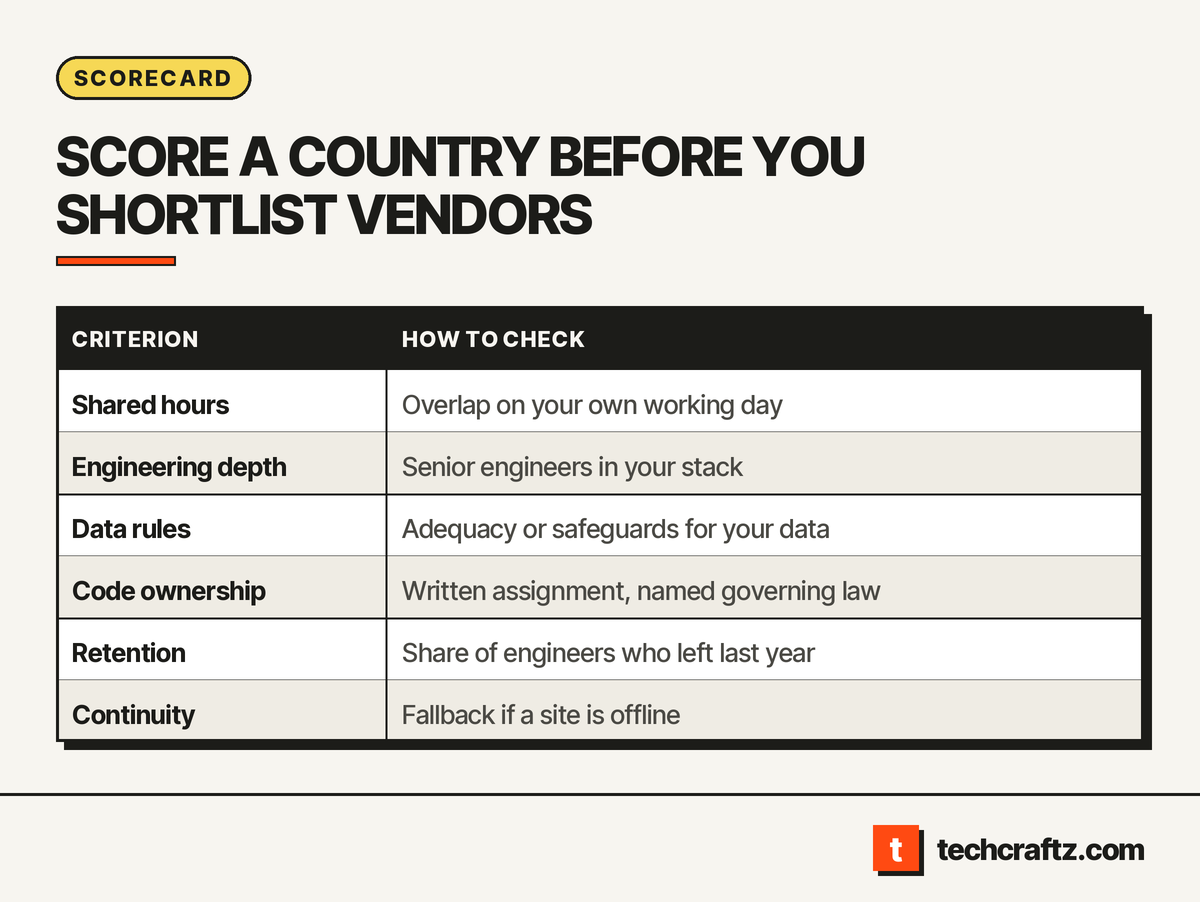
Weight the rows by your project. A product that changes weekly gives shared hours more weight. A product that stores health or financial records gives more weight to data and enforcement. If two countries score similarly, the vendor decides, which is why the guide on offshoring vs outsourcing is worth reading too.
Using more than one country
Where to outsource software development does not need a single answer. Improving describes a hybrid model: a core team in one region for real-time work and a second team elsewhere for bounded workstreams. The cost of the model is coordination, so give every workstream one owner and a written interface. If you cannot yet manage one remote team well, wait before you manage two.
Send the brief, get a written scope
techcraftz puts scope, milestones and the estimate in writing before the first line of code, then hands over the code, the accounts and the keys. Our offshore software development page explains how a distributed engagement runs, and staff augmentation covers adding engineers to your own team. When you are ready, send the brief. You can also read more about techcraftz.
Last checked: October 15, 2026. Country lists, adequacy decisions and legal rules change; verify before you sign.
Talk to us about your project
Tell us what you need. We help you scope the build, the milestones and a realistic estimate.
View services