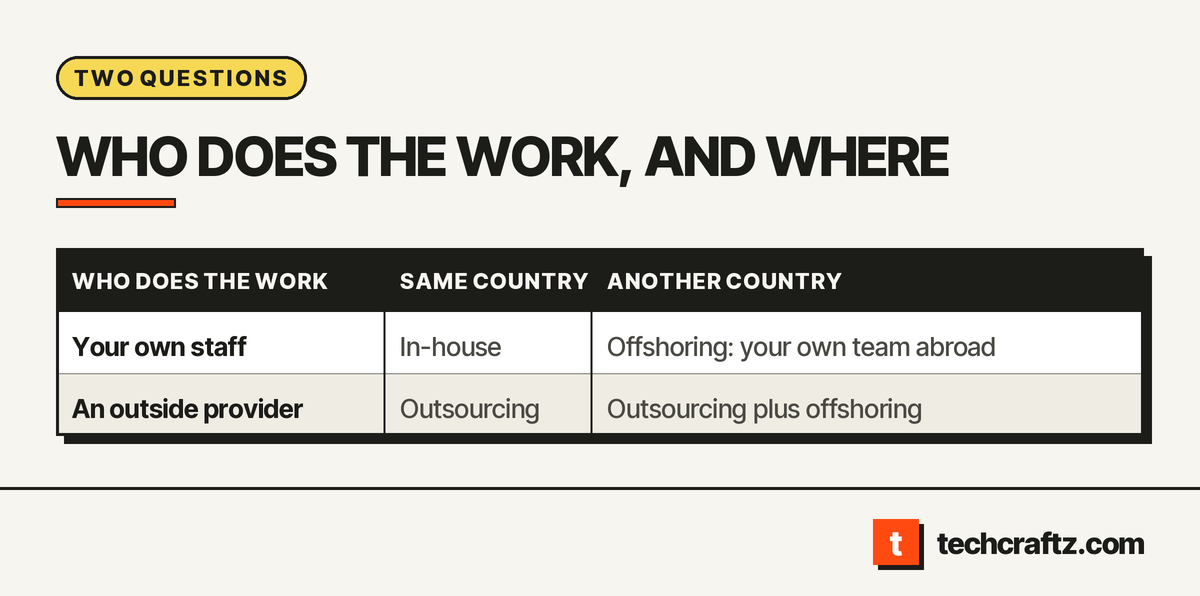
Offshoring vs outsourcing is not an either-or choice, because the two words answer different questions. Outsourcing is about who does the work: an outside provider instead of your own staff. Offshoring is about where the work happens: another country. A software project can be outsourced and offshore, outsourced and local, in-house and offshore, or neither. Each combination changes different lines of your contract, which is what this article compares.
Offshoring vs outsourcing: two different questions
Prialto’s explainer puts it plainly: outsourcing means delegating business processes to another company or to independent contractors, while offshoring means moving part of a business’s operations to another country. It adds that the two combine. A business can own and run its own facility abroad, or it can hand the work to a local firm.
Hubstaff draws the same line from the control side: outsourcing hands tasks to a third party wherever it is, while offshoring often keeps company control over operations that happen abroad.
Nearshoring is a variant of the second question. Personiv describes it as work performed in a different country than the client’s, usually much closer and often across a shared border, for example a UK organisation using providers in the Balkans.
Offshoring vs outsourcing in the contract: a side-by-side
The table below is our editorial reading of what to settle for each combination of offshoring vs outsourcing. It is not a legal template.
| Contract item | Outsourced, same country | Outsourced, another country | Your own team abroad |
|---|---|---|---|
| Who is accountable for delivery | The provider, per the written scope | The provider, per the written scope | You |
| Day-to-day management | Provider or you, by model | Provider or you, by model | You |
| Where data is processed | Your country, usually | A named foreign location | A named foreign location |
| Which courts or arbitration apply | Familiar | Must be stated | Depends on your entity there |
| Working-hours overlap | Full | Check, in writing | Check, in writing |
| Code, accounts and IP | Assigned to you | Assigned to you | Already yours |
| Exit | Handover of code and accounts | Handover of code and accounts | Winding down a team |
The contract under outsourcing
Handing software work to a provider moves accountability for delivery outside your walls, so the contract has to carry what a manager would otherwise supply. Two vendor guides on outsourcing contracts, N-iX and Codeable, converge on a short list:
- A written scope with deliverables and acceptance criteria
- How payment works and how changes are priced
- Full transfer of IP as work is delivered
- An NDA before work starts
- Data protection terms, including where data is processed
- Rules for the use of AI in the work
- A change-request process and a warranty period
Both are vendors with something to sell, so read these as common practice, not as a standard. For the engagement models themselves, see our software development outsourcing guide and the comparison of staff augmentation vs outsourcing.
The contract under offshoring
Moving work to another country adds three practical issues on top of any outsourcing terms. Hubstaff lists the hurdles as cultural differences, communication and time-zone barriers, and the complexity of managing a distant operation. Put each into writing:
- Overlap hours. Name the hours both sides are reachable, and what happens outside them.
- A written-first process. Decisions, demos and questions in writing, so time zones cost a day at most.
- Data location. If personal data from the EU is involved, GDPR Article 44 says transfers to a third country may take place only if the conditions of the regulation’s transfer chapter are met. Article 46 lists the safeguards that can apply when there is no adequacy decision, such as standard data protection clauses adopted by the Commission. And Article 28 requires a binding contract with a processor. Ask the provider where data is stored, where support staff can reach it from, and which safeguard applies. This is not legal advice.
Also ask which law governs the contract and where disputes are heard. That is a question for counsel, not for a sales call.
Nearshoring as the middle option
Nearshoring trades distance for overlap. Personiv notes the caveat: closer does not automatically mean culturally compatible, and neighbouring countries can differ a lot. Treat nearshoring as a way to buy more working-hours overlap, then verify the communication in a pilot, as in our guide to outsourcing web development.
Choosing between offshoring vs outsourcing
Start from your constraints, not from the label.
| If this is true | Lean toward |
|---|---|
| Software is your main differentiator, or you can staff a team long term | Building your own team, here or abroad |
| Requirements are clear, and you want a defined deliverable | Outsourcing, with a written scope |
| Data rules restrict where information can go | Providers in the permitted location, or outsourcing with strict data terms |
| You need real-time collaboration most days | Overlapping time zones, which may mean nearshore or local |
| You have no internal owner for the project | Fix that first. Neither model works without one. |
N-iX lists cases where outsourcing fits less well: when software is the main differentiator, when data residency or regulation restricts it, when requirements are unclear, when no internal owner exists and for small, bounded tasks. You may not need an agency at all. A freelancer or a small in-house hire can be the better answer.
Three scenarios for offshoring vs outsourcing
These are hypothetical, to show how the reasoning runs. They are not client stories.
A retailer with EU customers wants a customer portal. Requirements are clear and there are no engineers in house. This points to outsourcing under a written scope. Whether the provider is local or abroad then depends on the data terms and the hours of overlap, so settle those two items before comparing offers.
A founder whose product is the software. Software is the differentiator, and engineers will be needed for years. Outsourcing fits less well here. Building a team, possibly abroad, is the offshoring question, and it is as much about hiring and local entities as about any provider contract. Take advice on those before you commit.
A small company needing one integration between two tools. The task is bounded. A freelancer or a short outsourced job does it, and offshoring vs outsourcing barely matters. Put the scope, the acceptance check and the handover in writing, and move on.
A checklist before you sign
- Does the contract say who is accountable for delivery, and how “done” is checked?
- Is all code, every account and every domain assigned to you?
- Is the data location named, with the safeguard that applies?
- Are overlap hours, response times and written update rules stated?
- Is there a handover plan if you leave?
- Is there a named owner on your side with authority to decide?
Send the brief, get a written scope
techcraftz puts scope, milestones and the estimate in writing before the first line of code, then hands over the code, the accounts and the keys. Whether your project ends up outsourced, offshore or both, that written scope is what you compare offers against. See our pages on offshore software development and staff augmentation, or the techcraftz overview, then send the details.
Get a written scope for your project.
Last checked: October 14, 2026. Contracts and regulations vary by country; verify before you sign.
Talk to us about your project
Tell us what you need. We help you scope the build, the milestones and a realistic estimate.
View services