What is IT staff augmentation? It is a way to add specialists to your team for a defined period while you keep directing their day-to-day work. Wikipedia describes it as a contracting approach in which an organization temporarily increases capacity by contracting for individuals with specific skills, who often take daily direction from the client. The engineer joins your team, uses your tools and answers to your lead. That makes it different from outsourcing, where a supplier delivers a result under its own management.
This guide answers what is IT staff augmentation in plain terms. It covers the definition, who does what, the steps, a worked example, and a risk that most explainers leave out: how tax and employment authorities treat a person you control.
What is IT staff augmentation, in one paragraph
Questsys, an IT services firm, calls it a workforce strategy that lets a business temporarily expand its team with external professionals who have specific technical skills. You bring in people for a gap in skills, a surge in work or a time-limited project. Oyster, a hiring platform, lists the usual flavours:
- Short-term: a sprint, a one-off deliverable or cover for an absence.
- Long-term: a persistent skill gap, filled for several months or more.
- Skill-based or project-based: one specialist, or a temporary team for a defined initiative.
- Onshore or offshore: local engineers, or engineers from another country.
- Contract-to-hire: a trial period before a permanent offer.
For IT, the roles are typically developers, QA engineers, DevOps and security specialists. The common thread is that you remain the manager.
Division of work in staff augmentation
The table is our reading of how the sources divide the work, and it is the shortest answer to what is IT staff augmentation in practice.
| Task | You | The provider | The augmented engineer |
|---|---|---|---|
| Decide what to build and in what order | Yes | ||
| Direct day-to-day tasks and review output | Yes | ||
| Find and screen candidates | Interview and approve | Sources and pre-screens | |
| Employ and pay the engineer | Usually | ||
| Provide tools, repositories, access | Yes | ||
| Follow your process and standards | Yes | ||
| Replace someone who leaves | Usually | ||
| Hand over documentation | Require it | Produces it |
Notice what is missing from the provider’s column: managing the work. In staff augmentation, delivery is yours. Our article on staff augmentation vs outsourcing explains why that matters for contracts.
The staff augmentation lifecycle, step by step
Questsys describes five steps for what is IT staff augmentation in practice: identify needs, source candidates, interview and screen, onboard, and ongoing support. Vaultes, a security firm, lists a similar sequence. We add a sixth, because engagements need an ending.
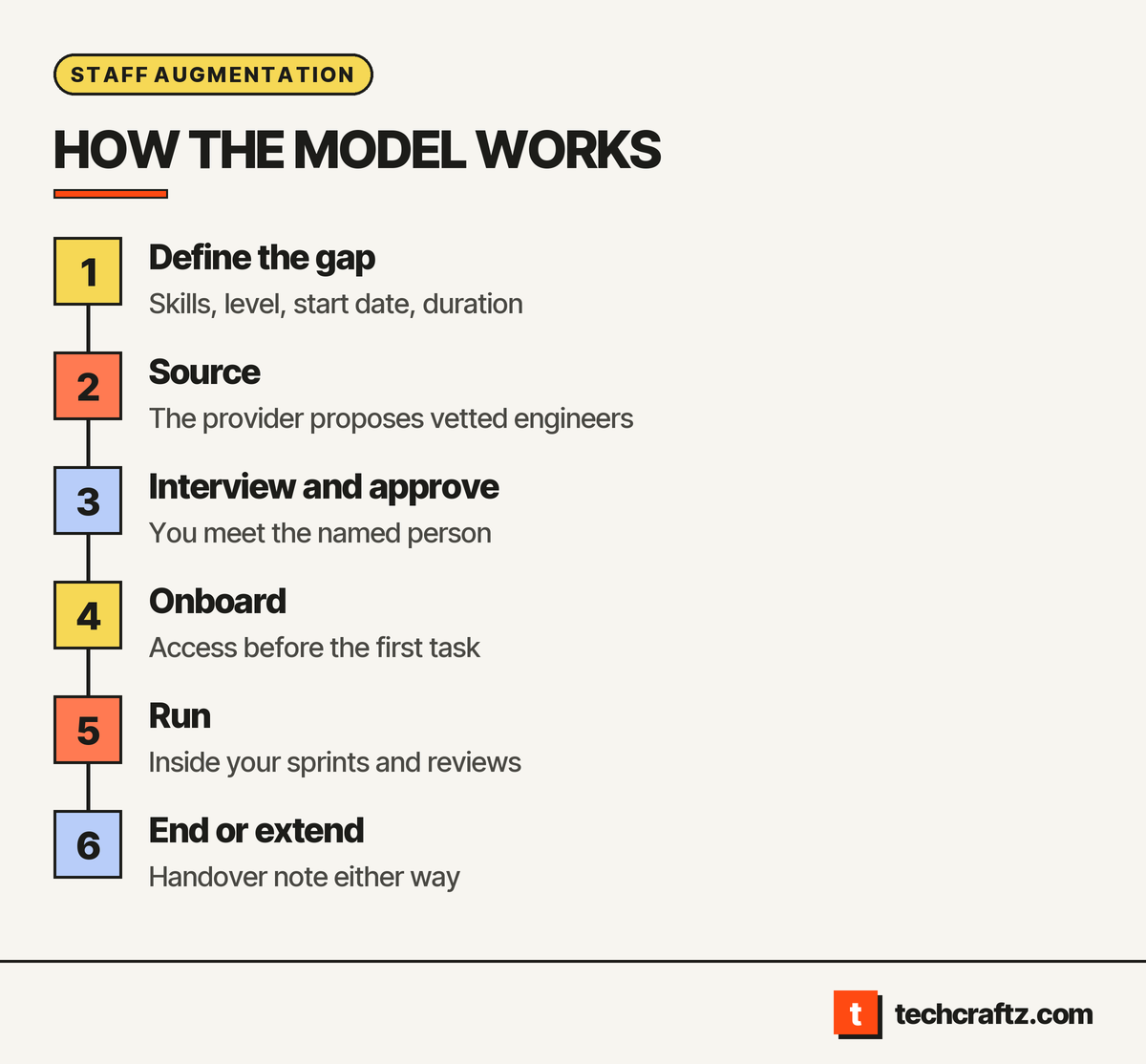
- Define the gap. Write the skills, experience level, start date and expected duration. The more specific, the better the shortlist.
- Source. The provider proposes pre-vetted engineers who match the description.
- Interview and approve. You talk to the named person and, if you want, run a technical screen. You decide whether they join.
- Onboard. Give access to repositories, documentation and tools before the first task, and introduce the engineer to your process.
- Run. The engineer works inside your sprints and reviews. The provider handles the contract and any concerns.
- End or extend. At the agreed date you extend, replace or stop. Ask for a handover note either way.
A worked example
To see what is IT staff augmentation in practice, take this example. It is invented, to show the shape. It is not a client story.
A small product team has a stable web application and a plan to ship a mobile app in one release. Nobody on the team has built a mobile app. Hiring a permanent mobile developer would take longer than the release window and the work may not continue afterwards.
The team defines the gap: one mobile developer for one release, with experience in the framework they have chosen. The provider proposes two engineers. The tech lead interviews both, asks each to walk through a past release and picks one. On day one the engineer has repository access and a “getting started” guide. The first ticket is small. For the rest of the engagement the engineer joins planning, takes tickets, opens pull requests and has them reviewed by the team. At the end, the app ships, the engineer writes up how the build and release process works, and the engagement closes.
At no point did the provider decide what to build or run the sprint. That is the test: if the provider did, it was outsourcing.
Neighbouring terms and how they differ
So what is IT staff augmentation not? The term gets mixed up with its neighbours, and sources use them loosely. Wikipedia notes that staff augmentation is sometimes contrasted with statement-of-work contracting and managed services.
| Term | What you buy | Who directs the work |
|---|---|---|
| Staff augmentation | Capacity: individuals added to your team | You |
| Outsourcing | A defined outcome from a supplier’s team | The supplier |
| Managed services | Ongoing operation of a function, to an agreed service level | The provider |
| Consulting | Advice, analysis or a recommendation | The consultant, within the brief |
The last row is our own shorthand for the usual distinction between advice and capacity. Consultants tell you what to do; augmented engineers do what you direct. For the line between augmentation and a run service, read staff augmentation vs managed services.
The legal side most explainers skip
Any full answer to what is IT staff augmentation has to cover the engineer’s employer. Because you direct the work, staff augmentation touches a question that most guides never raise: is the person an employee or an independent contractor? Tax and employment authorities decide this with their own tests, and in the United States control is central.
The US Internal Revenue Service says to weigh behavioural facts (does the business control what the worker does and how), financial facts and the type of relationship. It stresses that no single factor decides it and that the key is the extent of the right to direct and control the worker. It also says a remote worker is an employee under common-law rules if you can control what is done and how, even when the worker chooses to work remotely.
In the United Kingdom, the off-payroll working rules, known as IR35, apply when a worker provides services through their own intermediary and would have been an employee if they had worked directly for the client. GOV.UK says that in most cases the client decides the worker’s employment status for tax, with an exception for small clients outside the public sector, and that its CEST tool can help with the decision. Wikipedia also notes the EU framework for temporary agency workers, Directive 2008/104/EC, and that cross-border placements can raise immigration and work-authorization questions.
None of this means staff augmentation is risky by itself. It means the contract structure matters. A practical approach:
- Prefer a provider that employs the engineers, so the employment relationship sits with the provider. This does not remove every risk: Wikipedia notes joint-employment exposure where a client controls working conditions while a third party employs the worker.
- Ask who is the employer of record and who pays payroll taxes.
- Put supervision, confidentiality and security controls into the contract, as public-sector procurement documents commonly do, according to Wikipedia.
- Check IP assignment: work product should belong to you.
- Ask counsel to review. This is general information, not legal advice.
Fit: when staff augmentation works and when it does not
Asking what is IT staff augmentation good for gives a short answer: capacity and skills, under your direction. It fits when you have a skill gap or a temporary surge, you can direct the work and you want to keep decisions in-house. Questsys gives examples: a cloud migration with no cloud engineer on staff, or extra testers to speed a QA cycle before a launch.
It fits badly when nobody on your side can manage engineers, because nobody makes the decisions the added people need. Wikipedia lists the usual criticisms: budgeting uncertainty when time-and-materials engagements run longer than planned, dependency when knowledge sits with external workers, and security risk when outsiders need access to systems and personal data. Plan for each: set a review date, require documentation and give least-privilege access.
If you want a stable team on your product over a long period, the dedicated developers model may fit better.
Questions to ask a provider before you start
If you have decided that this is the model for you, ask these in writing:
- Who employs the engineers, and who pays their taxes and benefits?
- Can I interview the named person before they start?
- What happens if the engineer leaves or does not fit?
- Who owns the work product, and where is it stored?
- What access will the engineer need, and how is it removed at the end?
- How are hours reported and approved?
Send the brief, get a written scope
techcraftz puts scope, milestones and the estimate in writing before the first line of code, then hands over the code, the accounts and the keys. If your answer to what is IT staff augmentation is “the model we need”, see our staff augmentation page. When you are ready, send the brief. You can also read more about techcraftz.
Last checked: October 15, 2026. Employment and tax rules change; verify them with counsel before you sign.
Talk to us about your project
Tell us what you need. We help you scope the build, the milestones and a realistic estimate.
View services