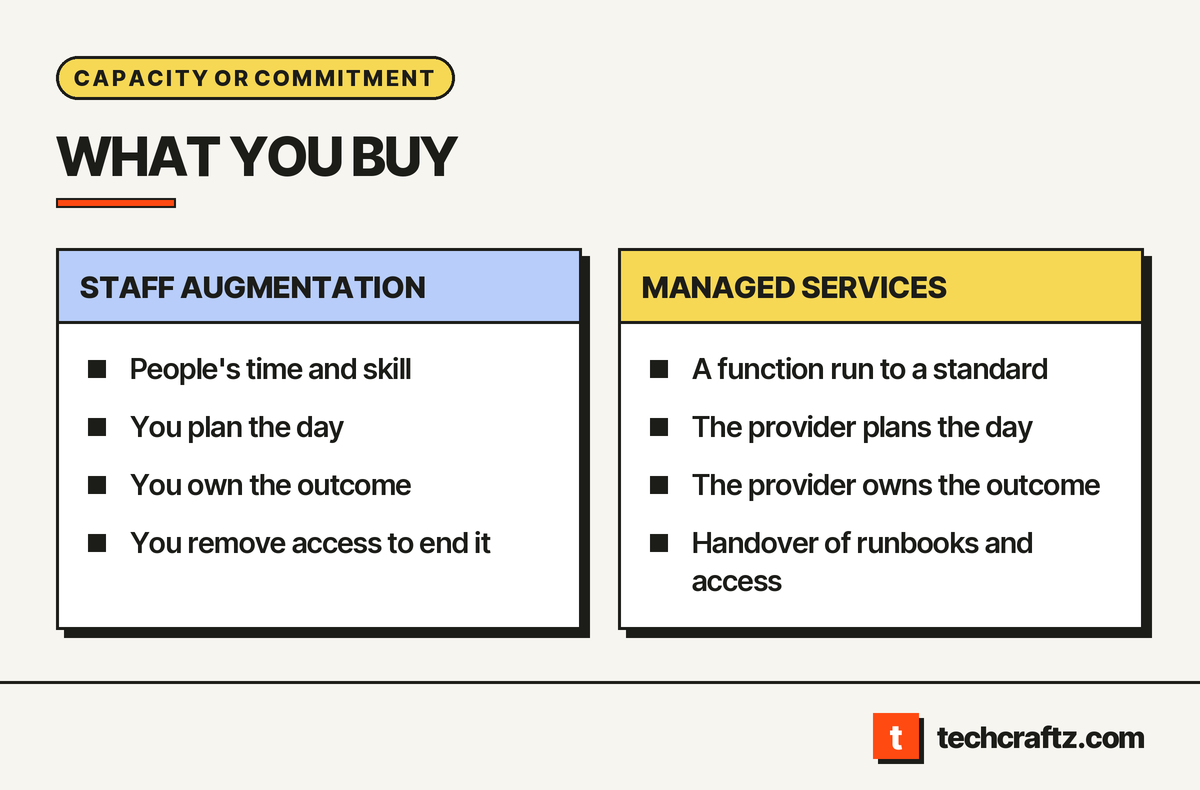
Staff augmentation vs managed services is a choice between buying capacity and buying a commitment. With staff augmentation, outside engineers work inside your team and you own the outcome. With managed services, a provider takes ongoing responsibility for a function, such as supporting and maintaining a live application, and answers to a written service standard. For software, the shortcut is this: augmentation suits changing a product, managed services suits keeping it running.
Staff augmentation vs managed services: two terms that sources blur
Pages on staff augmentation vs managed services do not agree on what “managed services” means, and the disagreement changes your decision.
Wikipedia describes managed services as a model in which a third-party provider assumes ongoing responsibility for managing and maintaining systems, proactively, against a defined service level agreement, often for a recurring fee. KORE1 uses the same frame: a provider owns an ongoing function to a standard such as uptime or response time.
Sphere describes managed services more loosely: the provider works on a designated task from a quote and a project timeline, and the client checks progress daily or weekly. That is closer to what other pages call project outsourcing. We covered that split in staff augmentation vs outsourcing.
In this guide, managed services means an ongoing function run to a written standard. Staff augmentation means people added to your team and directed by you. If a vendor proposes “managed services” for a build with an end date, ask which definition they use.
Capacity versus commitment in staff augmentation vs managed services
| Staff augmentation | Managed services | |
|---|---|---|
| What you buy | People’s time and skill | A function run to a standard |
| Who plans the day | You | The provider |
| Who owns the outcome | You | The provider, to the agreed standard |
| What is measured | Hours worked, tasks done as you define them | Service levels: availability, response, resolution |
| Typical billing | Time and materials | A recurring retainer or per-outcome terms |
| Where it fits | Changing the product, filling a skill gap | Running the product, steady upkeep |
| How it ends | You remove access; knowledge stays with your team | Handover of runbooks, access and history |
On staff augmentation vs managed services, Fieldnation and Sphere reach similar conclusions: augmentation gives more control and flexibility, managed services removes day-to-day management and works better for long-term needs. The table is our synthesis. It is not a rule that every vendor follows.
Run work and change work
Most confusion in staff augmentation vs managed services goes away once you split the backlog into two kinds of work. This is our framing, not an industry standard.
Run work keeps a live system healthy. Monitoring, incident response, bug fixes within the existing design, security patches, dependency updates, operating system and framework upgrades, and support questions from users.
Change work alters what the system does. New features, new integrations, a redesign, a migration.
Run work is repetitive, measurable and often unpredictable in timing: an incident does not wait for a sprint. A service level agreement fits it. Change work depends on priorities that move with your business: someone has to steer it, which is where staff augmentation fits.
| Work | Leans toward |
|---|---|
| Monitoring and incident response | Managed services |
| Security patches and dependency updates | Managed services |
| Operating system and framework upgrades | Managed services, or a scoped project |
| New features on a fast-moving roadmap | Staff augmentation |
| A one-time migration | A scoped project, or augmentation |
| A skill your team lacks for one quarter | Staff augmentation |
What a service level agreement for software support must state
Wikipedia defines a service level agreement as an agreement, typically a binding contract, that sets out aspects of the service such as quality, availability and responsibilities, often with measurable objectives like uptime and time to repair. It adds that agreements often require regular review meetings and may apply rewards and penalties.
For application support, a usable agreement should name:
- The scope. Which systems, environments and integrations are covered.
- The hours. When support is available, and what happens outside them.
- Severity levels. What counts as critical, high and normal.
- Response and resolution. They are different. A reply in minutes does not fix anything. State what “response” means: has a person diagnosed the issue and started work, or only acknowledged the ticket?
- Escalation. Who is contacted when a target is missed.
- Reporting. What you receive each month and how it is discussed.
- Exclusions. New features are change work and are not covered by the support fee. Say how a request is classified.
- Access and ownership. Code, accounts and documentation remain in your name.
- Exit. What you receive if you end the agreement, and when.
One failure mode to guard against: the provider meets every response target while the underlying problem stays open, because the agreement measured replies and not outcomes. Ask what is measured.
Staff augmentation vs managed services by situation
These are hypothetical situations, not client stories. Use them to test your own case against staff augmentation vs managed services.
| Your situation | Lean toward |
|---|---|
| Product team with a strong lead, a long roadmap, short on developers | Staff augmentation |
| A live application, no in-house engineers, users need support | Managed services |
| An internal tool nobody has time to patch | Managed services |
| A new module needs React skills for one quarter | Staff augmentation |
| Product team wants to stop being paged for incidents | Managed services for run work, your team on change work |
| You cannot yet define what the system should do | Neither: scope the work first |
Failure modes in staff augmentation vs managed services
Staff augmentation fails when no one directs the work. HumanCloud’s guidance is that augmentation needs hands-on management from your side, and that a stretched management layer can make it backfire. The engineers are capable. The backlog and the reviews are yours.
Managed services fails when the standard is vague or the scope has gaps. KORE1 notes that you give up day-to-day control in exchange for the provider carrying delivery risk. That trade only pays if the agreement says what “delivered” means, and if the provider’s runbooks and access end up with you.
Both fail when the system is undocumented. If one person holds the knowledge, neither model is safe.
Combining staff augmentation and managed services
Many products need both, so staff augmentation vs managed services is often a split, not a vote. Your team, with augmented engineers, owns the roadmap. A managed arrangement covers the run work, so product engineers are not interrupted by incidents and updates. The rule that keeps this clean: every ticket is classified as run or change before it is assigned, and each class has one owner.
Staff augmentation vs managed services with techcraftz
techcraftz offers staff augmentation: developers join your team, you direct them, and the code goes into your repository. A dedicated team works as a unit on your roadmap, and a scoped project under custom software development comes with post-launch support written into the agreement. We do not publish a service level template. If you need ongoing upkeep of an existing system, describe it and we will say in writing whether we can take it on and on what terms.
Name the system, the users and the kind of work. Get a written scope, or read about techcraftz first.
Last checked: October 14, 2026. Vendor guidance changes; verify before you sign.
Talk to us about your project
Tell us what you need. We help you scope the build, the milestones and a realistic estimate.
View services