Nearshore vs offshore software development comes down to three things that change with distance: the working hours you share with the team, the legal regime your data and code fall under, and how much of the coordination you have to write down. Price is a fourth factor, but we do not publish prices, and the sources we read agree that rate alone does not decide it. The labels also move depending on where you sit, which most comparisons skip. Start there.
Nearshore vs offshore software development: the labels depend on where you sit
Nearshore means a neighbouring or nearby country, offshore means a distant one, and onshore means your own. The examples in most guides are written from a US or Western European view. HatchWorks, a nearshore vendor, says nearshore usually means Latin America for US buyers and Eastern Europe for Western European buyers, while offshore for US buyers means India, the Philippines and parts of Southeast Asia. It puts the offshore time gap at 5 to 12 hours.
| If you are in | Commonly called nearshore | Commonly called offshore |
|---|---|---|
| United States or Canada | Latin America | South Asia, Southeast Asia |
| United Kingdom or Western Europe | Eastern and Southern Europe | Asia |
| Australia or Singapore | Nearby Asia-Pacific time zones (our reading) | Europe and the Americas (our reading) |
We could not find a source that defines nearshore for Australian or Singaporean buyers, so the last row is our reading of the same logic. If your buyer base is in those markets, check the hours, not the label. That is the next section.
Working hours decide more than borders
Full Scale, an offshore staffing vendor, makes the sharpest point on this topic: the country is incidental, the hours are what matter. An engineer in the Philippines on a US-aligned schedule gives you the same overlap as an engineer in Mexico on that schedule. It describes three patterns: half-day overlap, full buyer hours (a shifted schedule) and the engineer’s own time zone with async work.
Here is the arithmetic. It assumes both sides work nine to five local time, and daylight saving shifts the gap by an hour for part of the year.
| Hours apart | Shared hours in a day | What it feels like |
|---|---|---|
| 0 to 2 | 6 to 8 | Same working day. Standups and quick questions work. |
| 3 to 5 | 3 to 5 | Half a day together. Plan reviews and pairing sessions in that block. |
| 6 to 7 | 1 to 2 | One daily window. Everything else is written. |
| 8 or more | None | Someone shifts their hours, or work moves by written handoff. |
Arnia, a software firm, frames the choice as a spectrum. Product discovery, architecture and fast-changing requirements benefit from shared hours. Established product work can mix live and written communication. Clearly bounded work with stable requirements can run with fewer shared hours if documentation and ownership are strong. In nearshore vs offshore software development, then, ask how often your work needs a live decision, not which country is closer.
Data, law and contracts across the border
In nearshore vs offshore software development, distance changes which law applies to personal data your developers can reach. The label does not predict the answer, which is the surprise. The European Commission lists the countries it recognises as providing adequate data protection under GDPR Article 45. The list includes Argentina, Brazil, Canada (commercial organisations), Japan, New Zealand, South Korea, Switzerland, the United Kingdom, Uruguay and US organisations in the EU-US Data Privacy Framework. We checked it on October 15, 2026. It does not include India, Mexico, the Philippines or Vietnam.
So Brazil, a typical nearshore pick for US buyers, has an adequacy decision, while Mexico, another one, does not. Offshore India does not either. Without adequacy, GDPR Article 46 provides for transfers with appropriate safeguards, such as standard contractual clauses adopted by the Commission. That is a contract task, not a blocker. EU member states such as Poland and Romania sit inside GDPR, which is why Arnia says nearshore delivery within the EEA offers a familiar regulatory context for European companies.
Other buyer markets have their own rules:
| Buyer in | Rule | What it asks of you |
|---|---|---|
| Australia | Privacy Act, APP 8 and s 16C (OAIC guidance, updated October 3, 2025) | Take reasonable steps to ensure an overseas recipient does not breach the APPs, and stay accountable if it does |
| Singapore | PDPA section 26(1), transfer limitation | Transfer personal data abroad only in line with prescribed requirements that keep protection comparable |
| EU | GDPR Chapter V, Articles 44 and 46 | Adequacy decision or safeguards such as standard contractual clauses |
| UK | UK GDPR transfer rules | Ask counsel which mechanism applies to your destination |
This is general information, not legal advice. The practical step for nearshore vs offshore software development is the same on every row: decide which developers need production data, give them as little as possible, and put the safeguards in the contract.
What each model asks of you
Fullstack, another vendor, says governance expectations in nearshore vs offshore software development apply regardless of location: access, code ownership, review, incident response and change approval. Nearshore can make some of it easier when legal frameworks and business hours align. Offshore can meet strict requirements too, but it leans harder on structured approvals, documented protocols and regular checkpoints.
| Nearshore | Offshore | |
|---|---|---|
| Live meetings | Several a week are realistic | One short daily window, or shifted hours |
| Decisions | Settled in conversation | Settled in writing, with a stated reply time |
| Handoffs | Rare | Every day, so the handoff note matters |
| Documentation | Helps | Required |
| Talent pool | Can be thin for a specific stack (inVerita) | Wider, which helps niche skills |
| Management overhead | Lower for live work | Higher until the written habits are in place |
Arnia makes a related point: management overhead belongs in the decision, alongside rework and delay. A cheaper team that you cannot steer is not cheaper.
A decision list for nearshore vs offshore software development
This list adapts the questions Arnia asks. Answer it for the project, not for the company.
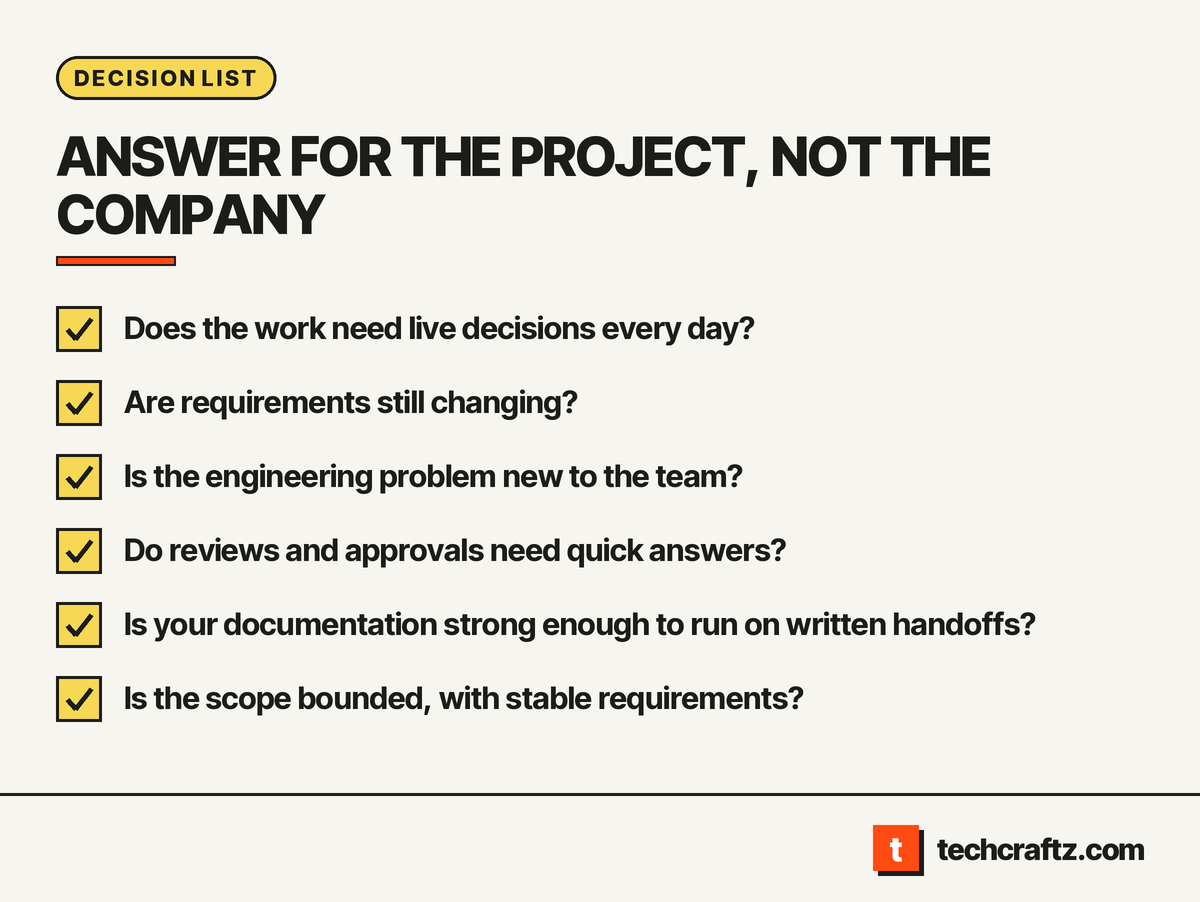
If you answer yes to the first four, lean nearshore, or pay for shifted hours in an offshore team. If you answer yes to the last two, offshore is easier to make work. Mixed answers point to the hybrid below.
Three scenarios for nearshore vs offshore software development
The scenarios below are invented, to show how the answers combine. None describes a real client.
| Scenario | Lean | Why |
|---|---|---|
| A US startup changing its product weekly, with a small in-house team | Nearshore, or an offshore team on shifted hours | Decisions are daily and live. Shared hours remove waiting. |
| An Australian retailer adding a bounded integration to a stable shop | Offshore with written handoffs | The scope is clear, acceptance criteria are testable, and live meetings are optional. |
| A UK scale-up with a core platform and a long maintenance backlog | Hybrid | Core work needs live review. Bounded maintenance tickets can run in writing. |
Notice that none of the three turns on the country. Each turns on how often the work needs a live decision, which is the test for nearshore vs offshore software development that survives a change of vendor.
Hybrid setups
You do not need one model for everything. Arnia describes a structure in which internal teams keep product ownership and architecture, nearshore teams work closely on core product development, and offshore teams handle clearly bounded workstreams. Its warning matters more than the structure: too many teams, providers or locations create coordination overhead and delay. Give every workstream one owner and a written interface.
If you want the difference between who does the work and where, read our piece on offshoring vs outsourcing. For how a stable team is set up once you choose a location, see the dedicated development team model.
Send the brief, get a written scope
techcraftz puts scope, milestones and the estimate in writing before the first line of code, then hands over the code, the accounts and the keys. Our offshore software development page explains how we run distributed delivery, and staff augmentation covers adding engineers to your own team. You can see how we work. When you are ready, send the brief. You can also read more about techcraftz.
Last checked: October 15, 2026. Adequacy lists and privacy rules change; verify them before you sign.
Talk to us about your project
Tell us what you need. We help you scope the build, the milestones and a realistic estimate.
View services