To outsource web development and keep control, you hold four things from day one: the written scope, the repository, the hosting and domain accounts, and the right to accept or reject each milestone. The vendor writes the code. You own the decisions and the keys. Most advice on this topic lists pros and cons. This guide is about the mechanics of control: what to keep, what to hand over, and what to demand in writing.
Decide what to outsource: web development tasks to hand over and keep
You do not have to outsource web development in full. Codeable sorts the decision by situation. Outsourcing tends to fit when you need an MVP built with little runway, when you need capacity for a defined period, when your team lacks a specific skill, or when your own developers are stuck on maintenance. Keeping work in-house tends to fit when web development is central to your product, when proprietary knowledge must stay inside, or when you need an immediate response to urgent fixes.
A hybrid is common and often the sensible answer. The table is our reading of those criteria for a web project.
| Piece of the project | Outsource | Keep |
|---|---|---|
| Product decisions, priorities, acceptance | Yes | |
| Interface build, back end, integrations | Yes | |
| Specialist work (accessibility audit, performance, security review) | Yes | |
| Core logic that makes your product different | Only with care | Preferred |
| Hosting, domain and repository ownership | Yes | |
| Content and data | Yes |
Codeable states the limit directly: outsourcing does not remove the need for oversight. Someone on your side defines requirements, reviews deliverables and approves milestones. If nobody can do that, fix it before you look for a vendor. N-iX makes the same point and adds that a task measured in days is often not worth the onboarding.
What control means when you outsource web development
Hirewithnear lists the usual worries about outsourcing: communication challenges, quality control, dependency on the vendor, lack of control and intellectual property. Each one maps to a concrete thing you can hold.
| Worry | What you hold to answer it |
|---|---|
| Dependency on the vendor | Repository and cloud accounts in your organization, with the vendor invited in |
| Quality control | Acceptance criteria per milestone, a staging site, a code review practice you can see |
| Communication | Named contacts, response times, a fixed update rhythm, written decisions |
| Intellectual property | Contract wording that assigns code, designs and documentation to you |
| Lack of visibility | A demo at every milestone, recorded so you can watch it later |
Droids on Roids recommends that the code be hosted on a standard repository host so you have access to it and know it is stored safely. The principle generalizes. If the only copy of your code sits on the vendor’s machines, you do not control the project, whatever the contract says.
Match the model to how stable your scope is before you outsource web development
Codeable’s guidance: most outsourcing failures come from picking a model that does not fit how stable the requirements are.
- Fixed price when scope is frozen, for example a small site with approved designs. Changes go through a formal request.
- Time and materials when requirements will change with feedback, for example an MVP that may pivot. It needs more oversight from you.
- Dedicated team for ongoing work lasting three months or longer.
Our general outsourcing guide compares these with the staffing and location models. If you cannot decide, treat the first phase as discovery and let it produce a written scope. Then choose the contract type for the build.
Before you outsource web development: the artifacts to demand
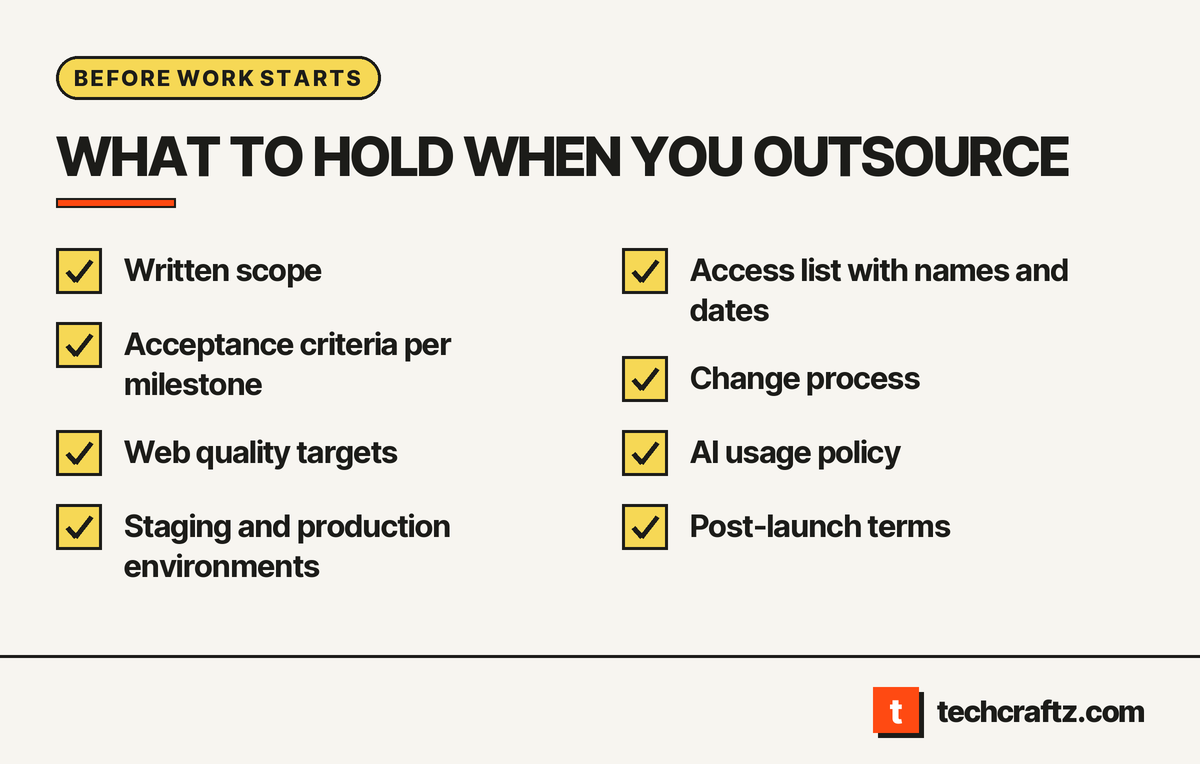
A control list is only useful if every item is a document or an account you can check. Ask for these before the first milestone.
- Written scope. Pages or modules, user roles, integrations, what is out of scope. Codeable’s test for a vague estimate is simple: if it reads “build website per discussions”, expect disputes later.
- Acceptance criteria. For each milestone, checks you can run yourself, such as “the form submits and the record appears in the admin”.
- Quality targets for the web. Codeable suggests asking about targets for Core Web Vitals (Largest Contentful Paint, Interaction to Next Paint, Cumulative Layout Shift) and about accessibility, specifically WCAG 2.2 Level AA. Add the code review practice: pull requests, automated checks, review before deployment.
- Environments. A staging site you can open, a production environment in your accounts, and a note on how releases move between them.
- Access list. Who holds credentials to the repository, hosting, domain, analytics and any third-party service. Names, roles, date added, date removed.
- Change process. How a new request is estimated, approved and recorded.
- AI usage policy. Codeable warns about “shadow AI”: proprietary code pasted into public tools. Ask how the vendor governs AI tools, and how generated code is reviewed.
- Post-launch terms. Warranty window, what counts as a bug versus a new feature, and who answers if your main developer is unavailable.
A first-month rhythm when you outsource web development
Control is a habit more than a clause. This is a simple cadence we would expect from any vendor, including us. It is our suggestion, not a standard.
| When | What happens | What you receive |
|---|---|---|
| Before kickoff | Roles, channels and response times agreed; accounts created in your name | Access list, contact sheet |
| Week 1 | Environments set up; scope walked through; open questions answered in writing | Repository with a first commit, staging URL, written answers |
| Every milestone | A demo, recorded; you check acceptance criteria; sign-off or a written list of fixes | Recording, acceptance record, updated change log |
| Every week | A short written update: done, next, blocked, decisions needed from you | Update, and a decision from you within a stated time |
The last row is where projects stall. A vendor cannot move while it waits for an answer. Name one decision-maker on your side and agree how fast they respond. Async updates and recorded demos also keep the project workable across time zones, which is how an offshore team normally operates.
Red flags before you sign
Codeable’s list of deal-breakers before you outsource web development is worth repeating in short form:
- Vague scope in the estimate. Vagueness is not flexibility.
- Lowest-price positioning. The cheapest bid tends to cut corners somewhere you cannot see yet.
- No references. Reluctance to share past work or connect you with previous clients.
- Unclear communication norms. No commitment to response times or meeting cadence.
- An overpromised timeline. If the estimate sounds too fast, ask what it assumes and what happens if the assumptions fail.
- No answer on AI governance.
- Trusting a platform’s vetting in place of your own check. A reputable platform lowers risk, it does not remove it.
N-iX adds two practical steps: interview the engineers who would actually work on your project, and start with a short paid pilot with a narrow scope and an agreed reason to stop.
Plan the exit on day one
Knowledge accumulates during a project. N-iX recommends a plan that states what knowledge is captured, who transfers it, who receives it, and how: demos, written documentation, question-and-answer sessions. Add the practical exit items: handover of repositories and accounts, a notice period, and what happens to your data when the engagement ends.
Droids on Roids notes one more clause that is easy to miss when the vendor is in another country: the contract should say where disputes are settled. Ask counsel to review that clause. We are not offering legal advice here.
Keep the control, hand over the build
When you outsource web development well, you end up with less to do, not nothing. You decide, accept and hold the keys. The vendor builds, demonstrates and documents.
techcraftz puts scope, milestones and the estimate in writing before the first line of code, then hands over the code, the accounts and the keys. For a browser-based product, start with our web application development page, or see how we work. When you are ready, send the brief. You can also read more about techcraftz.
Last checked: October 14, 2026. Vendor guidance changes; verify before you sign.
Talk to us about your project
Tell us what you need. We help you scope the build, the milestones and a realistic estimate.
View services