Software development outsourcing means paying an outside team to build or run part of your software while you keep ownership of the product decisions. It comes in three team structures, four contract types and four location models. Most failures come from a mismatch between those choices and how stable your requirements are, not from the vendor’s coding skill. This guide to software development outsourcing covers the models, the risks and a scorecard you can fill in before you sign.
What software development outsourcing covers, and what it does not
The scope runs from one specialist fixing a bug to a team building a product from nothing. Codeable puts the limit plainly: outsourcing does not remove the need for oversight and it will not make product decisions for you. Someone on your side still defines requirements, reviews deliverables and approves milestones.
That someone matters. N-iX lists “no internal owner” as one reason to hold off: an outsourced team needs a product owner to set priorities and answer questions, and without one even a capable vendor loses direction. Name that person before you request a single proposal.
Three engagement models in software development outsourcing, and the control each leaves you
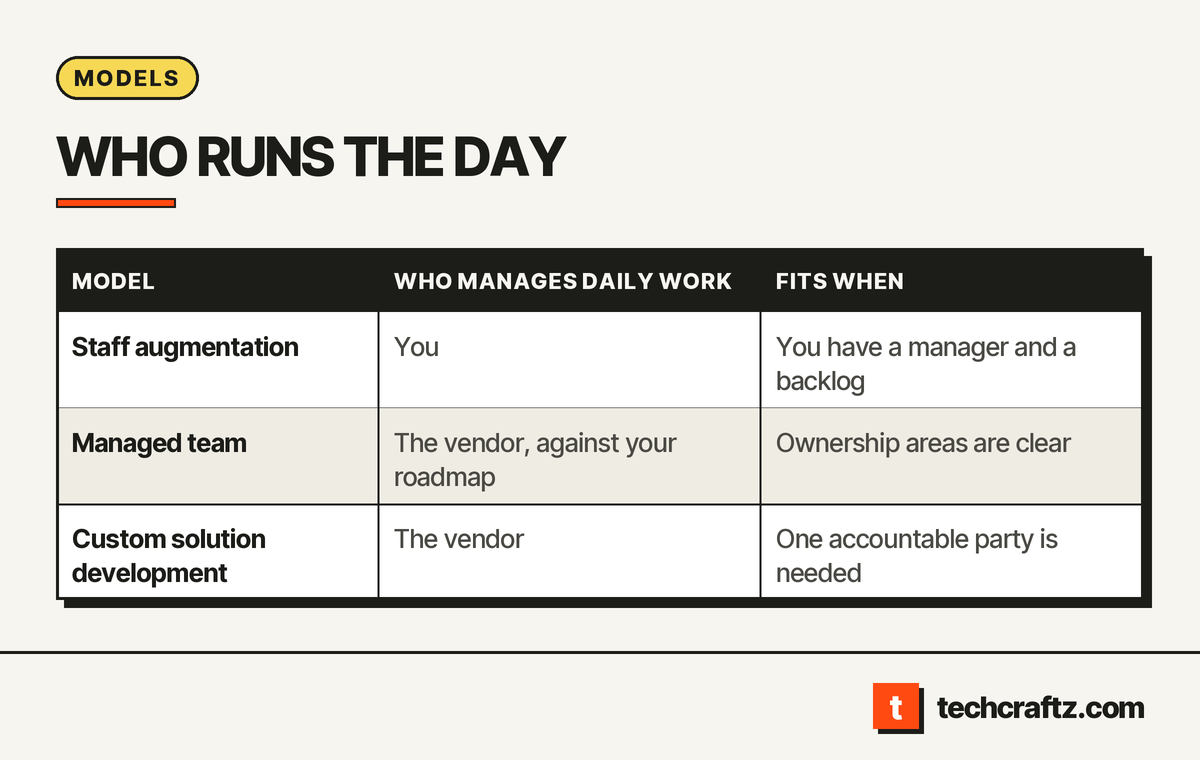
N-iX describes three structures. The table adds the question a buyer cares about: who runs the day.
| Model | What it is | Who manages daily work | Fits when |
|---|---|---|---|
| Staff augmentation | Individual specialists join your team | You | You have a manager and a backlog, and lack skills or capacity |
| Managed team | A dedicated team with a delivery manager on the vendor side | The vendor, against your roadmap | Ownership areas are clear, such as a platform migration |
| Custom solution development | The vendor is responsible for building the product or capability | The vendor | One accountable party is needed for a larger initiative |
N-iX adds a point worth keeping: the structure you start with is rarely the one you finish with. Write that into the contract by agreeing how you would move from one model to another. Our own pages on staff augmentation and dedicated developers describe two of these structures in more detail, and our comparison of staff augmentation vs outsourcing covers the first two head to head.
Four contract types in software development outsourcing, and the risk of each
The contract decides how a change in scope is handled. N-iX lists four types; Codeable explains the first three in plain terms.
| Contract type | Payment follows | Fits when | Main risk to manage |
|---|---|---|---|
| Fixed price | A defined scope | Requirements are stable and the roadmap is detailed | Every scope change triggers a renegotiation |
| Time and materials | Hours worked | Scope will evolve, or discovery is still running | Needs active oversight on your side |
| Dedicated team | Allocated engineers, monthly | Long-term product work | Paying for idle capacity if the roadmap stalls |
| Outcome-based | Defined results or milestones | Output is measurable | Both sides must agree what “done” means |
Codeable’s rule of thumb: choose fixed price when scope is frozen, time and materials when requirements will change with user feedback, and a dedicated team for ongoing work lasting three months or longer. If you cannot yet say which one describes you, you are probably not ready for a fixed-price contract. Run a short discovery phase first and let it produce a written scope.
Where the team sits: the four location models
In software development outsourcing, location sets time zone overlap, communication load and legal environment. N-iX names four models:
- Onshore. Same time zone, language and legal system. Local talent is scarce for the vendor too.
- Nearshore. Neighbouring time zones, with substantial working-hour overlap.
- Offshore. The widest talent pool and the largest time zone gap. It needs more written communication and process discipline.
- Reshoring. Moving outsourced work back home, usually for data residency or regulatory reasons. N-iX advises defining handover and exit clauses early in case you need it.
An offshore team is not a lesser choice. It is a different working style: written briefs, recorded demos, decisions made in documents instead of calls. Our page on offshore software development explains how we run that way.
When software development outsourcing is the wrong call
Outsourcing is not for every situation. N-iX names five where keeping work in-house, or a hybrid, fits better:
- The software is what sets your company apart. Keep the core in-house and outsource the work around it.
- Data residency or regulatory limits are binding, and external access is impractical.
- Requirements are still unclear. Start with discovery, not a full build.
- Nobody on your side can own the relationship.
- The task is small and finite. For a fix measured in days, onboarding a vendor can cost more than it saves.
If two or more of these describe you, fix that first. A vendor will not repair them.
The risks of software development outsourcing, and the control for each
Every risk below has a control you can request in writing before work starts.
| Risk | What it looks like | Control to ask for |
|---|---|---|
| Vague scope | An estimate that reads “build per discussions” | Named deliverables, acceptance criteria, an out-of-scope list |
| Knowledge loss | Only the vendor understands the system | A knowledge-transfer plan: what is captured, by whom, in which format |
| Code you cannot move | Repository and cloud accounts sit with the vendor | Repository and accounts in your organization from day one |
| IP gaps | Rights remain with the vendor after delivery | Assignment of code, designs and documentation to you as work is delivered |
| Data exposure | Your data is stored or processed somewhere unknown | Processing locations, access policy, and what happens to data when the engagement ends |
| AI tools in the workflow | Proprietary code pasted into public tools; unreviewed generated code | A written AI usage policy and a named code review step |
| Costs that sit on your side | Onboarding, knowledge transfer, tooling, your own management time | A list of what you must supply and how much of your time it needs |
Codeable calls the AI item “shadow AI”. N-iX recommends asking how a vendor reviews AI-generated code rather than whether it uses AI. Both are fair questions, and a vendor that cannot answer has not thought about it.
N-iX’s list of costs that never appear in a vendor’s billed rate is useful for the last row: environment setup, knowledge transfer from your team, tooling and licences if not included, your management overhead, scope changes and the handover at the end. Ask the vendor to confirm in writing which of these they absorb.
A software development outsourcing scorecard to fill in before you sign
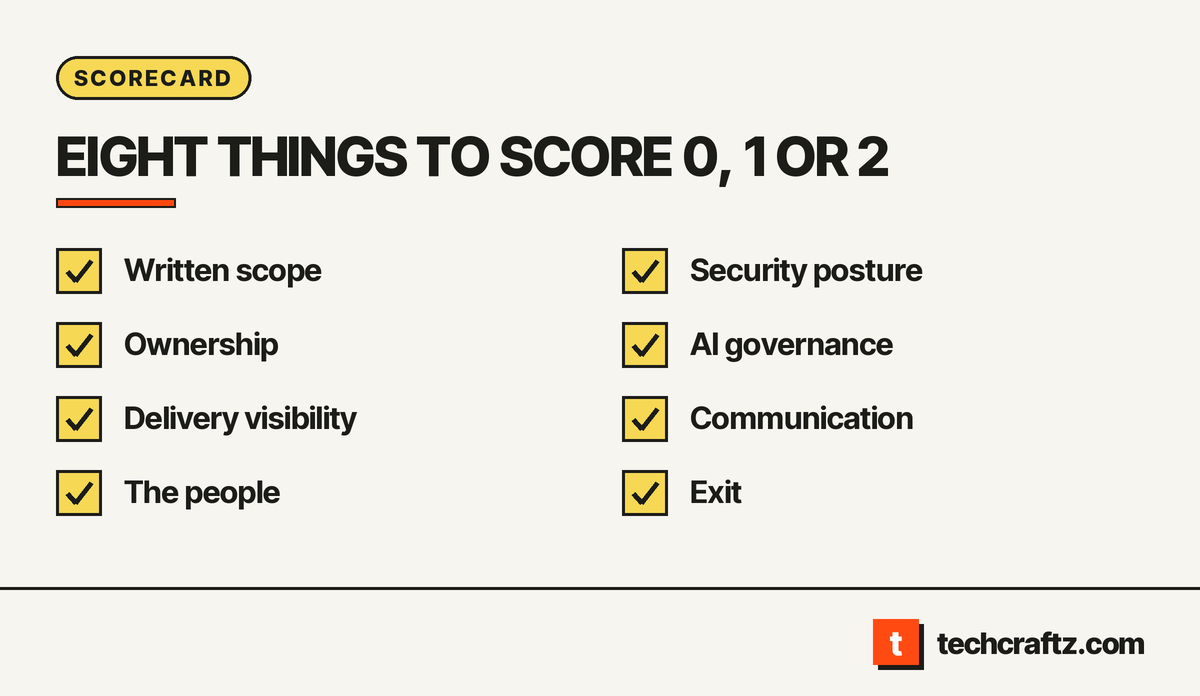
This scorecard is our own working tool, not an industry standard. Score each line 0, 1 or 2 after the vendor answers in writing. 0 means no answer. 1 means an answer without evidence. 2 means an answer backed by something you can check: a document, a sample, a repository, a person you can speak to.
| # | Criterion | Evidence to ask for |
|---|---|---|
| 1 | Written scope | A sample scope document with acceptance criteria and out-of-scope items |
| 2 | Ownership | Contract wording on IP assignment, repository and accounts |
| 3 | Delivery visibility | A demo schedule, a staging environment per milestone |
| 4 | The people | A conversation with the engineers who would work on your project |
| 5 | Security posture | Access control and password policy, data storage and transfer, end-of-engagement data handling |
| 6 | AI governance | A written policy and the review step for generated code |
| 7 | Communication | Named contact, response times, meeting cadence, time zone overlap |
| 8 | Exit | A knowledge-transfer plan and handover terms |
Two rules keep the scorecard honest. First, a 0 on criteria 1, 2 or 8 ends the conversation, whatever the total. Second, compare vendors on the same brief. If two estimates differ widely, Droids on Roids suggests asking each team what it assumed and whether the lower one contains everything the higher one does.
Contract clauses that do the practical work
N-iX lists the clauses that prevent most disputes. Codeable adds the same baseline: IP assignment, milestone-based payments, a change request process and warranty terms.
- Scope and deliverables. Detailed scope, acceptance criteria, a definition of done.
- Payment and changes. The contract type, the schedule, and how a change request is estimated and approved.
- Intellectual property. Unconditional transfer of code, designs and documentation to you as work is delivered.
- Confidentiality. An NDA signed before work begins, with defined access limits.
- Data protection. Terms for your regulatory setting, including processing locations. Under GDPR Article 28, processing by a processor is governed by a binding contract. A vendor that handles your users’ personal data is likely in that position. This is not legal advice, and whether GDPR applies to you is a question for counsel.
- AI usage. Whether AI tools are used, what review applies, who owns AI-assisted output.
- Warranty and support. What is covered after launch, for how long, and what counts as a bug versus a new feature.
- Exit. Handover of repositories, accounts and documentation, and notice periods.
Start with a pilot
Both N-iX and Codeable suggest a small first engagement, which lowers the risk of software development outsourcing before you commit. N-iX calls it a paid pilot: a short piece of real work, with a narrow scope and an agreed reason that would end the engagement. It tells you more about quality and responsiveness than a reference call does.
Pick a deliverable that can be accepted or rejected on evidence. A running build on staging, a test report, a repository you can open. Then score the vendor again.
Send the brief, get a written scope
techcraftz puts scope, milestones and the estimate in writing before the first line of code, then hands over the code, the accounts and the keys. If you are weighing custom software development against a team you manage yourself, the first step is the same: describe the problem, the users and the constraints. Get a written scope or read more about techcraftz.
Last checked: October 14, 2026. Vendor guidance and regulations change; verify before you sign.
Talk to us about your project
Tell us what you need. We help you scope the build, the milestones and a realistic estimate.
View services