Freelancer vs software development agency is mostly a question about your project, not about quality. A freelancer fits a short, well-defined job when someone on your side can direct the work every day. An agency fits when the scope will change, when you need several skills at once, or when work cannot stop because one person is ill. Either choice is only safe if the code, the accounts and a signed assignment of rights end up in your name.
We are an agency, so weigh this with that bias in mind. Below we also say where a freelancer is the better call.
Freelancer vs software development agency at a glance
| Question | Freelancer | Agency |
|---|---|---|
| Who you hire | One person, usually one specialty | A team: engineers, testing, a delivery lead, sometimes design |
| Who directs the daily work | You, or someone on your side | The agency lead, against a scope you approved |
| If the person is unavailable | Work stops until someone replaces them | Another team member can pick it up. Ask how, in writing |
| Review of the code | Only if you arrange it | Often a second engineer. Ask to see the process |
| When the scope changes | Each change is a talk with one person’s calendar | A change process exists, but it is still a scope conversation |
| Contract and rights | Varies widely, sometimes informal | Often standard terms. Read them anyway |
| What the rate covers | The developer’s time. Management is yours | Time plus management and review |
The pages we read (Zulbera, Arc, Sophilabs, SKM and eSparkinfo) agree on the shape of this table. Most are written by firms that sell one of the two options, and most lead with rates. We leave rates out. They depend on region, seniority and date, and they say little about whether the project survives a bad month.
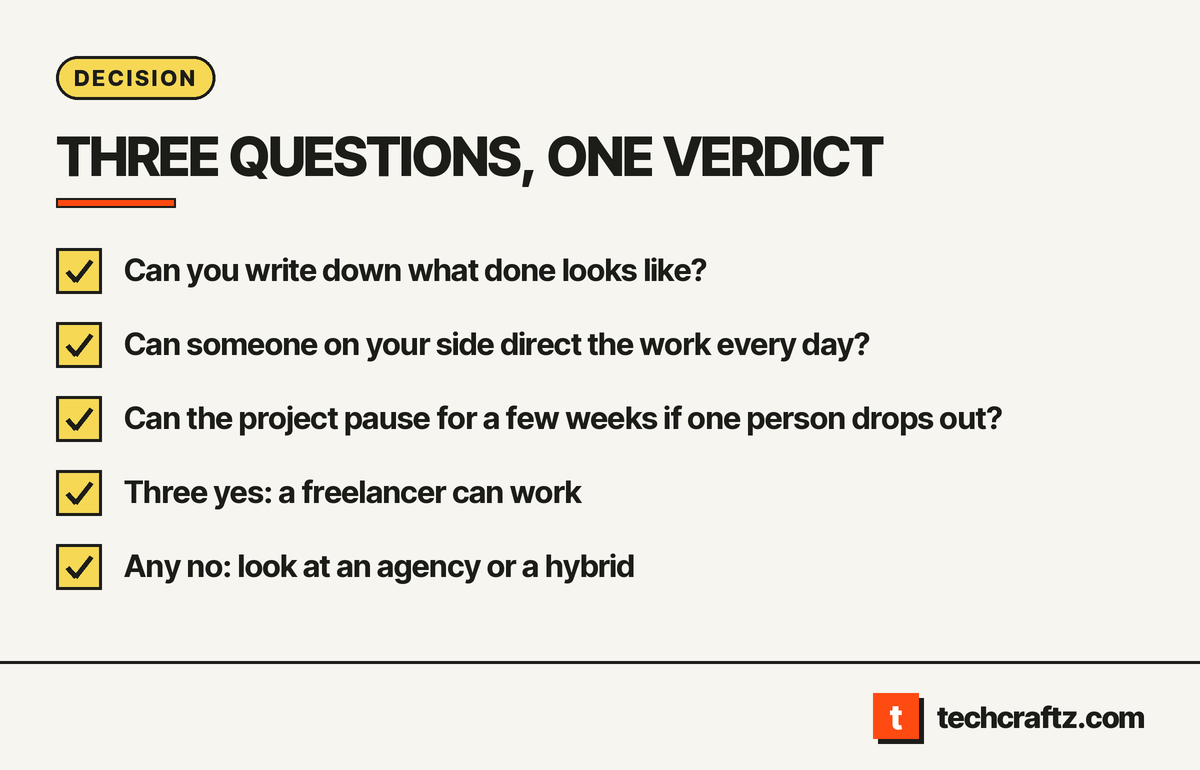
Three project facts that decide freelancer vs software development agency
In a freelancer vs software development agency decision, do not start from the supplier. Start from three facts about the project.
1. How stable is the scope? If you can write down what done looks like, such as one integration, one migration script or one defined screen flow, a freelancer can execute it. If the requirements will move as you learn from users, Sophilabs warns that you may pay a freelancer to rework parts of the product as the picture changes, and it calls an agency the smarter choice. We would put it more narrowly: what helps is a team and a change process, not the word “agency”.
2. Who directs the work every day? Zulbera puts it bluntly: with a freelancer, you are the project manager. That means writing clear tickets, ordering the backlog, unblocking questions, reviewing work in progress and catching scope drift. If you have a technical lead who does this anyway, a freelancer fits. If you are a founder who wants to spend the week on customers, you are paying in your own hours.
3. What does an interruption cost? Zulbera calls the single biggest freelancer risk the bus factor: your one developer gets ill, takes another job or loses interest, and progress stops. Finding and briefing a replacement takes weeks in its account. That is one agency’s estimate, so treat it as a prompt to ask, not a figure to plan with. The question for you is whether a few quiet weeks would hurt, for example a launch tied to a date.
When a freelancer is the right call
Choose a freelancer when most of these are true:
- The job is bounded: one integration, one performance fix, one data migration, one reusable component.
- You need a narrow specialist your team lacks, such as a payments expert or a mobile specialist for one module.
- You already have technical leadership that reviews code and sets direction.
- You are testing a technical assumption and the stakes are small.
- You can afford a pause if the person becomes unavailable.
Zulbera and Sophilabs reach similar conclusions on these points, and we agree with them. Start with a small paid task before the real job. It shows you how the person communicates and what they hand back.
When an agency is the right call
Choose an agency when most of these are true:
- You are building a first version and expect to change your mind.
- The work needs design, building, testing and deployment together, so one specialist is not enough.
- A date matters and you cannot absorb a gap in delivery.
- Your own buyers, investors or auditors will ask how the software was built and who had access.
- You want support after launch from people who know the system.
An agency is not automatically safer. Ask which named people will work on your project, what happens if one of them leaves, and who reviews their code. Our guide on how to choose a software development company gives twelve questions for that conversation, and the outsourcing guide covers engagement models and contract types.
Ownership in freelancer vs software development agency choices
Zulbera claims agencies include rights assignment as a standard term while freelancer agreements are often informal. It is the point most comparison guides raise and the one they back up least. That is a fair warning, but none of the five pages cites a statute, so here is what the primary texts say. This is general information, not legal advice. Laws differ by country and the facts of your case matter, so have a lawyer review the contract.
In the United States, the Copyright Office explains in Circular 30 that a work is “made for hire” in two situations. One is a work created by an employee as part of regular duties. The other is a work specially commissioned in one of nine listed categories, under an express written agreement signed by all parties. If a requirement fails, it is not a work made for hire. The nine categories do not name software, so do not assume a commissioned application qualifies. Transfer of copyright ownership, under 17 U.S.C. 204(a), requires a signed written instrument.
In the United Kingdom, the Copyright, Designs and Patents Act 1988 makes the author the first owner, with an exception for works made by employees in the course of employment, where the employer is first owner unless agreed otherwise (section 11). An assignment is not effective unless it is in writing and signed by or on behalf of the assignor (section 90(3)).
The shared lesson in any freelancer vs software development agency contract: a contractor is not your employee, and ownership does not follow payment on its own. Get the assignment in writing, signed, before the work starts. That applies to a freelancer and to an agency.
The handover test
Whichever you choose, run this test at the start and again at every milestone: if this person or firm vanished tomorrow, could another engineer continue from what you hold? You should have:
- The code in a repository your organization owns, from the first commit, not exported at the end.
- The accounts in your name: hosting, domains, app store accounts, third-party services.
- A signed assignment of rights covering the work, plus a list of third-party and open-source components used.
- Documentation: how to run, test and deploy the system.
- An access list that says who holds which credentials, and a way to revoke them.
A freelancer can meet all five. So can an agency. The point is that you ask, and that you check at milestones rather than at the end.
The hybrid: agency core, freelancer specialist
A hybrid softens the freelancer vs software development agency choice. Zulbera describes a pattern we also use as a frame: a team for architecture, core build and testing, and freelancers for bounded problems such as a specific integration or a short design sprint. The opposite also works. A freelancer builds, and a separate reviewer checks the code at each milestone.
Three rules keep a hybrid safe. The repository and its review rules belong to you. Each outside contributor gets access to a branch, not the whole system. Interfaces between their work and the core are written down before they start.
When you need neither
Sometimes the question is the wrong one. If a standard tool covers the need, buy it. Our article on when custom software beats off-the-shelf sets out the test. And if the product is your business and you will build for years, a full-time hire or a dedicated team may beat both options. The dedicated development team model explains how that works.
Send the brief, get a written scope
techcraftz puts scope, milestones and the estimate in writing before the first line of code, then hands over the code, the accounts and the keys. If you are weighing freelancer vs software development agency for a custom build, see our custom software development page, or the page on hiring dedicated developers if you want engineers working inside your team. Get a written scope, or read more about techcraftz.
Last checked: October 15, 2026. Laws and vendor pages change; verify before you sign.
Talk to us about your project
Tell us what you need. We help you scope the build, the milestones and a realistic estimate.
View services