What is custom software development? It is the process of designing, building and deploying software for the particular needs of one organization or person, rather than for a mass market. The result is also called bespoke or tailor-made software. It is the opposite of an off-the-shelf package, but the line is blurrier than most guides admit, because many real projects are a mix of both. This guide gives the definition, the options next to it, the common types by the job they do, and tests for when it fits. Sources were checked on October 15, 2026.
What is custom software development?
Wikipedia defines custom software as software developed specifically for some specific organization or other user, contrasted with packages made for the mass market. Lansa, a low-code vendor, phrases the activity as the process of designing, developing and deploying software for the particular needs of businesses or individuals. Serdao adds the contrast that matters in practice: off-the-shelf software is built to cover the general needs of as many businesses as possible, while custom software is built around one organization’s workflows.
Three things follow from the definition.
- One client sets the requirements. The software exists because of your process, not because a vendor found a market.
- It is a project, not a purchase. Someone designs it, builds it, tests it and deploys it, and then it has to be maintained.
- Ownership is part of the deal. Wikipedia notes that custom software projects often require the purchaser to own the source code, to secure the possibility of future improvement. That is a contract term you set, not something that happens by default.
So what is custom software development for a business owner? A way to get software that fits how you already work, paid for with a development project and a maintenance duty.
Beyond custom versus packaged
What is custom software development next to its alternatives? Most pages set it against off-the-shelf only. Wikipedia lists three options a business weighs: a spreadsheet, an off-the-shelf product, or custom software. It also describes a fourth, a hybrid model, in which you buy the package that satisfies most requirements and build extensions or add-ons for the gaps. It calls this the standard approach when implementing SAP ERP.
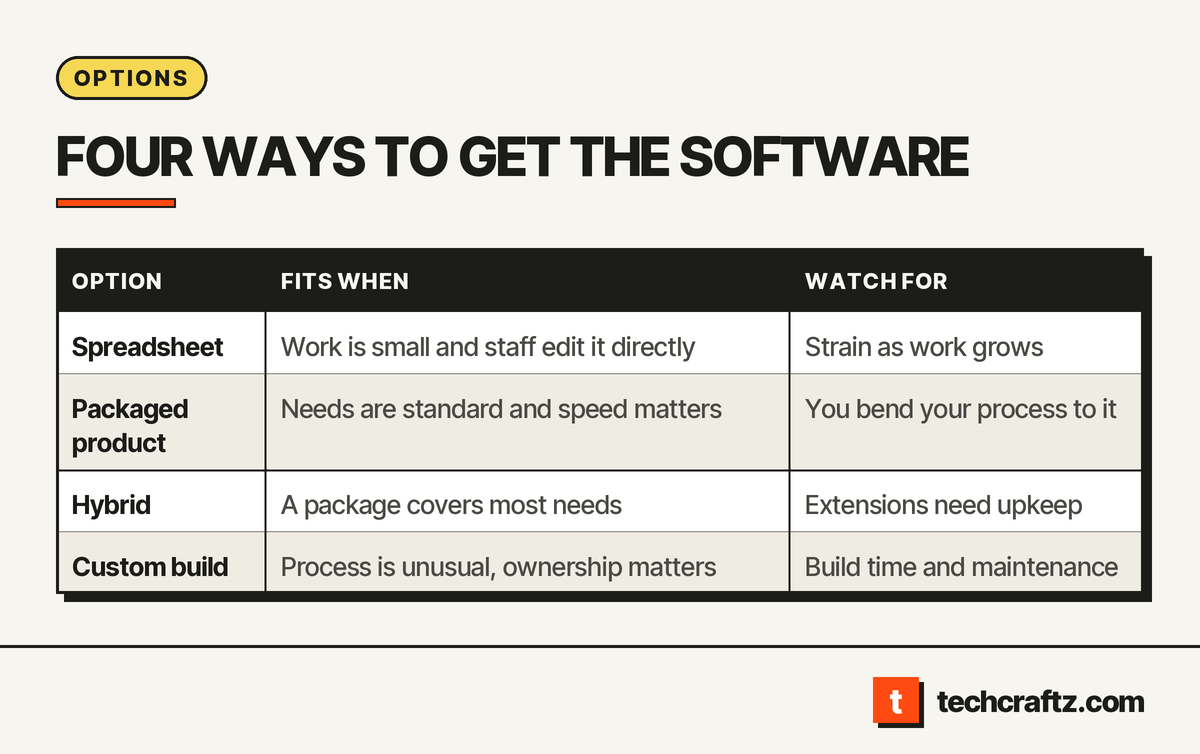
Read the diagram as a spectrum. A spreadsheet is fast and lets non-technical staff change it directly, but it strains with larger or more complex work, as Wikipedia notes. A package is fast to start and brings standard processes, at the cost of bending your process to its limits. A hybrid keeps the package and builds around it. Custom software is built around you, and you carry the build and the upkeep.
Custom does not mean from scratch. Libraries, frameworks, open-source components and cloud services are normally part of a custom build. What is custom is the combination and the logic that is yours.
Types of custom software, by the job it does
What is custom software development in concrete terms? Usually one of a few jobs. LeewayHertz lists many categories. We grouped them by what the software does for you, and they come down to six.
| Type | What it does | Examples |
|---|---|---|
| Internal systems | Run your own operations | HR management, inventory, employee scheduling, collaboration tools |
| Customer-facing applications | Serve your customers directly | Web portals, self-service platforms, online booking, mobile apps |
| Process automation | Remove manual steps from a defined process | Workflow automation, document management, project management |
| Integration and middleware | Move data between systems that do not talk to each other | Connectors between a CRM, a store and a database |
| Data and reporting | Collect, combine and show data | Custom reporting, dashboards, analytics tools |
| Compliance tools | Record what regulations require | Audit tracking, regulatory reporting |
Industry-specific software, such as for healthcare, education or retail, is not a separate type so much as any of these built for one sector’s rules. If you want the web version of the customer-facing row, our custom web application guide goes deeper.
Fit tests for custom software development
Wikipedia lists five criteria a business can use to compare a spreadsheet, a package and custom software: development cost and time, other staff costs, system efficiency, service improvement and flexibility. It cautions that initial assessments of these can deviate sharply from reality once the solution is in use, through overruns, insufficient training and poor fit.
From that and the vendor guides, these are the situations where custom software tends to be worth considering:
- Your process is unusual and a package would force you to bend it. Lansa and Serdao both make this the central case.
- You need to own the data and the code. Lansa lists complete data control among its benefits, and Wikipedia treats source ownership as a common requirement.
- Several systems must work together. Serdao argues custom software can integrate with existing tools and remove silos; an integration layer can also be custom while the rest stays packaged.
- The software has a long life. A short-lived need rarely justifies a build.
- You can maintain it. Serdao is direct: because you own the solution, you are responsible for maintaining it.
If two or three of these hold, read our article on the benefits of custom software development, which scores seven concrete situations.
Limits of custom software development
What is custom software development going to ask of you in time and upkeep? The same sources are candid about the limits.
- Time. Wikipedia names development time and cost as the main disadvantages, and says the process may take weeks, months or, for bigger projects, years. A spreadsheet or package delivers value sooner.
- Fit risk. Serdao warns of misaligned requirements: if your goals are not defined at the start, the product may not meet expectations. Good project management and communication matter.
- Uncertainty. Wikipedia observes that large custom software projects cannot fix scope, time or cost, and quality all at once, so either the cost or the benefits carry some uncertainty.
- Maintenance. Updates, bug fixes and upgrades continue after launch.
Wikipedia also lists large government IT failures that UK Members of Parliament investigated. Our own view: standard needs, such as payroll or a basic online store, usually point toward a package.
Deliverables you should own
If you commission custom software, the deliverables should be explicit:
- The source code, in a repository your organization owns.
- The accounts: hosting, domains, app stores, third-party services, registered to you.
- Documentation and tests, enough for another team to take over.
- Separate staging and production environments. Lansa lists this among its recommended practices, with version control and design before coding.
- A maintenance plan, since software is a long-lived asset and not a one-time handover.
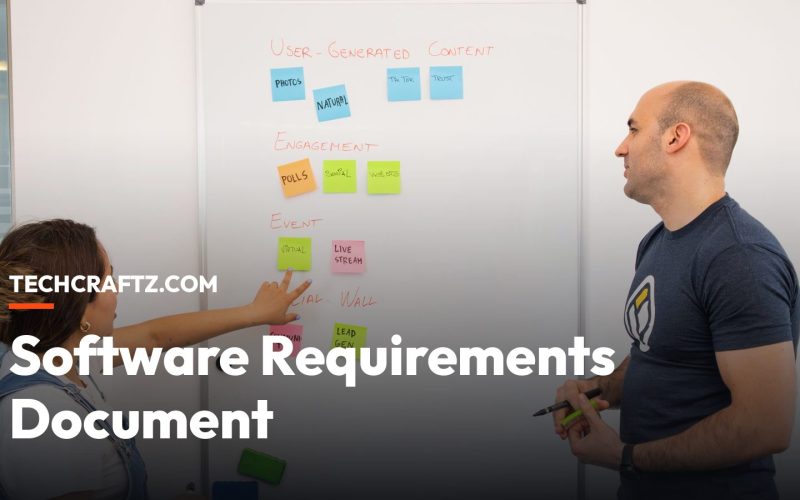
Writing these into a software requirements document before the build starts avoids most disagreements. The discovery phase is where they get settled, and the custom software development process walks through the steps from brief to handover.
Send the brief, get a written scope
techcraftz puts scope, milestones and the estimate in writing before the first line of code, then hands over the code, the accounts and the keys. Sometimes the written answer is that a package, a hybrid or a spreadsheet will do, and we say so. See our custom software development page, our work with startups and how we work. What is custom software development for your case? The written scope answers it. Get a written scope.
Last checked: October 15, 2026. Definitions are stable; vendor guidance changes, so verify before you decide.
Talk to us about your project
Tell us what you need. We help you scope the build, the milestones and a realistic estimate.
View services