Discovery phase software development is the short stretch of work before the build in which a team turns an idea into a written scope, a technical approach, a backlog and an estimate. You pay for answers, not code. This guide explains what happens inside it, which documents you should hold at the end, why published durations disagree, and five checks that tell you when discovery is actually finished.
Scope of discovery phase software development
Nix United describes the aim as turning a raw idea into a structured, feasible plan. In practice discovery phase software development work falls into a few strands:
- Scope. What is included, and just as important, what is excluded.
- Users and goals. Who the software is for and how success will be measured.
- Requirements. Functional needs plus performance, security and compliance criteria.
- Feasibility. Architecture options, integration limits and technical risks.
- Planning. A backlog, a roadmap, a risk list and an estimate.
Shakuro points out that discovery comes in more than one shape. Extended discovery suits large systems that will keep changing, and goes deeper into data structure and decisions that are hard to change later. Technical discovery suits projects where the open questions are about performance, architecture or integrations, and often uses small prototypes or tests to check assumptions.
The documents you should hold at the end
Vendors name the outputs of discovery phase software development differently. Nix groups them into business, UX, technical and planning deliverables. Vention lists a project charter, product vision, requirements document, sitemap, personas, scenarios, wireframes, technical description, test plan, risk assessment and timeline. Read those lists as a menu, not a requirement. What matters is that each question has a document.
| Question | Document | What to check |
|---|---|---|
| What are we building and for whom? | Vision, user stories | One user group first, in plain words |
| What is in and out? | Scope definition | Exclusions written down, not implied |
| How will it work? | Architecture overview, integration list | Every system it connects to is named |
| What could go wrong? | Risk register | Each risk has an owner and a response |
| What happens when? | Roadmap with milestones | Milestones are things you can see and test |
| What does it take? | Written estimate | It follows from the scope, line by line |
The people in the room, including you
Nix lists the business stakeholders, a business analyst, a solution architect, a UX designer, a project manager and, for outsourced work, representatives of the development company. Your seat is the first one. Stakeholders define the goals and priorities; without them the rest is guesswork.
Plan for your own time. Discovery needs access to the people who know the process, the data and the existing systems, and it needs one person on your side who can settle disagreements between departments. Nix names conflicting stakeholder expectations as the first common challenge, and its advice is to document agreed objectives after each session and have everyone confirm them.
Needed or not: a test based on uncertainty
Nix gives a usable test based on uncertainty. Discovery phase software development earns its place when:
- the idea is unvalidated or the goals are not clearly defined,
- the project involves complex functionality or several integrations,
- you are entering a new market or launching a new product line,
- estimates vary widely and you need a basis for a decision,
- you plan to outsource, so both sides start from the same document.
It may not be needed for a minor update or a feature extension on a well-documented system, for a near-identical copy of something already understood, or when requirements are stable and proven. For rare time-critical cases with low risk, Nix suggests a shorter discovery sprint. The more ambiguity around fit, feasibility or strategy, the more discovery is worth.
If your uncertainty is mostly about demand, a smaller first release may answer it sooner; see our notes on building an MVP in eight weeks.
Duration of discovery phase software development: sources disagree
Published ranges differ, and no source offers a neutral measurement.
| Source | Stated duration |
|---|---|
| Nix United | Typically 2 to 6 weeks, depending on complexity and clarity of inputs |
| Shakuro | 1 to 2 weeks for small projects, 2 to 4 for medium ones with several roles and integrations, 4 to 6 or more for enterprise projects |
| Vention | Typically one to three months |
| Keyhole | 2 to 4 weeks for discovery and planning in an enterprise lifecycle |
Shakuro adds that complexity matters as much as size: a small system with real-time processing or strict performance needs can take more discovery than a larger, simpler one. Treat the table as a range of vendor habits for discovery phase software development. The right duration is the time needed to remove the uncertainties that would change the estimate, and a good proposal says which uncertainties those are.
Does discovery cut rework? What the evidence says
Vendors say yes. Shakuro writes that discovery does not make projects cheap but makes costs more predictable, and that disagreements surface earlier, when changes are still easy. Nix says clear scope and validated requirements reduce change requests and prevent rework.
The mechanism is believable: a misunderstanding found on paper costs a conversation, and the same misunderstanding found in code costs a rebuild. But in the agency pages we read in full for this article (Nix United, Shakuro, Vention and Fulcrum), the claim comes from the sellers of discovery, and none offers a neutral measurement. Treat “cuts rework” as a reasonable expectation, not a proven number. That is also a reason to judge discovery by its outputs, which you can inspect, rather than by its promise.
Five checks before you leave discovery
These checks are our working rule for calling discovery phase software development finished. They are not from the sources, and they apply whoever runs it.
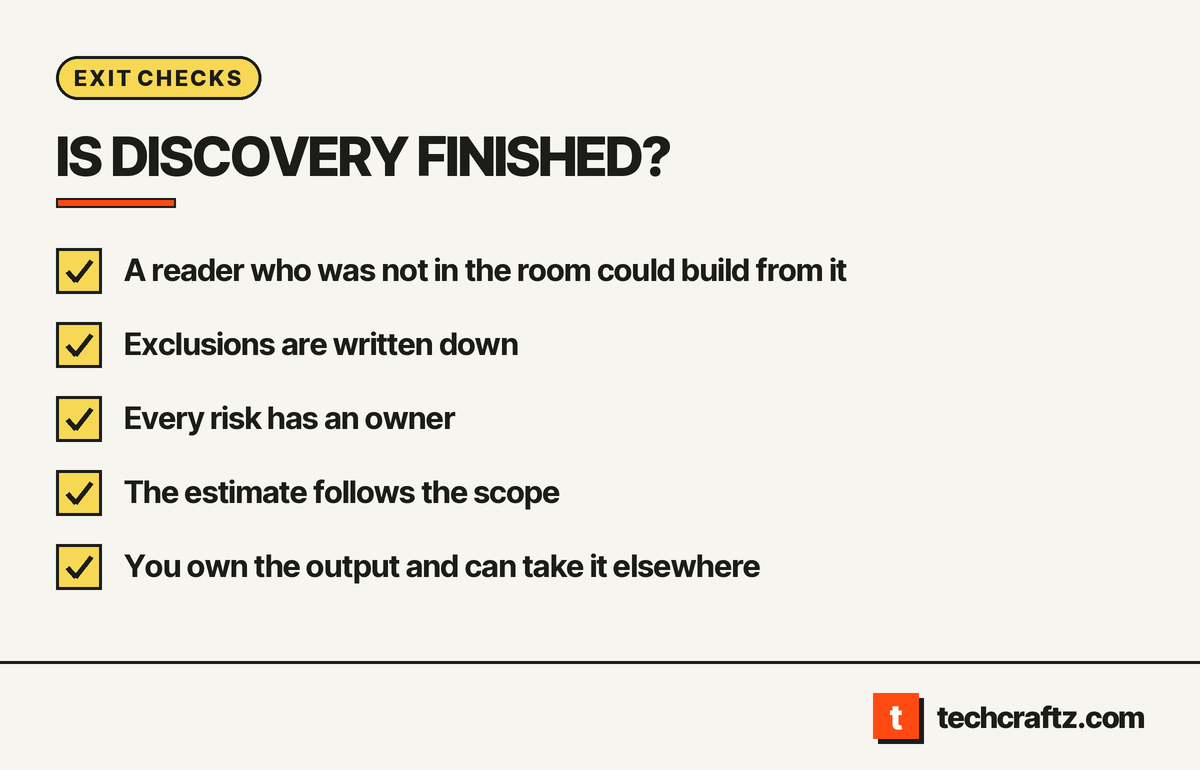
- A reader who was not in the room could build from it. The scope, requirements and architecture notes stand on their own.
- Exclusions are written. The document says what is out, so “we assumed” cannot decide a dispute later.
- Risks have owners. Each risk names who watches it and what happens if it occurs.
- The estimate follows the scope. You can trace each line of the estimate to an item in the scope.
- The output is portable. You own the documents and could hand them to another team. Nix advises formal sign-off on scope documentation; add the right to take it elsewhere.
If one of the five fails, ask for the gap to be closed before the build is priced. Our guide to the custom software development process shows where discovery sits in the full sequence, and the twelve questions for choosing a software development company help you check a vendor’s answers.
Common failures in discovery
Nix lists five typical failures, each with a practical fix:
- Conflicting expectations. Fix by written summaries after each workshop.
- Biased user research. Fix by speaking to real users, not only to colleagues.
- Underestimated complexity. Fix by involving an architect early.
- Shallow requirements. Fix by writing acceptance criteria and separating first-release features from later ones.
- Weak transition to the build. Fix by ending with a roadmap, an estimate and named owners.
A long discovery that produces slides but no decisions is the version to avoid.
Send the brief, get a written scope
techcraftz puts scope, milestones and the estimate in writing before the first line of code, then hands over the code, the accounts and the keys. If you want discovery scoped for your project, see our custom software development page, or look at the MVP development page if you are testing demand first. Send the brief or read more about techcraftz.
Last checked: October 14, 2026. Durations are the vendors’ own statements and change as they revise their pages.
Talk to us about your project
Tell us what you need. We help you scope the build, the milestones and a realistic estimate.
View services