How to choose a software development company comes down to comparing written answers, not sales calls. Send every firm the same brief, ask the same twelve questions, and score what comes back. The firms that answer specifically, push back on your brief and put terms in writing are the ones worth a pilot. The firms that agree with everything and stay vague are telling you how the project will go.
How to choose a software development company: write the brief first
Your selection can only be as good as the brief. Fingoweb, an agency, puts it plainly: a vague brief attracts vague proposals that cannot be compared side by side. Start with the business problem, not the solution you have in mind. “We need a mobile app” tells a firm almost nothing. “Support agents copy data between three systems all day” invites a better conversation, and maybe a smaller answer than an app.
One page is enough:
- The problem and who has it.
- What success looks like, in terms you can check later.
- What already exists: systems, data, accounts.
- Constraints: deadline, regulations, who on your side makes decisions.
Fingoweb adds a useful side effect. A serious firm reads the page and comes back with questions. A weak one repeats it back as a quote.
The twelve questions below are our own selection, built from the four agency guides we read (Fingoweb, Boldare, Fingent and Chetu). All four sell development services, so we attribute their points and mark the rest as our judgment.
Questions 1 to 3: how to choose a software development company on fit
| Question | Listen for | Red flag |
|---|---|---|
| 1. Which projects like ours have you shipped, and can we speak to that client? | A named kind of project, the problems it had, a reference you can call | A long list of technologies and no comparable project |
| 2. What would you change in our brief? | Specific questions, a cheaper or smaller alternative, a feature they would drop | Agreement with everything |
| 3. Which engagement model fits this work, and why? | A reason tied to how clear your scope is | The model that happens to suit their calendar |
Fingoweb argues that domain proof beats a technology list, since almost every firm lists the same frameworks. Question 2 is where the value shows. Boldare warns against “yes” people for a simple reason: if you already knew everything, you would not be hiring experts.
On question 3, our guides to staff augmentation vs outsourcing and staff augmentation vs managed services explain the models. The short version: a fixed deliverable suits a scoped project, an evolving roadmap suits a dedicated team, and a skill gap suits added engineers.
Questions 4 to 6: how to choose a software development company on working style
| Question | Listen for | Red flag |
|---|---|---|
| 4. Who is our named contact, and can we meet the engineers? | One named person who owns timeline and scope, and access to the people building | A sales contact who disappears after kickoff |
| 5. How do we communicate, and how fast do you acknowledge a request? | An agreed channel, demos you can watch later, written updates | “We are very responsive” with no detail |
| 6. How is AI-generated code reviewed, and who signs off? | Human review, automated tests, a named approver | “We do not use AI” or “AI makes it all faster” with no process |
Fingoweb recommends one accountable person rather than a rotating cast. Boldare lists lateness during the selection itself as a warning: if replies and proposals arrive late now, expect the same later.
Question 6 is new for most buyers. AI coding tools are common, and the useful issue is oversight, not whether they are used. Fingoweb suggests asking who signs off on generated code and whether the contract keeps the firm responsible for quality however the code was produced. We agree with that framing.
Questions 7 to 9: how to choose a software development company on money and ownership
| Question | Listen for | Red flag |
|---|---|---|
| 7. What is in this quote, and what is not? | A list covering project management, QA, DevOps and hosting setup | A tidy headline number with exclusions you discover later |
| 8. How are changes estimated and approved? | A written change process | “We are flexible” |
| 9. Who owns the code, and when do we get repository access? | Ownership transfers on payment, repository and cloud accounts in your name from day one | Access only at the end, or silence on IP |
Compare firms by what each quote includes, not by its headline. Fingoweb notes that quotes that look cheap often leave out project management, QA and DevOps, and that on fixed-price work the change-request terms are where a tight price grows. Chetu asks whether fixed-price models are a trap: they work for scope that will not move, and hurt when it does.
On ownership, Fingoweb states that IP transfer on payment is not automatic, and that in some jurisdictions the developer keeps ownership unless the agreement says otherwise. This is a vendor’s claim and not legal advice. It is reason enough to write the transfer into the contract and have counsel read it.
Questions 10 to 12: how to choose a software development company on risk and proof
| Question | Listen for | Red flag |
|---|---|---|
| 10. How do you handle our credentials, secrets and user data? | Scoped access, an NDA, a data processing agreement where personal data is involved | Surprise or irritation at the question |
| 11. What if a key person leaves, or we part ways? | A named backup per person, maintained documentation, a handover of access and knowledge | “That will not happen” |
| 12. Tell us about a project that went wrong. How did you recover? | A real story with a cause and a fix | A project where nothing ever failed |
If the app handles personal data under GDPR, Article 28 says processing by a processor is governed by a binding contract. A firm handling your users’ data is likely in that position, so ask for it in writing. Whether GDPR applies to you is a question for counsel.
Fingoweb’s test for question 11 is the one we would keep: could another team pick up this project tomorrow from the repository and the documentation alone? If the honest answer is no, you are locked in, whatever the contract says. Fingent quotes a business development specialist on vendors who hold data hostage or charge heavily to let you leave. Agree how you get your data back before you sign.
For question 12, Fingoweb suggests that on a reference call you do not ask whether the firm was good. Ask what went wrong and how the team handled it. Every real project hits a problem, and the recovery is what you are buying.
Score the answers, then run a pilot
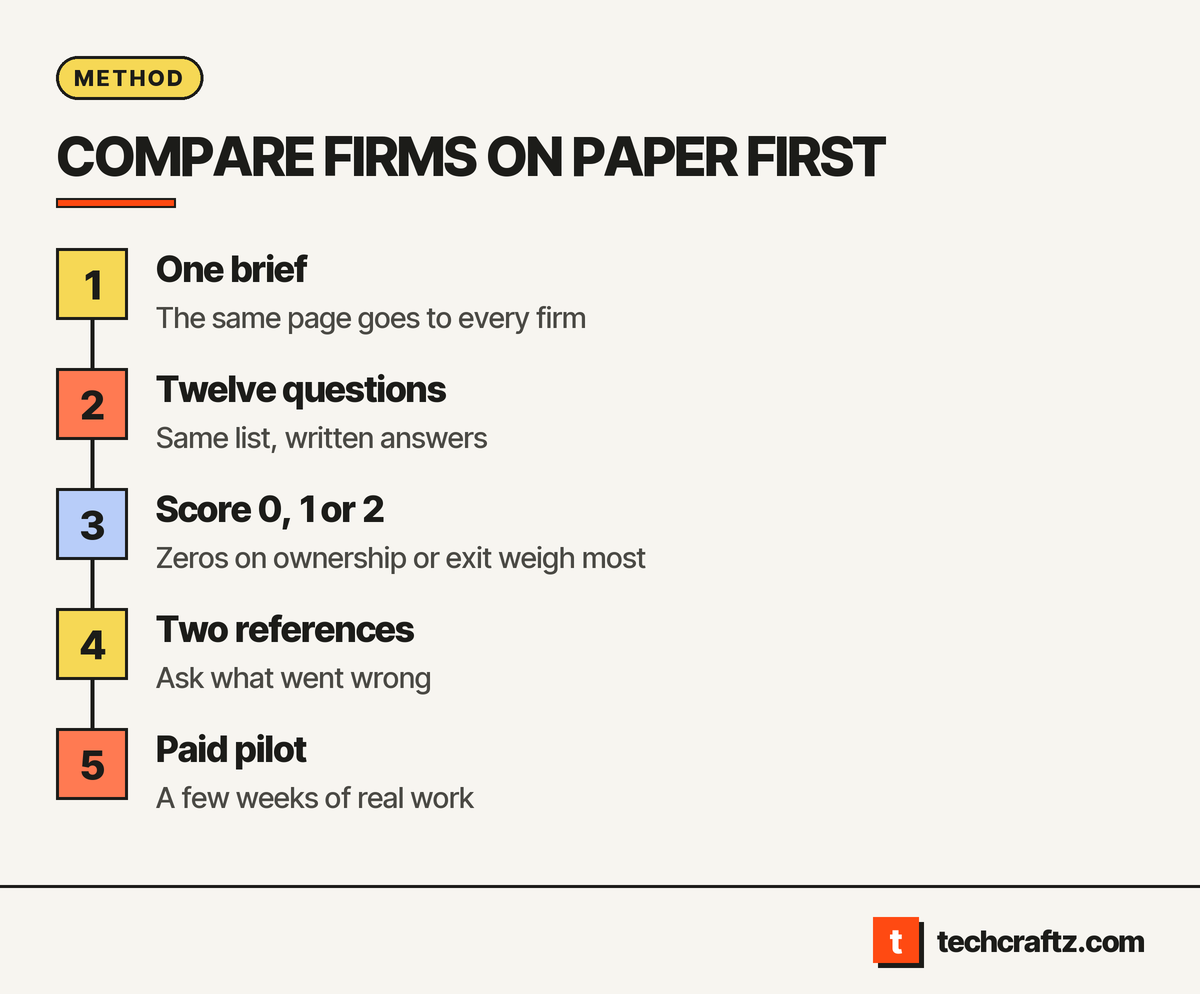
To choose a software development company with evidence, put the questions into a document, send the same brief and the same list to every firm you are considering, and score the written answers. Our method, not an industry standard:
- Score each answer 0, 1 or 2. Zero is vague or evasive, one is reasonable but generic, two is specific and verifiable.
- Plant one flaw in the brief. Fingoweb suggests a slightly flawed requirement, something expensive or pointless to build, to see who catches it.
- Compare the totals and the zeros. One zero on ownership (question 9) or exit (question 11) can outweigh a good total.
- Call two references. Use question 12 on both calls.
- Run a small paid pilot with the top one or two. A scoped piece of work over a few weeks shows how a firm communicates, estimates and delivers better than a proposal does.
Fingent suggests a trial before buying, which fits packaged software. For a custom build there is nothing to trial, so the paid pilot is the equivalent: a real deliverable, a real review, and a contract you can end if it does not work.
Warning signs the sources agree on
When you choose a software development company, Boldare and Fingoweb name overlapping signals. Treat any one as a reason to dig, and several together as a reason to walk away.
- A price far below the others, with fast delivery. Boldare says it is almost always too good to be true, and that it has been asked to finish projects left unfinished by a provider that won the job on price alone.
- Agreement with everything. The firm never questions a feature or a deadline.
- Vague answers. No named people, no named process, no written terms.
- Slow replies during selection. Selection is the firm at its most attentive.
- Resistance to ownership terms. Repository, accounts and IP in your name should be routine. If the vendor resists, treat it as information.
When the answer is not an agency
Sometimes the answer to how to choose a software development company is a different shape of help. A skill gap inside a team that can manage engineers points to staff augmentation. Ongoing product work on a roadmap that will keep changing points to a dedicated team. Upkeep of a live system points to managed services. If your own requirements still live in one person’s head, the next step is a short scoping exercise before any vendor.
Location is a separate decision. The method for how to choose a software development company applies whether the firm is on your continent or not. If you are in Australia, see how we handle remote work across time zones.
How techcraftz answers
Ask us the same twelve questions when you choose a software development company. techcraftz puts scope, milestones and the estimate in writing before the first line of code. We hand over the code, the accounts and the keys. Our custom software development work starts with a written scope that names what is included and what is not, so that you can compare it with any other proposal.
Whichever way you go on how to choose a software development company, send the brief and the list. Get a written scope, and score us like the others.
Last checked: October 14, 2026. Vendor guidance and contract law vary; verify before you sign.
Talk to us about your project
Tell us what you need. We help you scope the build, the milestones and a realistic estimate.
View services