Build vs buy software has a default answer: buy when the need is standard, build when the process is how you compete or when you must own the data and the code, and consider a third path in between. We are a software studio, so we have an interest in the build side. This guide is written to be usable even if you decide to buy. It sets out four paths, seven questions with a simple tally, how each path fails, and a test to apply before any build. The sources are vendors on both sides, labelled as such, and were checked on October 15, 2026.
Build vs buy software: the verdict first
Reflex, which sells an AI app builder and so leans toward building, still says that many internal tools are commodity workflows and buy is the default for most of them. Payroll is its example. We agree. The test it gives is plain: would a competitor using the identical tool actually matter? If not, buy.
Build is worth a look when the answer is yes, when a package would flatten how you work, or when compliance, residency or ownership rules narrow the choice. Between them sits a path that most binary guides skip, which is to buy a platform and extend it.
Four paths, not two
Build vs buy software is rarely a clean two-way choice. Zylo, which sells SaaS management software, separates build, buy and buy plus extend, and notes that low-code platforms sit between build and buy with a lock-in profile closer to buy. Wikipedia describes the same middle ground as a hybrid model: buy the package that meets the most requirements and build extensions for the gaps. It calls this the standard approach when implementing SAP ERP.
| Path | What it is | Where it works | Where it fails |
|---|---|---|---|
| Buy | A packaged product or subscription, configured | Standard needs, speed, vendor-run support | You bend your process; you follow the vendor’s roadmap |
| Buy and extend | A package plus extensions through APIs or low-code | Most of the need is standard, a few parts are yours | Extension creep, upgrades that break extensions |
| Low-code or no-code | A platform you assemble your own app on | Internal tools, quick fit | Platform lock-in, limits at the edges |
| Build | Software written for you, owned by you | The process is the edge; ownership is required | Build time, maintenance, a team to own it |
Forbes Tech Council contributor writing says that in many cases a hybrid, buying something customizable enough to fit, is the better answer. Quickbase, a no-code vendor, ends by steering readers toward a no-code platform, which is what you would expect it to say. If you want the broader definition of the build side, see our guide to what custom software development is.
Seven questions that decide it
To settle build vs buy software for one system, run these seven questions. They come from Reflex’s four questions, Wikipedia’s decision factors and the vendor guides, regrouped. For each one, decide which way it leans.
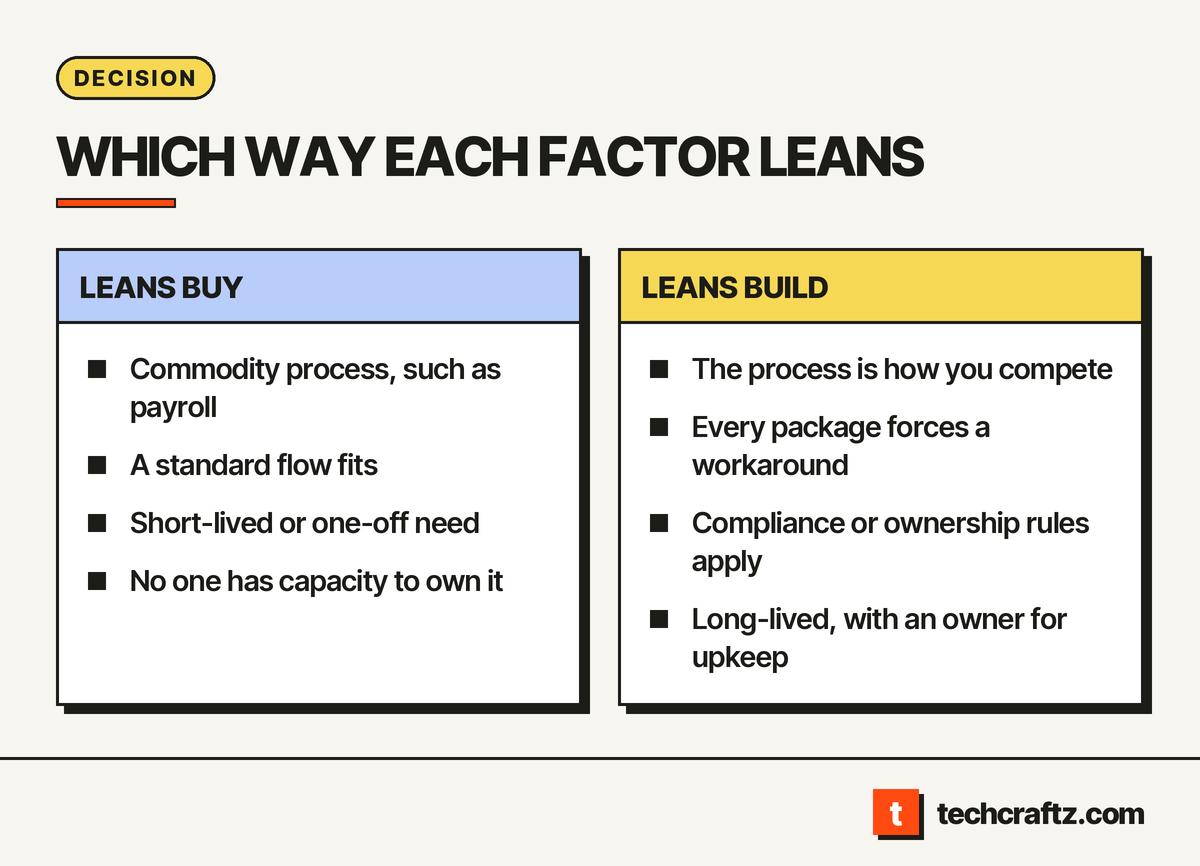
| Question | Leans build when | Leans buy when |
|---|---|---|
| Is the process how you compete? | A competitor with the same tool would matter | It is commodity, such as payroll |
| Does a package fit, or would you bend your process? | Every candidate forces a workaround layer | A standard flow fits |
| Must you own the data or the deployment? | Compliance or residency rules require it | No such rule applies |
| How long will it live? | Many years and a growing user base | A short-lived or one-off need |
| Can you maintain it? | You have an owner and capacity for years of upkeep | No one has capacity to own it |
| How fast do you need it? | Time allows | Wikipedia notes packages usually reach the market sooner |
| Will the vendor last and let you extend? | Roadmap and extension rights are weak | Supplier is stable and extensible |
Our tally is a rule of thumb, not a standard. Count the rows that lean build. Five or more: a build deserves a serious scope. Two or fewer: buy. In between: buy and extend, and write the extension terms down first. Reflex’s own scorecard weights seven criteria and bands the result, which suggests the same logic with more precision than most teams need.
What each path costs over time, without the numbers
We do not quote figures, and we would not trust a build vs buy software comparison that does. The useful thing is the shape. Reflex describes it this way: buying compounds through seat growth, tier upgrades, usage charges, integration and admin overhead, while building front-loads and then flattens into maintenance. Neither is cheaper in general, it says. The crossover depends on lifespan and user count.
Both sides tend to be underestimated. Zylo makes the point for each: a build can miss its budget and its value target together, and a purchase can hit its budget while much of what was bought sits unused. Zylo’s phrase is that bought software rarely gets cancelled, it gets ignored. That is a SaaS-management vendor’s view, so apply it to your own licence list rather than take it on trust.
How each path fails
Build fails by neglect. Zylo’s list of common mistakes includes treating a build as one-time when maintenance recurs through its life, underestimating the integration layer, which it says is often the largest part of a build, and letting an AI-assisted prototype reach production with no owner. Zylo puts re-architecture pressure for most internal tools at roughly five to seven years, which is its estimate and not a standard.
Buy fails by drift. Teams buy because a build felt risky, with no comparison to back it up, or accumulate overlapping tools because nobody owns the framework. Both are in Zylo’s list. The hidden cost, as Reflex puts it, is the workaround layer around a tool that almost fits.
Buy and extend fails by creep. Zylo says vendor platform updates can break extensions, knowledge silos form when one person understands the customization, and extensibility rights are rarely negotiated at procurement, so bargaining power is gone by the time you need them.
If you build: the maintainability test
Reflex proposes one gate before development starts. Can your team read the code? Does it run in a stack you already use, under your version control, and get reviewed the way your team reviews code? If any answer is no, it calls the result deferred cost, however fast it shipped. It adds that hosted builders whose output you cannot export or read fail the test, because that is a build you do not own.
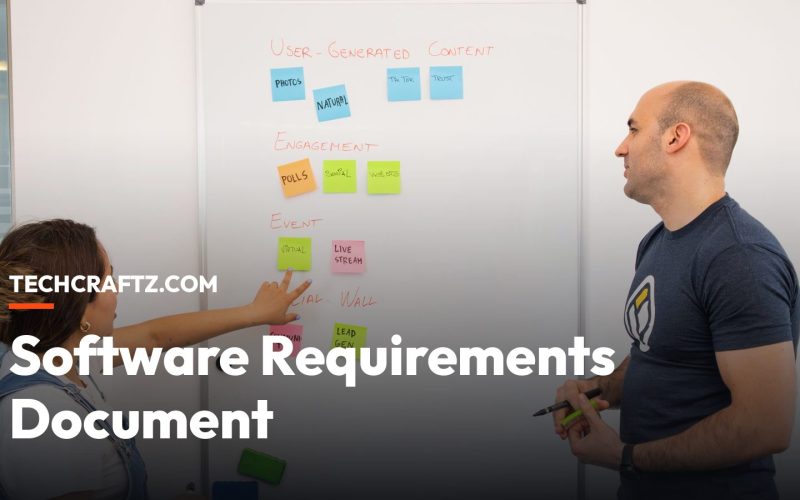
Add three checks of ours. The code and the accounts are registered to you. Tests and documentation exist. And someone is named to maintain it after launch. Our guide to the software requirements document covers how to put these into a scope.
If you buy: terms to settle before signing
- Extensibility. What can you extend, through which interfaces, and under what rights?
- Data exit. Can you export your data in a usable form, and when?
- Roadmap and continuity. Wikipedia asks whether the supplier is likely to remain in business and whether support and customization will be available, from the vendor or third parties.
- Fit. Which of your steps will you change to match the product, and who agreed to that?
Splunk adds one more question that is easy to forget: do you need ongoing support? A package usually comes with vendor support and maintenance, while a build needs your own team to provide it.
Does AI change build vs buy software?
A little, and not where it counts. Zylo says AI-assisted development has reopened some narrow, low-stakes categories, but most decisions that were buy five years ago are still buy. Reflex makes the same point from the other side: faster building does not shorten the maintenance tail, and it can raise the risk of one, because generated code needs an owner, tests, security review and updates like any other. Regulated workloads and customer-facing systems at scale still depend on work that generation alone does not do. Build vs buy software remains a question about ownership and upkeep, not about typing speed.
Send the brief, get a written scope
techcraftz puts scope, milestones and the estimate in writing before the first line of code, then hands over the code, the accounts and the keys. Build vs buy software decisions go better with the answers in writing, and when the right answer is to buy, we say so. For a close look at one decision, see our comparison of a custom CRM and Salesforce, or the benefits of custom software. See also our custom software development page and how we work. Get a written scope.
Last checked: October 15, 2026. Vendor positions and platforms change; verify before you decide.
Talk to us about your project
Tell us what you need. We help you scope the build, the milestones and a realistic estimate.
View services