Custom CRM vs Salesforce is rarely a features contest. It is a question of whether your sales and service process fits a standard CRM data model, and which kind of dependency you want to carry for the next five years. This comparison gives the verdict first, then the test, the ownership timeline, the maintenance burden and the exit checklist. It names no prices, because licences and build scope are quoted per case.
Custom CRM vs Salesforce: the verdict first
| Pick this | When |
|---|---|
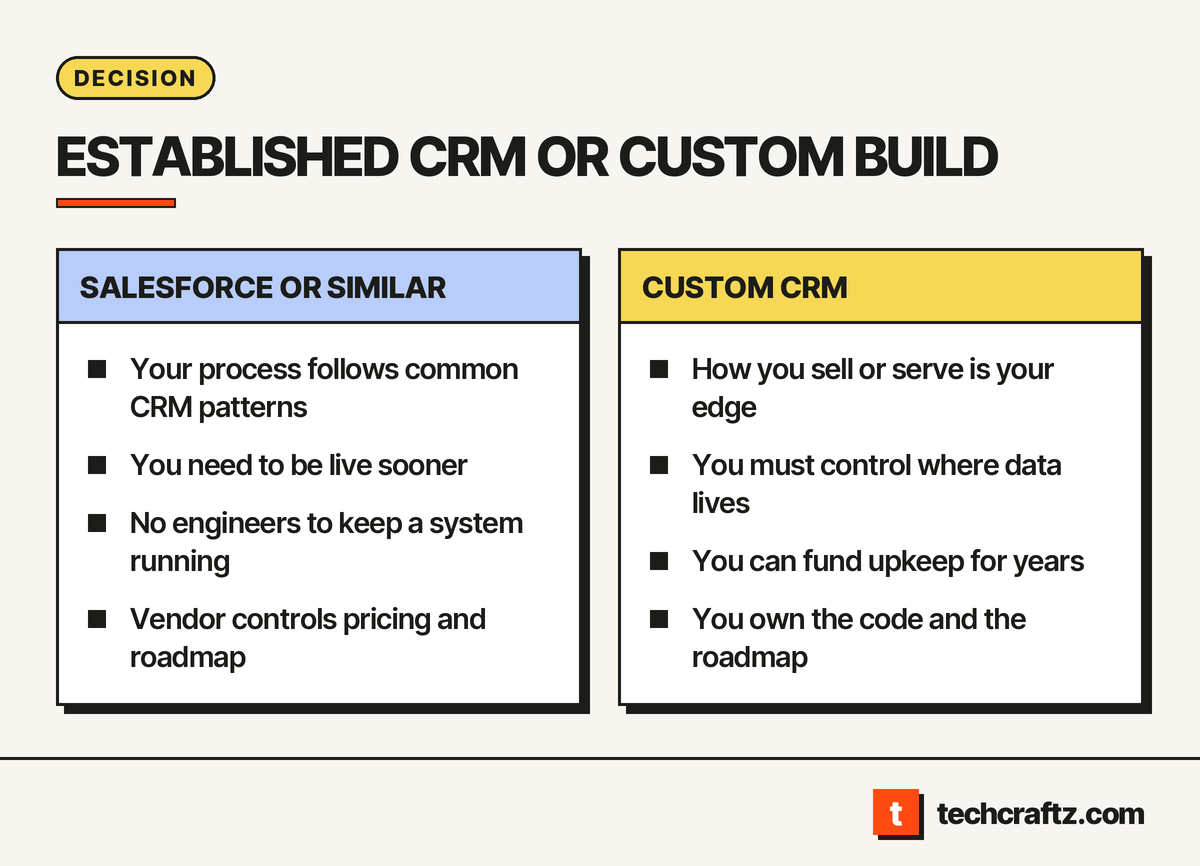
| Salesforce, or another established CRM | Your process follows common patterns (lead to opportunity, accounts, cases). You need to be live soon. You have no engineers to keep a system running. |
| A custom CRM | The way you sell or serve is your edge, and a standard data model keeps forcing workarounds. You must control where data lives. You can fund maintenance for years. |
| Something in between | A standard CRM covers most of it, and one or two pieces are poorly served. See the middle path below. |
This is our judgment, built from vendor positions we cite below. Every source here sells something: Salesforce sells its platform, Dhruvsoft and Pretius sell development. Read the claims as positions, not measurements.
What each option actually is
Salesforce describes custom CRM as software tailored to a company’s processes, workflows and data, and it offers a middle ground: a CRM with many features, extended by custom apps that third-party firms or your own programmers build. It also admits that a fully custom build “could be costly and take time from your IT department”.
A custom CRM in the sense of this article is a system built to your specification and run on infrastructure you control. Nothing sits between you and the roadmap. Nothing is handed to you either: updates, hosting, backups and security become yours.
The data model test for custom CRM vs Salesforce
Before comparing anything, write your process as nouns and verbs. Nouns are the records you keep. Verbs are what happens to them. Then check the nouns against the standard ones: accounts, contacts, opportunities, cases.
- If your nouns fit, with a few extra fields and some automation, a standard CRM is the sensible default.
- If you need several record types with their own rules and relationships, you are building an application whichever route you pick. Salesforce can host it, and so can your own stack.
- If the verbs are where you differ, such as a multi-party approval or a scoring method you treat as intellectual property, that is the argument for custom.
Dhruvsoft puts it the same way: Salesforce is optimized for common CRM patterns, and businesses with unusual workflows can find themselves fighting its data model.
Five years of custom CRM vs Salesforce ownership, period by period
Dhruvsoft recommends a decision horizon of five to seven years, not one or two, because the cost shape differs by path. The table describes what usually changes, without figures.
| Period | Salesforce path | Custom path |
|---|---|---|
| Start | Configure, migrate data, connect apps. Live sooner. | Discover, design, build, migrate data. Usable later. |
| Years 2 to 3 | New needs become configuration, add-ons or code on the platform. Licences follow your seat count. | New needs become change requests to your team or vendor. No per-seat licence. |
| Years 4 to 5 | The vendor controls pricing and feature changes. Your customizations meet upgrade cycles. | Dependencies, frameworks and staff turn over. Without upkeep the system ages. |
Dhruvsoft also warns that a custom system needs ongoing engineering for maintenance, security updates and features, and that each integration must be built and kept alive. The same page says per-seat pricing grows with the team. Both statements are vendor claims, and both are plausible. Test them against your headcount plan.
Custom does not mean safer
In custom CRM vs Salesforce debates, some vendor pages suggest bespoke software is a smaller target. That is not a safe assumption. OWASP Top 10:2025 lists risks such as A01 Broken Access Control and A03 Software Supply Chain Failures, and they apply to any code, including yours. If you build, put access control tests and a dependency policy in the scope, as in our custom web application guide. If you buy, ask how roles and permissions are configured and audited.
The middle path
Dhruvsoft calls heavy Salesforce customization, with custom objects, Apex code and flows, a middle ground: more flexible than standard configuration but still inside the platform’s constraints, costs and upgrade cycles. It is “not the same as owning your own system”.
A second middle path is editorial: keep the CRM for what it does well, and build the one thing it does badly as a small separate application that talks to it through an API. That limits both the build and the dependency. Our article on the benefits of custom software covers when a targeted build is enough, and the custom software development process shows how such a project runs.
Data, privacy and exit
Both routes have a processor, which is whoever runs the system on your behalf. GDPR Article 28 says processing by a processor is governed by a binding contract. Article 44 sets the general principle that personal data goes to a third country only if the conditions of the regulation’s transfer chapter are met, and Article 46 lists appropriate safeguards such as standard data protection clauses. Where the data sits is therefore a contract question for both Salesforce and a custom build. This is not legal advice.
Exit deserves its own list, because a CRM holds years of history. Dhruvsoft says export is possible but leaving Salesforce is costly and complex, and Pretius says migration out is feasible and includes exporting data through the API. Whatever the outcome of custom CRM vs Salesforce, write down:
- Full export in open formats, including notes, attachments and activity history
- API access to every record type, not only the main ones
- Documentation of every custom object, rule and integration
- Who holds the source code, the hosting accounts and the domains
- A retrieval and deletion clause in the contract
Questions to settle before you decide
Five questions settle custom CRM vs Salesforce for most teams.
- Does our process fit the standard records, or do our verbs differ?
- Who maintains the system in year four, and are they named?
- Where must the data live, and who is the processor?
- What does leaving look like on day one of the contract?
- Could a standard CRM plus one small build do the job?
A discovery phase answers the first and fifth in writing before anyone commits.
Send the brief, get a written scope
techcraftz puts scope, milestones and the estimate in writing before the first line of code, then hands over the code, the accounts and the keys. If custom CRM vs Salesforce is the decision on your desk, or a build around an existing CRM, describe the process, the users and the systems it must connect to. Our custom software development page lists what a build includes, and the techcraftz overview explains how we work.
Get a written scope for your CRM decision.
Last checked: October 14, 2026. Vendor positions change; verify before you sign.
Talk to us about your project
Tell us what you need. We help you scope the build, the milestones and a realistic estimate.
View services