Custom web application development means building browser-based software around one organization’s workflow, instead of bending that workflow to fit a SaaS product. It pays off when the process is what sets your business apart, or when off-the-shelf tools force workarounds you pay for every month. What it costs follows scope, so this guide explains the drivers instead of quoting figures. It covers the decisions in the order a buyer makes them.
What custom web application development is, and is not
A web application runs in the browser. Nothing to install. It is built for a defined group of users to do a defined set of tasks: a dispatch dashboard, a booking portal, an approval tool for internal teams.
Elementor offers a simple test: if the main value is in reading the content, it is probably a website. If the main value is in doing something, it is a web application. A marketing site with a contact form is a website. A portal where customers upload documents, staff review them and managers approve them is a web application.
“Custom” means it was designed and coded for one purpose, not sold as a product to the general public. That is the whole difference, and it drives everything else in this guide: scope, cost, ownership, risk.
Custom, SaaS or the middle ground: how to decide
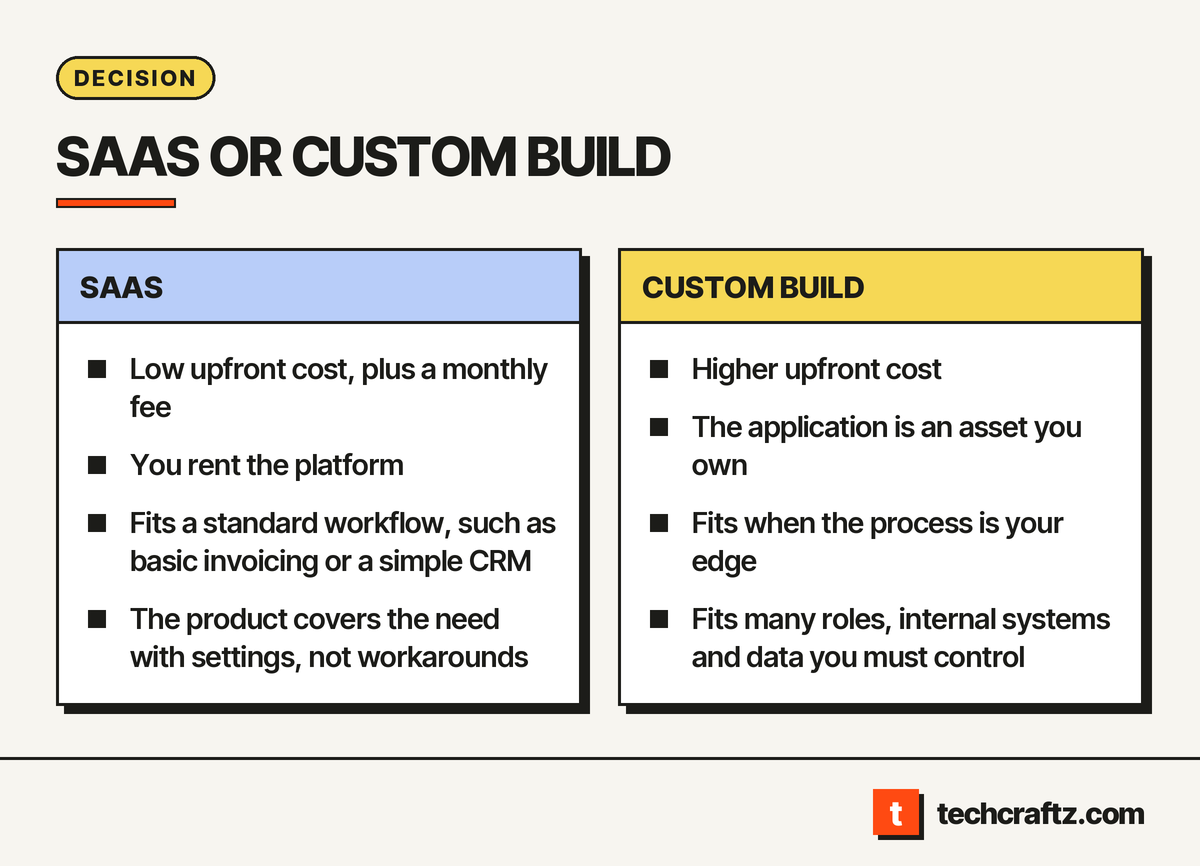
You may not need custom software. Buy SaaS when the workflow is standard and the product covers it with settings, not workarounds. For custom web application development decisions, the table below is our judgment, not a formula.
| Your situation | Lean toward |
|---|---|
| The workflow is standard (basic invoicing, a simple CRM) | SaaS |
| The process is your edge, or SaaS needs workarounds every week | Custom build |
| Mostly content, with a few interactive features | A CMS-based site with plugins |
| You need to test an idea before committing | The smallest custom build that proves it (MVP) |
| Many roles, internal systems to connect, data you must control | Custom build |
Two facts from Elementor’s comparison help. SaaS has a low upfront cost and a monthly fee, and you rent the platform. A custom build has a higher upfront cost, and the application is an asset you own. Elementor also describes a “middle ground” of app-like sites built on WordPress. It sells that route, so weigh it as a vendor view, but it is a real option when the need is closer to a website than to software.
What a written scope for custom web application development contains
Scope creep is the first risk Elementor lists, and its mitigation is a thorough discovery and planning phase. A usable scope is a document, not a call summary. It should hold:
- Users and roles. Who logs in, and what each role can see and change.
- Workflows. For each: the trigger, the inputs, the rules, the outputs.
- Data and integrations. What is stored, where it comes from, which systems it talks to.
- Non-functional needs. Security, performance, browser support, availability.
- Milestones. Each with a demo and acceptance criteria written as checks you can run.
- Out of scope. An explicit list, so “Phase 2” is a decision and not a surprise.
- Ownership and handover. Repository, cloud accounts, domains and IP in your name.
- Change process. How new requests are estimated and approved.
Your side of the exchange is the brief. Elementor lists its parts: who you are, the problem, the users, the high-level solution, must-have features, technical details such as existing systems, and an honest budget and timeline. Brief in, scope out.
What you should hold at each phase of custom web application development
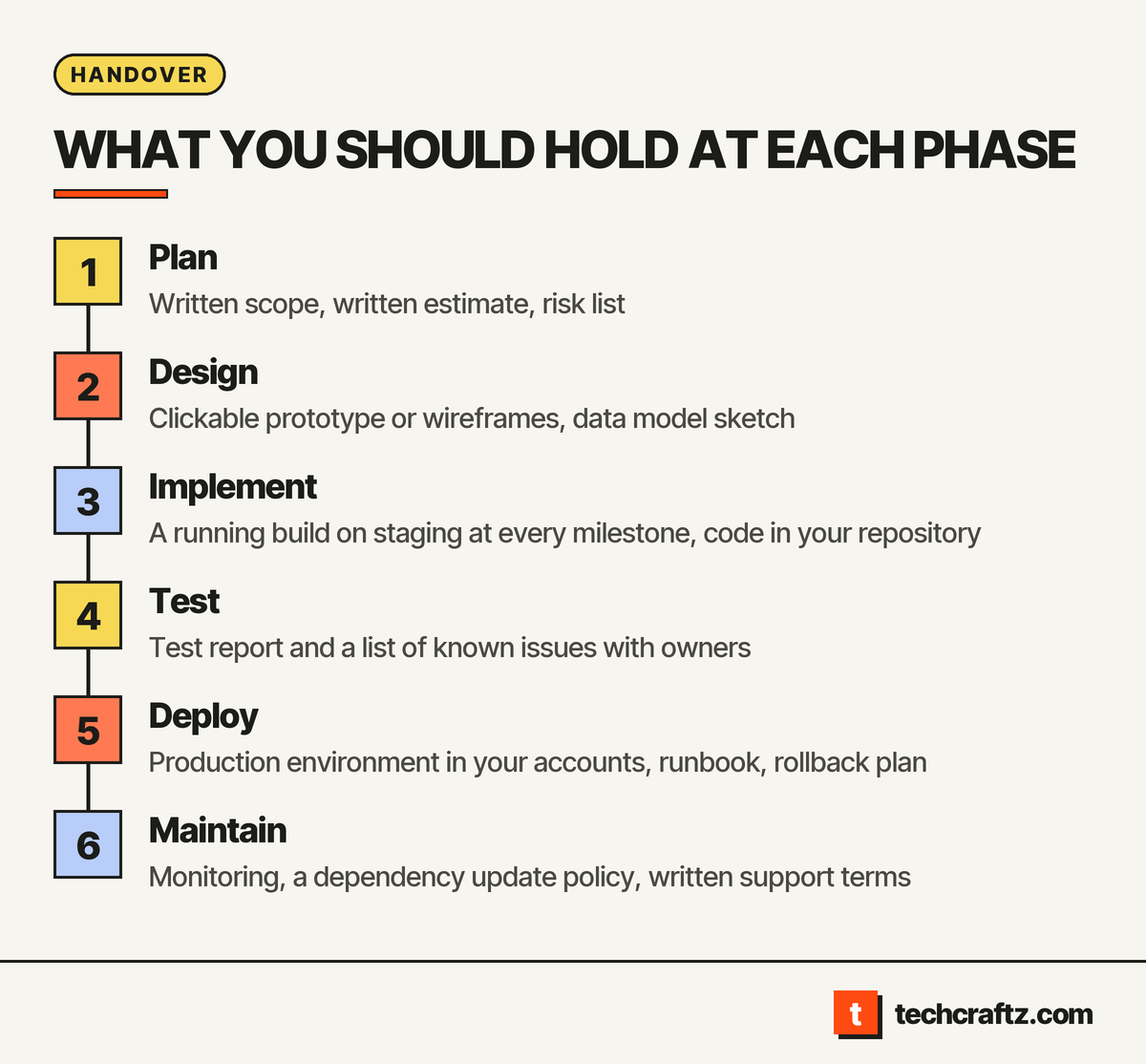
AWS describes six common SDLC phases: plan, design, implement, test, deploy, maintain. For a buyer, each phase should end with something you can inspect.
| Phase | You should hold |
|---|---|
| Plan | Written scope, written estimate, risk list |
| Design | Clickable prototype or wireframes, data model sketch |
| Implement | A running build on a staging site at every milestone, code in your repository |
| Test | Test report and a list of known issues with owners |
| Deploy | Production environment in your accounts, runbook, rollback plan |
| Maintain | Monitoring, a dependency update policy, written support terms |
Utsubo argues that the discovery work before code is where project value is made or lost. That is one vendor’s view, not an industry standard. The point survives anyway: the plan phase is the cheapest place to find a wrong assumption.
Stack choices for custom web application development
You do not need to pick a framework. You need answers to questions that protect you later:
- Is the language and framework widely used, so another team can maintain it if you change vendors?
- Does the repository live in your organization from day one?
- Does the app run in cloud accounts you own, or in the vendor’s?
- Is there setup documentation a new developer could follow?
- How are third-party dependencies tracked and updated?
The last one is no longer a footnote. OWASP Top 10:2025 lists “Software Supply Chain Failures” as risk A03. Ask for the dependency policy in writing.
Team: who builds it and who decides
In our view a build needs a delivery lead, a designer, engineers and QA. On your side it needs one named decision-maker who can answer within days, not weeks. Decisions that wait are a common way to stall a project.
In-house or agency? Elementor’s summary: an in-house team is dedicated and knows your business but is expensive and hard to hire. An agency arrives as a full team that has seen the pitfalls but will not know your business as well as you do at first. Elementor concludes that for most businesses an agency is the more practical route. Either way, ask for updates in writing and demos you can watch later. That keeps the project workable across time zones.
Cost drivers in custom web application development
Vendors publish many figures for custom web application development, and they disagree widely. We do not repeat them. A tier means different things to different vendors, and a number from someone else’s scope says little about yours. What helps is knowing which factors move an estimate and what to ask for in writing.
| Cost driver | Why it moves the estimate | Put this in writing |
|---|---|---|
| Number and depth of workflows | Each workflow brings rules, screens, edge cases and tests | Workflow list with trigger, inputs, rules, outputs |
| Roles and permissions | Access control has to be built and then tested | A role matrix: who sees and changes what |
| Integrations | Each connected system adds mapping, error handling and a dependency on someone else’s API | Systems list with owner and API documentation |
| Data migration | Existing records must be cleaned and moved | Source, owner of the cleanup, acceptance check |
| Security and compliance | Privacy duties and OWASP checks add design and testing work | Named checks, as in the section below |
| Team shape and seniority | Who works on it, and for how long | Roles, and weekly involvement from your side |
| Timeline | A compressed schedule needs parallel work and more coordination | Milestone dates, each with a demo |
| Hosting and running services | Cloud, third-party APIs and monitoring continue after launch | Accounts in your name, and who pays each provider |
| Maintenance | Dependency updates, fixes and support after release | Written support terms |
The build is not the whole bill. Utsubo says cloud hosting, third-party APIs, data migration, maintenance and compliance often add to the cost of the first year on top of the build. Plan for the life of the app, not only for launch.
Will AI coding tools make this simple? One vendor claims they shorten timelines sharply, while the same page cites a much smaller measured productivity gain. Treat both as claims. Utsubo adds that what AI does not shorten is understanding how your team really works, which is why scope comes first. Can ChatGPT build the app for you? In our view, anything generated is code someone must review. The checks in the sections above still apply, and custom web application development still needs a written scope.
We do not publish a price list, because no two builds match. After a short discovery call you get a written estimate. Compare estimates by what each one includes, using the drivers above, not by the headline alone.
Security and privacy checks to put in the contract
Security belongs in the scope of any custom web application development project, with named checks. Start from the OWASP Top 10:2025, a standard awareness document for web application risk. Three items matter early for a custom app:
- A01 Broken Access Control. Roles and permissions decide who sees what. Ask how they are tested.
- A03 Software Supply Chain Failures. See the dependency policy above.
- A07 Authentication Failures. Ask how login, resets and sessions are handled.
If the app processes personal data covered by GDPR, four articles are worth knowing. This is not legal advice, and whether GDPR applies to you is a question for counsel. The text below is as reproduced on gdpr-info.eu.
- Article 25: data protection by design and by default. By default, only the data necessary for each purpose is processed.
- Article 28: processing by a processor is governed by a binding contract. A vendor that handles your users’ data is likely in that position.
- Article 33: the controller notifies the supervisory authority of a personal data breach without undue delay and, where feasible, within 72 hours of becoming aware, unless the breach is unlikely to result in a risk to people’s rights and freedoms. A processor notifies the controller without undue delay. Your incident process must exist before launch.
- Article 83: two fine tiers. Breaches of the controller and processor obligations in Articles 25 to 39, which include the three articles above, fall in the lower tier. The higher tier covers, for example, breaches of the basic processing principles. In both tiers the ceiling is a fixed sum or a share of worldwide annual turnover, whichever is higher.
Put each item into the written scope as a deliverable, with an owner.
Send the brief, get a written scope
techcraftz puts scope, milestones and the estimate in writing before the first line of code, then hands over the code, the accounts and the keys. If your project is a web application, SaaS product or MVP, the first step is the same: describe the problem, the users and your constraints.
Get a written scope or read about techcraftz first.
Last checked: October 14, 2026. Vendor guidance and regulations change; verify before you sign.
Talk to us about your project
Tell us what you need. We help you scope the build, the milestones and a realistic estimate.
View services