How long does it take to build a web app? Published ranges run from about one to five months for a small build to a year or more for a large one, and the sources disagree because “simple” means different things to each of them. Treat any number as a range that holds only while decisions on your side arrive on time. This guide shows what the sources say, why they differ, and how to get a usable number for your own scope. Figures were checked on October 15, 2026.
Published ranges: how long does it take to build a web app
We read five public guides. Each gives a range by size, and none matches another.
| Source | Small | Medium | Large |
|---|---|---|---|
| Ramotion (web apps) | 2 to 4 months | 4 to 8 months | 8 to 12 months or longer |
| Ampersands (web apps) | 12 to 20 weeks | not split out | 20 to 40+ weeks |
| Itransition (apps in general) | several weeks to 3 months | 3 to 7 months | 7 to 12+ months |
| Base44 (apps, traditional coding) | 1 to 3 months | 3 to 6 months | 6 to 12 months or more |
Two details matter more than the numbers. Ramotion’s own text and its table do not agree: the text puts a medium app at 4 to 8 months and a CRM in its table at 5 to 8, and the text gives complex apps 8 to 12 months while its table lists an ERP at 9 to 15. And Ramotion counts a portfolio site as a “simple web app”, while Ampersands quotes simple websites separately, at 4 to 8 weeks, and starts “web app” where people log in and save data.
So, how long does it take to build a web app? A band, not a point. Months, not weeks, once there are accounts and stored data. Base44 sells an AI app builder and says the same build can take hours to days with its tool. That is a vendor claim about a different kind of build, which we come back to below.
Where the sources disagree
How long does it take to build a web app? Three things move the answer, and each source fixes them differently without saying so.
What “simple” includes. A brochure site, a small store and a member portal are all called simple somewhere. Ampersands ties its bands to features: a simple web app has logins, saved data and something like a member portal or booking system. A complex one has dashboards, several user roles and many integrations.
What the clock covers. Ampersands starts the clock when you approve the scope and stops it when the site is live. Others fold discovery and design into the total. Itransition lists business analysis, design and planning as separate stages before development starts.
Who is counted. Ramotion says a larger team of experienced people can speed delivery and a smaller team may take longer. Itransition adds team size, experience and tech stack to its list of factors. A range quoted for a large team says little about a small one.
When you compare vendor quotes, ask which of these each one assumed. A fast quote and a slow quote can describe different projects.
Stage by stage: where the weeks sit
Itransition gives per-stage ranges for app development. OTG Lab gives its own for web apps. They overlap, and they differ on the long pole, which is the build.
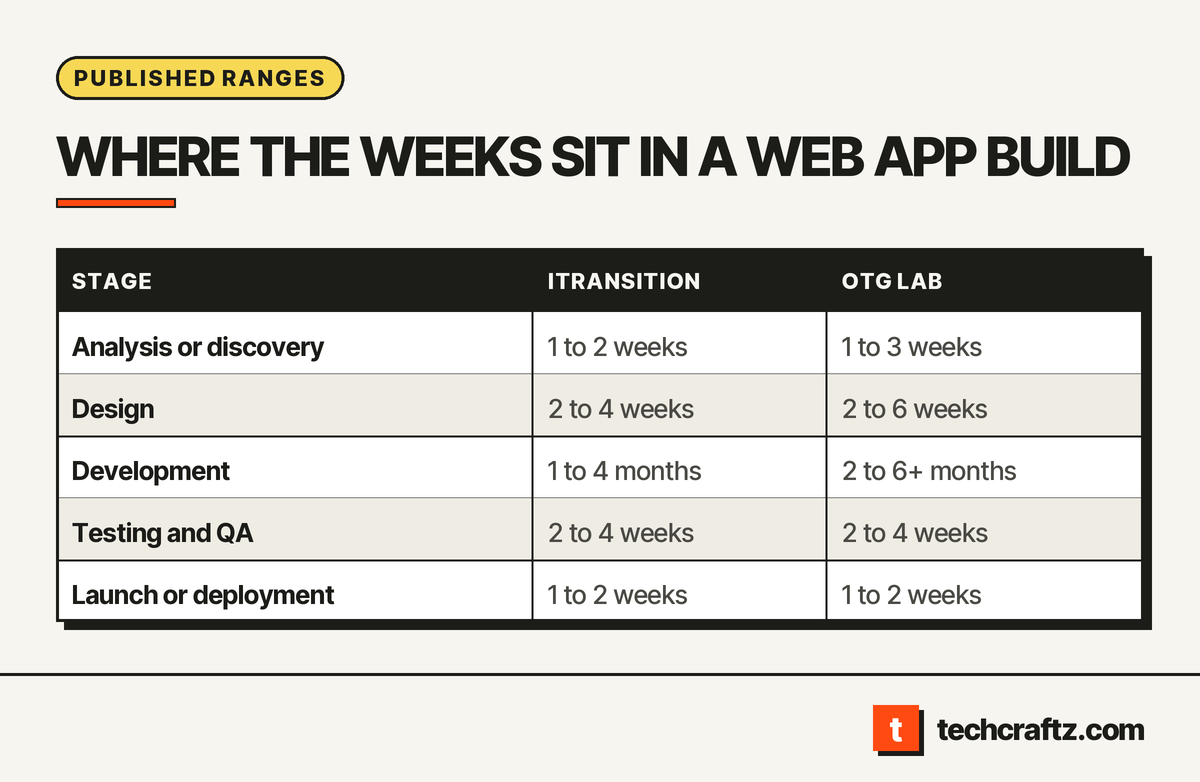
In the diagram:
- Itransition: analysis 1 to 2 weeks, design 2 to 4 weeks, development 1 to 4 months, testing and QA 2 to 4 weeks, launch 1 to 2 weeks. It also lists a planning stage of 1 to 2 weeks between design and development.
- OTG Lab: discovery 1 to 3 weeks, design 2 to 6 weeks, development 2 to 6+ months, testing and QA 2 to 4 weeks, deployment 1 to 2 weeks.
Do not add the rows and call it a schedule. Stages overlap in practice, design continues while the first screens are built, and testing runs alongside development. Use the diagram to see proportions: discovery, design, test and launch are weeks, the build is months. Any honest timeline starts with the stages. Our guide to the stages of app development covers what you receive at each one.
The calendar stretches on decisions, not typing
Ampersands says it directly: the build is rarely what slows a project, waiting on content and approvals is. It walks through an example in which a quote of 12 weeks ends at 17, and none of the five extra weeks is developers working slowly. One is a wait on a payment decision, two are a feature nobody planned, one is a holiday and one is a bug caught late. Read it as an illustration, since it is one agency’s example, but the pattern is familiar.
Sources point to the same short list:
- Kinds of user. Ampersands counts an admin, a manager and a customer as three sets of rules to build and test, not one.
- Connected systems. Each payment gateway, CRM or accounting tool is its own small project. Ramotion notes that payment features carry compliance work such as PCI-DSS and extra testing of payment scenarios.
- Moving old data. Ampersands calls the migration of years of records out of a legacy system often the single longest task.
- The unhappy paths. Failed payments, refunds and someone leaving mid-approval take longer than the happy path.
- Changes after the build starts. Itransition links mid-project changes to scope creep, rework and a longer project. Ampersands notes that changing a colour is cheap while changing how logins work touches everything built on top.
- Waiting on your side. Content that is not ready, approvals that need someone not in the room, access to an old system.
The practical reading: how long does it take to build a web app on your side of the table? It depends heavily on how many decisions you owe and how quickly you make them. A written requirements document turns many of these into answers before development starts.
No store review: one wait a web app skips
A web app runs in a browser, which removes one wait from the end of the schedule. Base44 notes that it needs no app store review, while cross-platform mobile frameworks still take longer than a web app. It is a wait you do not control, and a mobile build has it. If you are choosing between formats, our article on web app vs website covers the line between the two, and the custom web application guide covers the build itself.
How long does it take to build a web app with AI?
Shorter, but not by as much as the pitch suggests, and not where the calendar is longest. Base44 says an AI builder can turn a prompt into a deployable web app in days. Ampersands says the build phase has genuinely got faster, but the calendar has barely moved, because deciding what to build, getting content, approvals and testing what happens when things break are unchanged.
Both can be true. A prototype in days is a fast way to learn what you want. A production app with roles, stored data, integrations and tests is a larger job, and the decisions still queue behind people. If a vendor promises a fraction of the usual calendar, ask what is left out.
Five ways to shorten the real calendar
None of these is exotic.
- Cut to one core flow first. Ramotion lists an MVP among its ways to accelerate, and Itransition says an MVP needs less development time than a full product. See our eight-week MVP plan for how to cut.
- Name one decision-maker before work starts.
- Agree turnaround times for feedback, in writing.
- Have content, data exports and access ready on day one.
- Add integrations one at a time. Each is its own mini-project.
Questions that make a vendor’s timeline usable
How long does it take to build a web app? Any vendor’s answer is only as good as its assumptions. Ask for these in writing:
- What is the definition of done for each milestone, and who accepts it?
- How many user roles and which integrations does the number assume?
- Is data migration included, and from what?
- What turnaround does the plan assume from you, and what happens to the date if it slips?
- How does a change request move the date?
- What is demonstrated at the end of each increment?
A vendor who answers these will give you a range with a reason attached. One who cannot is quoting a guess.
Send the brief, get a written scope
How long does it take to build a web app like yours? techcraftz writes scope and milestones before the first line of code, then hands over the code, the accounts and the keys. We do not publish a standard timeline, because no two builds match, and a number without a scope behind it is the problem this article describes. If you want a range for your own project instead of a published average, see our web application development page and how we work. If you only need to validate an idea first, the MVP development page covers that route. Get a written scope.
Last checked: October 15, 2026. Published ranges change; verify them against the source before you plan.
Talk to us about your project
Tell us what you need. We help you scope the build, the milestones and a realistic estimate.
View services