What are the 7 stages of app development? The most common answer is strategy, planning, design, development, testing, deployment and maintenance. Other sources use different names and different counts, so treat the number as a convention, not a law. What matters to a buyer is the output of each stage: what you should hold in your hands before the next one starts. This guide lists seven stages and, for each, what you receive and how to tell it is done.
What are the 7 stages of app development, and why do sources disagree?
Count the stages in five well-known descriptions and you get different answers, sometimes within a single page. The work is the same. The slicing differs. So what are the 7 stages of app development, once the labels are set aside? The section further down answers it in terms of deliverables.
| Source | Stages | Count |
|---|---|---|
| Mobilions | Strategy, planning, design, development, testing, deployment, maintenance | 7 |
| Droids on Roids | Choosing a vendor, product discovery, UX/UI design, project kick-off and setup, development with QA, store publishing, post-launch maintenance | 7 |
| Kissflow | Ideation or discovery, planning, design, development, QA and testing, deployment and maintenance (one passage); planning, requirements analysis, design, development, testing, deployment, maintenance (the next) | 6 in one passage, 7 in the next |
| AWS (SDLC) | Plan, design, implement, test, deploy, maintain | 6 |
| LANSA | Research and planning, requirements analysis, technical feasibility, wireframes, prototyping, application design, development, testing, deployment, maintenance and updates | 10 |
Two lessons from the table. First, nobody skips the work: discovery, design, build, test, release and upkeep appear everywhere. Second, ask a vendor to show you their own list. A vendor that has no explicit stage for discovery or for maintenance has told you something.
Stages and models are different things: the 7 stages of app development in time
The question “what are the 7 stages of app development” is about kinds of work. A stage is a kind of work. A model is how the stages are arranged in time. AWS discusses four SDLC models: waterfall, iterative, spiral and agile. In a waterfall each stage ends before the next begins. Most modern teams overlap them. Mobilions describes design, development and testing running as a loop, where one feature is built and tested while the next is designed, while strategy and planning still come first and deployment and maintenance still come after.
For you, the practical effect is that “done” applies to a deliverable, not to a calendar slot. You may hold a tested design while the first features are already being built.
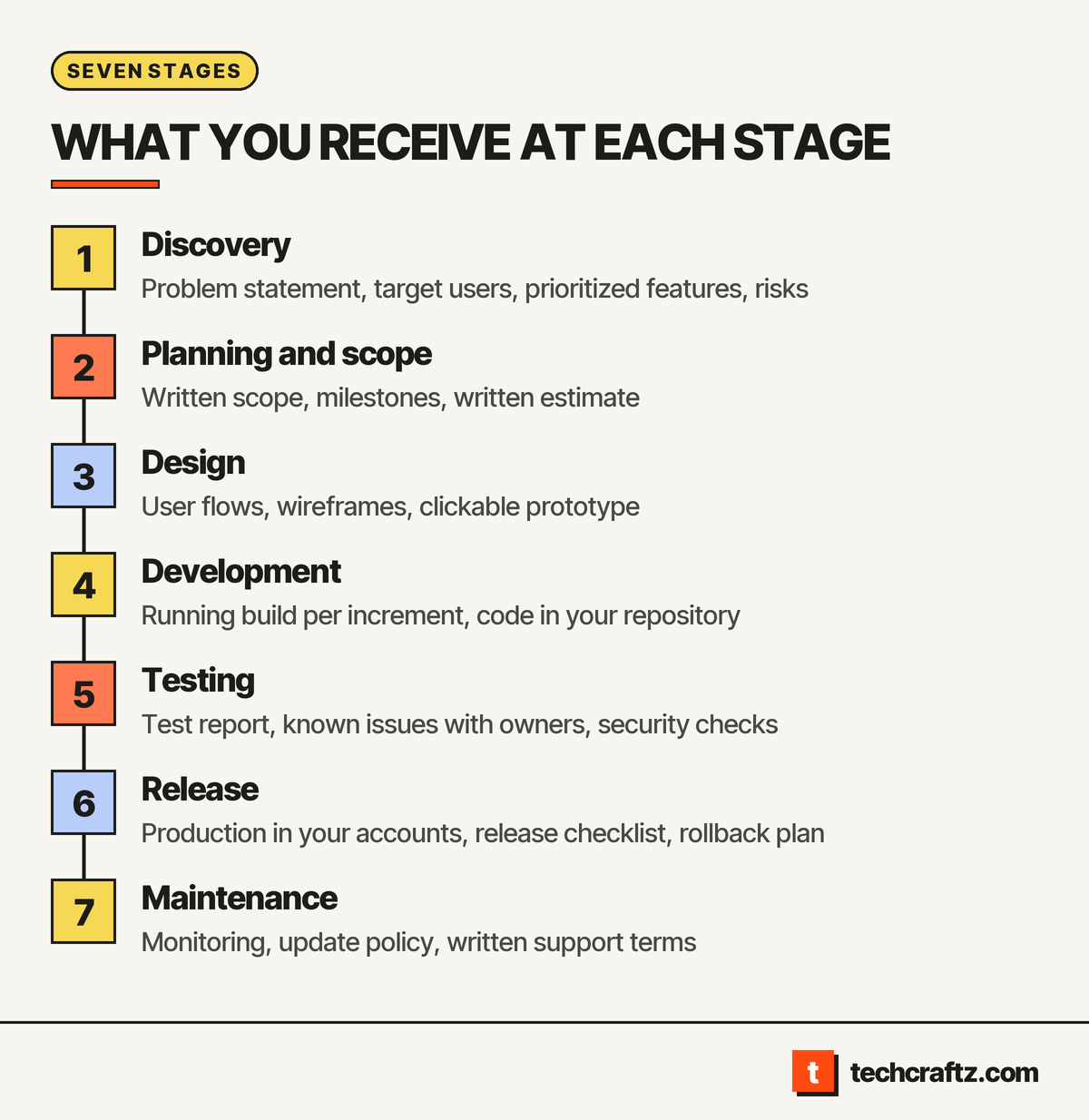
What are the 7 stages of app development, and what do you receive?
Stage 1: Discovery
The team learns the problem, the users and the constraints, and you agree what success looks like. Droids on Roids calls this building the right thing, as opposed to building the thing right, and lists tools such as user journey maps and prioritization charts.
You receive: a written problem statement, the target users, a prioritized feature list with the first release marked, and a list of risks.
Done when: you can state in a sentence who the app is for and what it does first.
Goes wrong when: the team falls in love with a solution before the problem is confirmed. If the idea is still unproven, consider a smaller test first, as in our MVP workflow.
Stage 2: Planning and scope
Features are scoped, the technical approach is chosen (native, cross-platform, backend, integrations), and a timeline is set. Mobilions says a good plan prioritizes ruthlessly and that scope creep and a timeline assuming nothing goes wrong are the usual failures.
You receive: a written scope, milestones with demos, a written estimate and a technical approach summary.
Done when: each milestone has acceptance criteria written as checks you can run.
Goes wrong when: the platform decision is made by default. iOS first, Android first or both is a planning decision with consequences, which our mobile app development page covers.
Stage 3: Design
User experience (how the app works) and user interface (how it looks) are drawn before they are built. Mobilions notes the stage ends with a clickable prototype, and that problems found by watching someone use a prototype are cheap to fix compared with problems found after the build.
You receive: user flows, wireframes, interface screens, a clickable prototype.
Done when: someone outside the team has completed the main flow on the prototype without help.
Goes wrong when: screens are polished before the flows are right.
Stage 4: Development
The team builds the front end, the back end and the integrations in short increments. Droids on Roids describes a sprint as refinement, planning, coding, testing, review and retrospective, and lists six setup steps before coding: repository, continuous integration, beta distribution, architecture, development environment and store registration.
You receive: a running build after each increment, the code in your repository, a staging environment, a recorded demo.
Done when: each increment passes its acceptance criteria on staging.
Goes wrong when: the team builds well against a weak plan. Check the repository access on day one, not on handover day.
Stage 5: Testing
Droids on Roids argues that quality assurance should be part of development from the start and that developers should not be the only ones testing their own code. Mobilions adds that testing covers devices and operating system versions, performance under load and security, and that testing only on the developer’s own clean, fast phone is a common way testing goes wrong.
Security needs named checks. OWASP Top 10:2025 is the standard awareness list, and items such as A01 Broken Access Control, A06 Insecure Design and A03 Software Supply Chain Failures make a sensible starting point for a conversation about what will be tested.
You receive: a test report, a list of known issues with owners, and the results of the security checks you named.
Done when: all Must acceptance criteria pass and open issues are listed, not hidden.
Goes wrong when: testing is squeezed at the end because a deadline slipped.
Stage 6: Release
For mobile this means the stores. Three platform facts to check early, as of October 14, 2026:
- Google requires new apps and updates to target Android 16 (API level 36) or higher from August 31, 2026, with lower targets for some device types, per the Play Console help page.
- For personal developer accounts created after November 13, 2023, Google requires a closed test with at least 12 testers opted in for 14 continuous days before production access. The page we read covers personal accounts only. Check which type of account applies to you.
- Apple’s developer program accepts enrollment as an individual or an organization, with verification by Apple.
Droids on Roids says stores also need separate assets and legal configuration, and Mobilions recommends a staged rollout over a single launch to everyone.
You receive: the production environment in your accounts, store listings, a release checklist, a rollback plan.
Done when: the app is live from accounts that belong to you.
Goes wrong when: store requirements are discovered at submission.
Stage 7: Maintenance
Mobilions calls maintenance the stage people forget when they plan, and says the work after launch usually outlasts the work before it. That is one vendor’s view, and it is plausible: operating systems and store policies change every year, as the Android target requirement above shows.
You receive: monitoring, a dependency update policy, written support terms, a documented process for urgent fixes.
Done when: you know who answers if the app breaks, and how quickly.
Goes wrong when: nobody budgets for it, so the app is left to age.
Where the stages go wrong most often
Every answer to what are the 7 stages of app development should include the failure modes. Mobilions offers a short list of the most common failure per stage. We have added what to ask for in each case.
| Stage | Common failure | Ask for |
|---|---|---|
| Discovery | Solution chosen before the problem is checked | Problem statement and user evidence |
| Planning | Scope creep, hopeful timeline | Written scope and change process |
| Design | Skipping the prototype | A prototype test with real users |
| Development | Building against a weak plan | Repository access and demos |
| Testing | Rushed, device-limited | Test report and device list |
| Release | Store review treated as formality | Release checklist, staged rollout |
| Maintenance | Not planned | Written support terms |
How to use the stages with a vendor
Put the question “what are the 7 stages of app development” to each vendor and ask what its own process looks like. Then ask for the deliverable list per stage before signing. A vendor that can show it has thought about the handover. A vendor that offers only a timeline has not. Add three standing items to the contract: the repository and cloud accounts in your organization, a recorded demo at each milestone and written acceptance criteria.
techcraftz puts scope, milestones and the estimate in writing before the first line of code, then hands over the code, the accounts and the keys. Our process page describes how that runs in practice, and the MVP development page covers the smallest first release. Whichever way you answer what are the 7 stages of app development, the first stage is the same. When you are ready to begin it, send the brief or read more about techcraftz.
Last checked: October 14, 2026. Store requirements and vendor guidance change; verify before you plan a release.
Talk to us about your project
Tell us what you need. We help you scope the build, the milestones and a realistic estimate.
View services