Who owns the code when outsourcing software development? By default, the person who wrote it, until a signed written agreement says otherwise. Paying the invoice does not move ownership. A contract that is clear on the point does, and so does a repository and a set of accounts that sit in your name from the first day.
A note before we start: this is general information drawn from statutes and official guidance, not legal advice. Laws differ by country and the facts of your case matter. Have a lawyer read the contract before you sign.
The default rule: who owns the code when outsourcing software development
Start with the law as written, in three places.
United States. Section 201(a) of the Copyright Act says copyright vests initially in the author. The exception that people reach for is “work made for hire”. The Copyright Office explains in Circular 30 that this covers work by an employee within the scope of the job, and commissioned work in one of nine listed categories, such as a translation or a contribution to a collective work, when the parties sign a written agreement that says so. If a requirement fails, it is not a work made for hire. Software is not named among the nine categories, and whether a particular codebase could fit one is a question for a lawyer, not something to assume.
So a contract line saying “all code is a work made for hire” may not do what the buyer expects. What does move ownership is an assignment. Under section 204(a), a transfer of copyright ownership needs a signed written instrument.
United Kingdom. The Copyright, Designs and Patents Act 1988 makes the author the first owner (section 11). The exception is a work made by an employee in the course of employment, where the employer is first owner unless agreed otherwise. An assignment is not effective unless it is in writing and signed by or on behalf of the assignor (section 90(3)).
European Union. Article 2(3) of the Software Directive (2009/24/EC) gives the employer the economic rights in a program created by an employee in the execution of his duties, unless the contract provides otherwise. The article speaks about employees. For a program written by a contractor, national law and the contract decide.
The pattern is the same everywhere we looked: a contractor is not your employee, so the contract has to carry the transfer.
Four layers: who owns the code when outsourcing software development
“The code” is not one thing. Treat it as four layers, each with its own default and its own request.
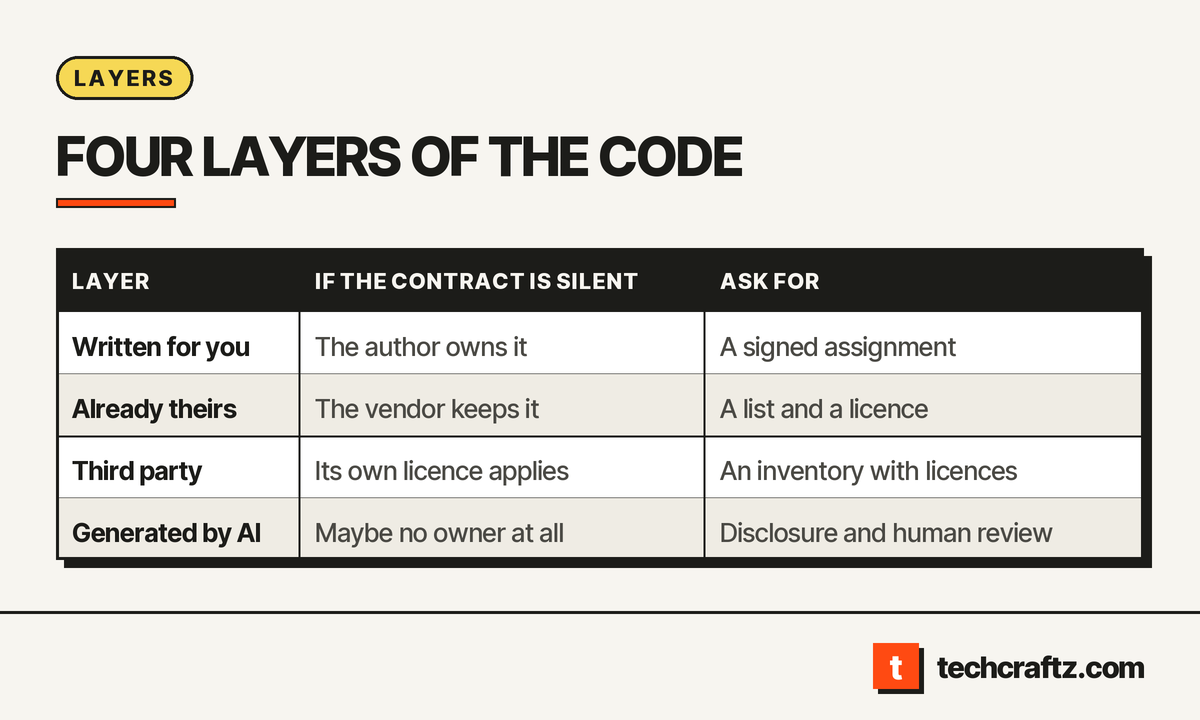
| Layer | What it is | Default if the contract is silent | What to ask for |
|---|---|---|---|
| Written for you | The application code your team commissioned | The author owns it | A signed assignment to you |
| Already theirs | The vendor’s libraries, scripts and tools reused across clients | The vendor keeps it | A list of each item and a licence to use and modify it in your product |
| Third party | Packages and frameworks, each under its own licence | The licence terms apply | An inventory with the licence of each component |
| Generated by AI | Parts produced by coding assistants | Possibly no copyright owner at all | Disclosure of the tools, and a human review of the output |
The second and third layers are where “you own all the code” turns out to be too broad. An assignment can only transfer what the vendor owns. Open-source packages stay under their own licences, and the vendor’s pre-existing tools stay the vendor’s. That is normal. The trouble starts when nobody wrote down which is which.
The assignment clause: five jobs
A good ownership clause answers who owns the code when outsourcing software development in five ways. This list is a set of questions to put to your lawyer, not a form to copy.
- It transfers now, not later. Willcox Savage, a law firm, explains that wording such as “agrees to assign” or “will assign” can be read as a promise to transfer in the future, while “hereby does assign” is a present transfer. The Federal Circuit cases it cites are patent cases, but the drafting lesson is the one lawyers repeat.
- It takes effect as the work is created. Mercury Development, an agency, warns against clauses that transfer ownership only on final payment or final acceptance. A project that stalls leaves you with invoices and no rights. The vendor’s protection against non-payment is a payment clause, which does not have to be your copyright.
- It reaches the person who typed. Your contract is with a company, and the company’s rights depend on its own agreements with its engineers and subcontractors. Ask the vendor to confirm that each person on your project has signed an assignment to the vendor, and to name subcontractors before they start.
- It deals with what cannot be assigned. Pre-existing tools get a list and a licence. Open-source components get an inventory. Moral rights, where they apply, get a waiver, and the vendor agrees to sign confirmatory documents later if you need them.
- It covers confidentiality separately. An NDA protects your secrets. It does not transfer ownership. You need both.
AI-generated code: what an assignment cannot transfer
Who owns the code when outsourcing software development is less clear when AI wrote part of it. If a vendor’s engineers use AI assistants, part of your codebase may be partly machine-generated. The US Copyright Office’s report on copyrightability (Part 2, published January 29, 2025) concluded that, with current technology, prompts alone do not give a user enough control to be the author of the output. Human authors keep their rights in the human contributions, in the creative selection and arrangement of material, and in creative modifications. On March 2, 2026, the US Supreme Court denied the petition in Thaler (docket 25-449), a case about whether an AI system can be an author.
For you, the practical points are short. An assignment cannot hand over a copyright that nobody holds. Ask the vendor which AI tools are used, and require that engineers review and rework generated code before it merges. And treat this as a moving area: check it again before you sign. Other countries may take different positions.
Control of the system, not only copyright
Owning the copyright is only half of who owns the code when outsourcing software development in practice. Owning the copyright and controlling the system are different. You can hold a perfect assignment and still be unable to run, change or move the product. Put these in your name from day one:
- The repository. Create the organization and the repository, then invite the vendor with write access. Do not accept an export at the end. Daily commits in your repository are the strongest proof that you hold the code.
- The accounts. Hosting, domains, app store accounts, third-party services, the build pipeline and the secrets store.
- A build that runs without the vendor. Before the first milestone is accepted, have someone build and deploy from a clean machine using only your accounts.
- The access list. A short document of who holds which credentials, and a way to revoke them.
We use the same five-point handover test in our guide to choosing between a freelancer and an agency. The principle holds whoever builds for you, whether it is a freelancer, an agency or an offshore team.
Four moments to check
Ownership is not a clause you check once, because who owns the code when outsourcing software development depends on what is signed and what you hold at each stage.
- Before signing. Read the ownership clause with a lawyer. Ask the questions in the contract section above. Our guide on how to choose a software development company has twelve more.
- At kickoff. Create the repository and accounts. Confirm who will touch the code.
- At each milestone. Look at the commit history in your repository and run the clean build.
- At handover. Collect the licence list, the open-source inventory, the documentation and the access list. Revoke the credentials the vendor no longer needs.
If you are working with an offshore team, the same checks apply; our outsourcing guide covers engagement models and contract types in more detail.
Send the brief, get a written scope
techcraftz puts scope, milestones and the estimate in writing before the first line of code, then hands over the code, the accounts and the keys. On our projects the code and the rights belong to you, and we put that in the contract. If you are asking who owns the code when outsourcing software development and want it settled before work starts, see our custom software development and offshore software development pages. Get a written scope, or read more about techcraftz.
Last checked: October 15, 2026. Laws and court rulings change; this is not legal advice, so verify with a lawyer before you sign.
Talk to us about your project
Tell us what you need. We help you scope the build, the milestones and a realistic estimate.
View services