The benefits of custom software development are real in a narrow set of situations: when your process is what sets you apart, when off-the-shelf tools force weekly workarounds, when systems must be connected, when data control is binding. In other situations they are not, and a bought product wins. The pages that rank for this topic mostly list advantages. This guide goes the other way: seven situations, a test for each, and the cases where custom software is the wrong call.
What is custom software development?
Lansa defines it as designing, developing and deploying software for the particular needs of a business or an individual. It is built around one organization’s work, not sold as a product to everyone. The benefits of custom software development follow from that difference. Off-the-shelf software is the opposite: built for the generic requirements of a category.
Arkbauer states the practical difference. A ready-made product is built on generic requirements that may not fit how you operate, so you adjust your process to the tool. Custom software adjusts the tool to your process. That trade is the source of every one of the benefits of custom software development below, and of every drawback.
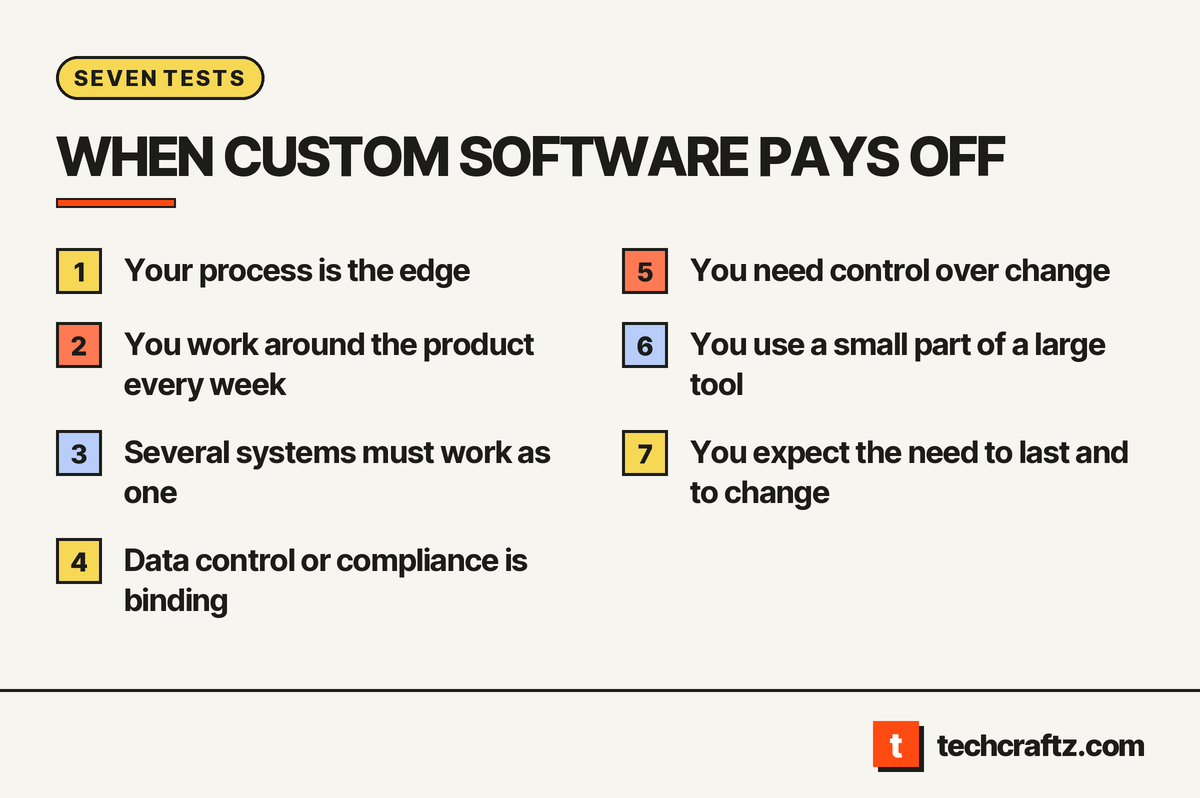
Seven situations where the benefits of custom software development are real
Each situation has a test for the benefits of custom software development. If you can answer yes with specifics, the benefit applies to you. If you answer with a general feeling, it probably does not.
1. Your process is the edge
Lansa asks whether your operations or service model fit the standard functions of off-the-shelf software. When the way you work is the reason customers choose you, a generic tool flattens it.
Test: if a competitor bought the same product, would they run the process just like you? If yes, buy. If no, the process is worth encoding.
2. You work around the product every week
Lansa notes that off-the-shelf software often forces businesses to change their processes to fit it. A few workarounds are normal. A standing spreadsheet that fixes the tool’s output, or a manual step between two screens, is a recurring cost.
Test: list the workarounds. If they total more than a few small items, or any of them is slow and error-prone, you are paying for a poor fit.
3. Several systems must work as one
Arkbauer observes that tools used by one organization often need to talk to each other, and that building those interfaces is hard with ready-made products. A bought tool may offer some integrations, but not necessarily the ones you need or in the shape you need.
Test: draw the systems and the data that moves between them. If every connection already exists as a supported integration, you may not need custom software. If the central hand-off has no integration, that is the piece to build.
4. Data control or compliance is binding
Lansa lists complete data control and compliance with regulations such as GDPR, HIPAA and PCI DSS among the benefits, since the system can be designed with those requirements from the start. Treat it as an opportunity, not as automatic. Compliance is a result of how the software is built and run, not of the word “custom”.
On security, Arkbauer argues that popular off-the-shelf products attract attackers and that a bespoke tool used by one team draws fewer intrusions. We would not rely on that. The OWASP Top 10:2025 lists risks such as Insecure Design and Software Supply Chain Failures that apply to any code, including code written for you. Security depends on how the software is built, tested and updated.
Test: do you have a written requirement (a regulation, a client contract, a residency rule) that a product cannot meet? If yes, custom is a candidate. If the worry is only “custom feels safer”, it is not a reason.
5. You need control over change
Lansa points out that off-the-shelf vendors push updates on their schedule, which can cause sudden disruption, while custom software can be updated on yours. Arkbauer adds a vendor risk: products are retired, older versions lose support, and companies stop operating.
Test: what happens to your business if the vendor changes the product, drops a feature or stops supporting your version? If the answer is “we stop”, the dependency is a risk worth pricing.
6. You use a small part of a large tool
Arkbauer notes that ready-made products carry many functions based on generic requirements, so a team may use only a few of them and still find the tool bulky to operate. Custom software can contain just the functions you use.
Test: how many of the product’s screens does your team use in a normal week? If it is a handful, a narrow tool may be easier to learn and cheaper to support, though with upkeep of its own.
7. You expect the need to last and to change
Lansa frames the choice as temporary solution versus long-term investment. Custom software also becomes an asset you own, with its code and accounts in your name, as long as the contract says so.
Test: will this need exist, in a similar form, in several years, and will it keep changing? If it will, owning the system lets you change it. If you need a stopgap for one season, buy.
Where the benefits of custom software development run out
Arkbauer is direct about the other side. Custom software needs a large investment of time as well as money, and delivery can take months, while an off-the-shelf product is usable at once. Your team must spend time writing requirements and testing. Arkbauer says a bought product has already been tested for defects and usability; yours will go through several rounds before it works the way you intended.
Arkbauer lists the cases where it recommends off-the-shelf software:
- You are a very small organization with no plans to scale.
- You have no integration needs and no special security concerns.
- You are in a hurry.
- The investment is too high for the return you can expect.
You may not need custom software. We say so because it is true, and because a project that should have been a subscription wastes everyone’s time.
Several vendors, Lansa and Arkbauer among them, claim custom software costs less over the long run than licence fees. Neither page shows data, and the answer depends on how many licences you need, how often your process changes and what maintenance you will pay for. We do not quote figures. Test the claim against your own numbers, with a written estimate in hand.
What the benefits of custom software development leave you to maintain
Ownership has duties that a subscription hides.
- Maintenance. Someone must fix defects and update dependencies. Arkbauer advises building maintenance into the contract and keeping it flexible for later changes.
- Environments. Lansa recommends separate staging and production environments, so changes are tested before they reach users.
- Version control. Every change recorded in a system such as Git, so work can be reviewed and reverted.
- Design before code. Lansa’s advice is to design before building, so architecture, data flows and interface match the requirements.
- Documentation. Setup notes a new developer could follow, in case you change vendors.
If these look like a burden, the middle path is worth considering: keep a bought product for the standard work and build only the part that is different, connected through an integration. Our buyer’s guide to custom web application development covers the written scope, the deliverables at each phase and the security checks in more detail.
Score your own case against the seven situations
Count how many of the seven tests you answered yes to, with specifics. That count shows how many benefits of custom software development apply to you.
| Yes answers | Reading |
|---|---|
| 0 to 1 | Buy or subscribe. Revisit when the need changes |
| 2 to 3 | Look at a hybrid: bought product plus a custom piece for the gap |
| 4 or more | A custom build deserves a written scope and an estimate |
This is our own rule of thumb, not a standard. One strong yes (a binding compliance requirement, for example) can outweigh several weak ones.
Next step
If your answers point toward a build, the next document is a scope, not a quote. techcraftz puts scope, milestones and the estimate in writing before the first line of code, then hands over the code, the accounts and the keys. See our custom software development and web application development pages, or the page for startups if you are earlier in the process. Get a written scope or read more about techcraftz.
Last checked: October 14, 2026. Vendor claims and standards change; verify before you decide.
Talk to us about your project
Tell us what you need. We help you scope the build, the milestones and a realistic estimate.
View services