Technical debt in software development is the extra work you inherit because something was built quickly instead of properly. Features still ship, but each new change takes longer than it should, because the code underneath resists it. For a business owner the question is not whether you have it, since every system does, but which parts are slowing you down and which can wait.
Technical debt in software development, defined without jargon
Wikipedia describes technical debt as a qualitative description of the cost of maintaining a system that comes from choosing an expedient solution. A fast solution speeds things up now, and the lower quality can raise future costs if left unresolved. Unlike money owed, technical debt is often taken on without anyone intending to.
Ward Cunningham coined the term in 1992 to explain to his boss why the team needed to refactor a financial product. Martin Fowler, who has written about the idea for years, values the metaphor for a practical reason: it is handy for communicating with non-technical people. That is the use we make of it here.
Prudent or reckless: the four kinds
Fowler argues that the useful question is not whether a flaw counts as debt. It is whether the debt was prudent or reckless, and whether it was taken deliberately or without noticing. Crossing the two gives four kinds.
| Prudent | Reckless | |
|---|---|---|
| Deliberate | “Ship now, fix after launch”, with a plan and a reason | “We have no time for clean code”, with no plan |
| Inadvertent | “Now we know how it should have been built” | The team did not know good design practice |
The prudent-deliberate case is a business decision: a team knows it is taking a shortcut and has weighed the payoff of an earlier release against the cost of fixing it. The reckless cases are the ones to worry about. Fowler also says the prudent-inadvertent kind is inevitable, because developers learn the right design only while building. Even excellent teams will have some, which is why it should be expected and budgeted for, not blamed.
Where the extra work comes from
Atlassian lists common causes of technical debt in software development, and most of them are ordinary management pressures rather than bad developers:
- Tight deadlines. Quick fixes replace proper solutions.
- Lack of testing. Bugs that slip through create ongoing maintenance.
- Poor communication. Misread requirements lead to rework.
- Skill gaps. Teams new to a technology produce solutions that need refining.
- Evolving requirements. Code that once fit the plan no longer does.
Atlassian also names “bit rot”: even good code can become a problem as dependencies change and new features arrive. Replacing outdated dependencies that no longer receive security updates is one of its examples, so debt is not only about how the code was written.
Warning signs you can see without reading code
You do not need to inspect source files to notice technical debt in software development. Atlassian points to recurring bugs and to simple changes that take longer than expected. Its list of detection methods includes code reviews, complexity metrics, developer feedback and performance monitoring.
From the owner’s seat, here is our reading of what those look like:
- Estimates for small changes keep growing, and nobody can explain why.
- The same kind of defect returns after being fixed.
- Developers describe parts of the product as “fragile” or avoid them.
- A release needs a long manual checklist because tests do not cover it.
- Pages or screens slow down and nobody has time to look.
One sign alone proves little. Several together, over a few months, are worth a conversation. Ask the team to show you where the pain is concentrated.
Which debt to leave alone, which to pay down
This is the point most introductions miss. Fowler explains that the extra effort is only paid when you work in the affected code. A terrible area that nobody has to modify costs you nothing today, so messy but stable code can be left alone. Areas of high activity are different: there, he calls for a zero-tolerance attitude toward cruft, because every change pays the cost.
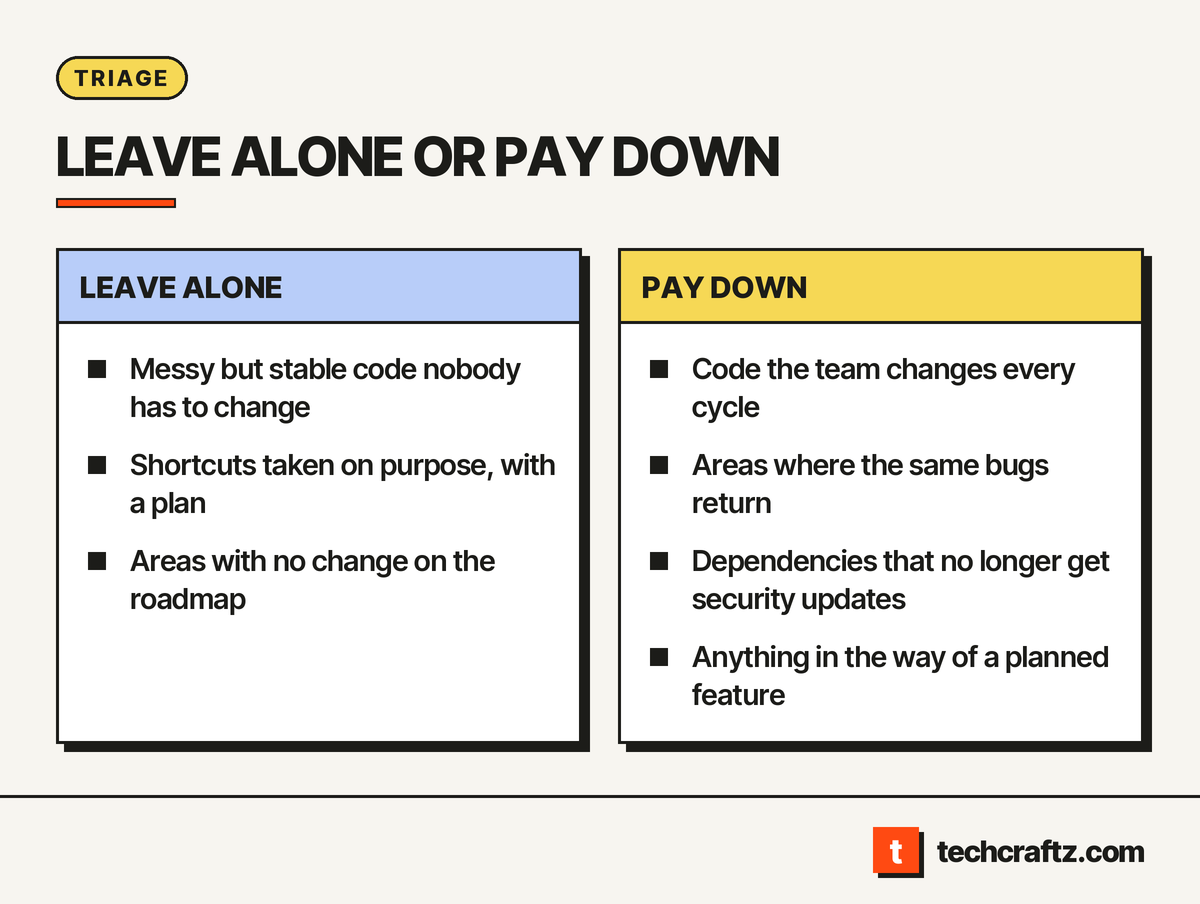
That gives you a triage rule for technical debt in software development that you can apply without reading code: ask how often a part of the system changes. Fowler also notes that cruft tends to accumulate where developers make changes, so the busy areas are where the problem grows. He cautions against measuring this too precisely, since productivity cannot be measured objectively and estimates of the payoff are rough.
Not all debt is bad. Atlassian’s FAQ says strategic debt can be acceptable when a team consciously chooses speed for a valid business reason. The key is managing it on purpose instead of letting it accumulate by accident.
A four-move plan for owners
Fowler suggests paying technical debt in software development down gradually, spending a little extra effort cleaning up the area each time a feature touches it. Combined with Atlassian’s management advice, that gives four moves.
- Agree a definition. Atlassian notes that product and engineering often disagree about what counts as debt. Write one shared definition, and separate debt from planned architectural change and from new features.
- Put testing in “done”. A story is not finished until it is tested. Deferring tests is how new debt starts.
- Keep one backlog. Atlassian advises prioritising debt like normal feature work, in the same backlog, not hiding it in a separate tracker.
- Attach cleanup to change. Reserve part of each cycle for cleaning the areas the next features will touch. This follows Fowler’s logic that improvement pays off where changes are frequent.
Notice what is missing from a sound plan for technical debt in software development: a big-bang rewrite. If you suspect a rewrite is the answer, treat it as a separate decision with its own written scope. Our guide to when custom software beats off-the-shelf explains why long-lived software needs maintenance planned in from the start.
Questions to put to your developers
- Which three parts of the product slow us down most, and how do you know?
- Which of those areas do we change every month?
- Which shortcuts did we take on purpose, and what is the plan for them?
- Which dependencies no longer receive security updates?
- What would we need to be able to test the riskiest flow automatically?
Answers that arrive with examples and a proposed order of work are a good sign. Answers that arrive as a request for a long pause on features deserve a second look.
Technical debt is also easier to avoid than to repay. A written scope, acceptance checks and a staged build keep shortcuts visible; see how that works in the custom software development process and in what a discovery phase should settle.
Send the brief, get a written scope
techcraftz puts scope, milestones and the estimate in writing before the first line of code, then hands over the code, the accounts and the keys. If you want an outside view of a system you already run, or a scoped plan for a new build, see our custom software development page and send the brief. You can also read more about techcraftz.
Last checked: October 14, 2026. The definitions come from the cited sources and are used as descriptions, not as measurements.
Talk to us about your project
Tell us what you need. We help you scope the build, the milestones and a realistic estimate.
View services