How to hire software developers is two decisions, in order: which route you buy through, and how you test the person at the end of it. Most guides give a long list of channels and a handful of interview questions. This one starts with the route, because the route decides who employs and manages the developer. Then it covers where to look and what to test, including what to do if you are not an engineer yourself.
How to hire software developers: pick the route before the channel
FullStack, a software consultancy, names three ways to hire engineers: full-time employees, freelancers and a consultancy. Add the two vendor-supplied options and you have five routes. The table is our summary of how the sources describe them.
| Route | Who employs them | Who manages them | Continuity | Fits when |
|---|---|---|---|---|
| Employee | You | You | Highest | The work is steady and you can invest in onboarding |
| Freelancer | Themselves | You | Depends on their availability | A short, specific need |
| Consultancy or agency | The consultancy | The consultancy or you, by contract | Handled by the firm | You want vetting and replacement handled for you |
| Dedicated developers | A vendor | You set priorities | Long-term by design | Ongoing product work, see how to vet them |
| Staff augmentation | A provider | You | For the engagement | A skill gap in an existing team, see our staff augmentation page |
FullStack’s summary of the trade-offs: employees give commitment and control but are slow to onboard and inflexible; freelancers are quick to start but may not be available when you come back; a consultancy handles vetting, onboarding and replacement. It is a consultancy, so weigh that last point accordingly. For the freelancer-or-agency question in depth, see our guide to freelancer vs software agency.
Write a role card and a scoring rubric first
Karl Hughes, an engineering leader, lists “not defining the skills I wanted to hire for” among his own hiring mistakes. He looked for a specific set of languages and frameworks and passed on people who were excited about the mission but did not match perfectly. His fix was a rubric.
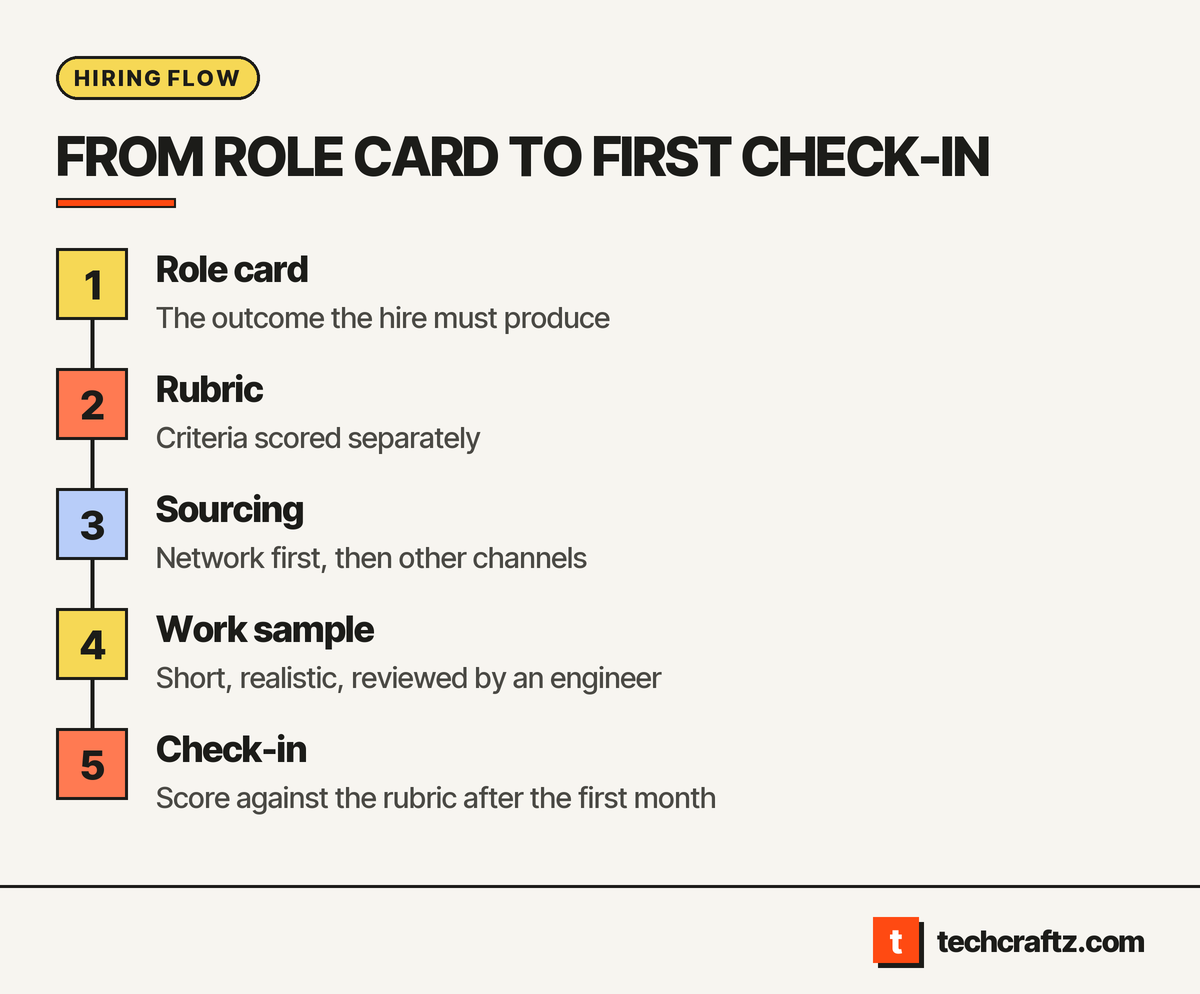
The rubric is the part of how to hire software developers that most guides skip. It is a short list of criteria you score every candidate against. Hughes looks for four things: initiative, reliability, competency (can this person learn to solve the problems we face) and interest in the mission. Use his or write your own, but write it before the first interview. Then:
- Define the outcome the hire must produce in their first months.
- List three to five criteria, each with a plain description of a strong answer.
- Have every interviewer score each criterion separately, before anyone discusses the candidate.
The last step matters. Hughes stopped putting his team in one room after interviews because the loudest voices swayed the outcome. He now collects input individually and weighs it himself.
The channels worth your time
Sources list dozens of channels for how to hire software developers. These are the ones worth a founder’s time.
| Channel | What it gives you | Watch for |
|---|---|---|
| Your network and referrals | Candidates someone has worked with | Narrow pool; ask referrers specific questions |
| A detailed job listing | Candidates who self-select | Vague listings attract vague applications |
| Cold outreach | Passive candidates | Reads as spam unless it is a conversation first |
| Recruiters and staffing firms | A shortlist, faster | Fees; keep recruiting yourself in parallel |
| Open-source projects and public repositories | Visible work and communication | Not everyone has public work |
| Freelance marketplaces | A global pool, fast start | Quality varies; do your own testing |
| Consultancies and vendors | Pre-vetted people, replacement | You inherit the vendor’s standards |
Hughes argues the strongest engineers are rarely on job boards. They move when someone they trust mentions an opening, so he treats his network as the first channel. iMocha, an assessment vendor, also lists referrals as a major source and lists open-source work on GitHub as a way to judge skill before contact. Hughes’s advice on a listing is practical: state the tools, the projects and the day-to-day work, and publish the interview process, so candidates know what to expect.
On recruiters, Hughes says some are well networked and honest, but a small company should not rely on one alone. Keep your own pipeline running.
What to test: the job, not trivia
The test is where how to hire software developers is won or lost. Hughes says he has never used whiteboarding or live-coding sessions. His argument is that they test something engineers rarely do on the job, and many candidates dislike them. He used take-home projects for a while, but they did not show how a person works in a team. He now pairs with the candidate for two to three hours on an open-source issue.
There is research behind testing realistic work. SIOP’s summary of a 2022 re-analysis of selection research ranks structured interviews first among predictors of job performance, and puts job-specific assessments such as work samples in the top five too. An essay on the Stack Overflow blog makes the same case in practical terms.
It argues that an unscripted “conversation over coffee” is no better than choosing at random, and that a developer’s work is unusually easy to assess because code is self-evident: you can watch someone write it. If the interview cannot look like the job, the author says, at least make one interview look like the next by following the same script. Its example of a strong process is a short paid audition: a real task, a pull request, feedback from the team and payment either way.
Our reading: use the same structured questions for every candidate and add a work sample that looks like the job.
| Role | Work sample | What it shows |
|---|---|---|
| Back-end developer | Review a short pull request and write the comments you would leave | Judgment, reading code, tone |
| Front-end developer | Extend a small component with their own tools | Craft, attention to detail |
| Full-stack developer | Pair on a real ticket for two hours | How they work with others |
| Senior or lead | Walk through a system they built and one decision they would reverse | Depth, honesty, trade-offs |
| Any role | A written answer to a technical question from your product | Clarity in writing |
Keep samples short. If a task takes more than a couple of hours, pay for it, which is also a fair way to see how someone works.
If you are not technical
You can learn how to hire software developers without writing code, but you need an engineer’s eye on the results.
- Hire a reviewer. Pay a senior engineer you trust for a few hours to review work samples and sit in on the final interview.
- Ask for plain-language explanations. A developer who cannot explain a past decision to a non-technical person will struggle to report progress to you.
- Check references with specific questions. Hughes notes that lukewarm references made him doubt a candidate’s judgment, so ask what the person did, not whether they were good.
- Try before you commit. A contract-to-hire period, which Oyster lists among augmentation models, lets you evaluate fit before a permanent offer.
Red flags in how to hire software developers
Hughes’s mistakes double as a checklist:
- Ignoring early signals. He hired someone who arrived late to the interview and was always “really busy” but never finished anything.
- Counting years over learning ability. He passed on strong bootcamp graduates and hired someone with years of habits he then had to undo.
- Reaching for recruiters before your network.
- No rubric. If you cannot say what good looks like, you will hire the strongest talker.
Extra checks when you hire a freelance software developer
How to hire a freelance software developer follows the same steps with a few additions. FullStack notes that freelancers may not be available when you return to a project, and that integrating them into your workflow takes effort, including a decision about how much of your infrastructure to share. So:
- Ask for past work you can verify, and speak to someone who hired them.
- Agree the scope and milestones in writing before work starts.
- Put code ownership in the contract and keep the repository in your own account.
- Share production credentials only after a small paid task goes well.
- Ask who else can maintain the code if they become unavailable.
The first weeks after you hire
Newxel, a staffing vendor, offers a rule that holds for any hire: have access ready before the first task. Repositories, documentation, boards and chat should work on day one. Start with a small ticket, review it carefully and set a check-in at the end of the first month against your rubric. Then treat how to hire software developers as a process you repeat and improve, not a one-off event.
Send the brief, get a written scope
techcraftz puts scope, milestones and the estimate in writing before the first line of code, then hands over the code, the accounts and the keys. If hiring directly is not the right route, our dedicated developers service gives you named engineers on your product, and staff augmentation adds skills to an existing team. When you are ready, send the brief. You can also read more about techcraftz.
Last checked: October 15, 2026. Vendor guidance and research summaries change; verify before you rely on them.
Talk to us about your project
Tell us what you need. We help you scope the build, the milestones and a realistic estimate.
View services