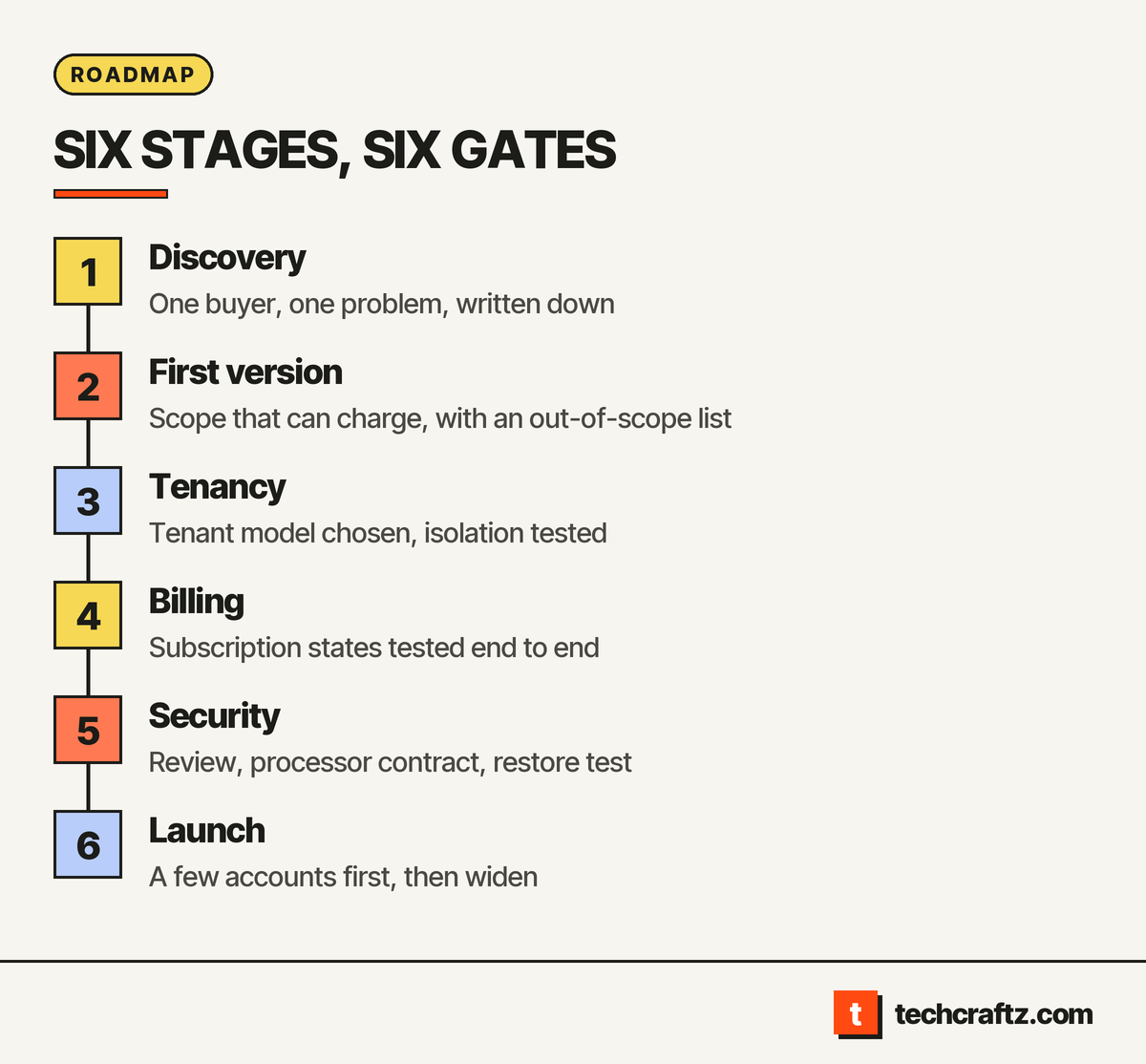
SaaS product development is the work of building software that many customers use by subscription, and that you operate for them. A SaaS product development roadmap does not end at launch. It ends when the first customer pays, keeps paying and could leave with their data. That asks for four things most step lists skip: a tenancy decision, a billing lifecycle, onboarding and an exit path. This guide runs through six stages, with the gate to pass before the next one.
SaaS product development versus a custom build
A custom web application serves one organization. Its workflows are yours, and you pay once to have it built. Our guide to custom web application development covers that case.
A SaaS product serves many customers from one running system. Three things change.
- You operate it. Uptime, backups, support and updates are your job after launch, for every customer at once.
- Customers share the product. One customer’s data must never appear in another’s account.
- Revenue recurs, and so does leaving. Read AI’s guide puts it plainly: customers can churn instantly. The product has to earn the next payment, not only the first.
None of this makes SaaS product development harder to start. It makes the unglamorous parts matter earlier.
Stage 1: Discovery around one buyer and one problem
Taazaa and Read AI both begin with market analysis and validation. In SaaS product development the useful version is narrow: one type of buyer, one problem, one outcome the product must deliver.
Write down who pays, who uses the product, and what happens today without it. If the buyer and the user are different people, say so now. Their needs diverge later and the scope has to hold both.
Gate: a one-page problem statement, a named buyer and a named user. If you cannot describe the competing alternative, including spreadsheets, discovery is not done.
Stage 2: A first version scoped to charge money
Read AI defines the minimum viable product as the smallest version that tests one core promise to a real user, and notes it is not a beta or a demo. It suggests tying the MVP to one to three activation metrics.
For SaaS, “can charge money” belongs in the definition. A first version that cannot take a payment, create an account or let an admin see who signed up is a prototype. A written scope for SaaS MVP development should list:
- The one workflow the product exists for.
- Sign-up, sign-in and password recovery.
- Roles inside a customer account, and an admin view for you.
- Billing, as set out in Stage 4.
- What is out of scope, written down so “later” is a decision.
Gate: a written scope with milestones and an explicit out-of-scope list. Whether to build the first version at all is a fair question. A landing page and a handful of conversations can test demand before you commit.
Stage 3: Tenancy and data decisions that are costly to reverse
A tenant is the unit that owns data in your product. In a business product, a tenant is usually a customer company. Microsoft’s architecture guidance warns that a customer may need more than one tenant, for example separate teams or a separate test environment, so decide the definition before you design tables.
The second decision is how much each tenant shares with the others. Microsoft describes isolation as a spectrum from shared nothing to shared everything, and lists four common models.
| Model | What it means | Trade-off, per Microsoft |
|---|---|---|
| Automated single-tenant deployments | Each customer gets a dedicated set of infrastructure | Strong isolation, low cost efficiency, slow to maintain without automation |
| Fully multitenant deployments | Everyone shares the same components | Cheaper to operate, higher risk if a bug leaks data or one customer overloads the system |
| Vertically partitioned deployments | Some shared infrastructure, some dedicated, for example a dedicated tier for larger customers | Mixes the two, with more moving parts |
| Horizontally partitioned deployments | Separate components for each tenant where load is concentrated, such as the database | Reduces the “noisy neighbor” problem, still needs automated management |
Read AI observes that many products start shared and add isolation later. That is common and workable only if tenant identifiers exist in every table and every query from day one. Retrofitting them is the costly part.
Microsoft frames the choice as commercial as well as technical: business goals, compliance expectations, scale, how much operations you can automate, and the service levels customers expect. Ask your first customers what they require before you pick.
Gate: a written tenancy decision, a data model with tenant identifiers, and a test that proves one tenant cannot read another’s data.
Stage 4: Billing is part of the product
In the eight guides we opened, billing gets at most a line. Lollypop lists subscription lifecycles as a challenge and stops there. Yet billing is where the first paying customer meets the product.
Stripe’s documentation, used here as one example of how a payment provider models it, shows how many states a subscription passes through. A subscription can be trialing, incomplete until the first payment lands, active, past due or unpaid after a failed payment, paused, and canceled. Each state decides what the customer can still do.
Questions to settle in the scope:
- When is access granted? Stripe’s guidance is to provision access when the subscription becomes active, or by feature entitlements, and to follow changes through webhook events.
- What happens on a failed payment? Does the account lock, show a notice, or keep working for a set grace period?
- How do plan changes work? Upgrades, downgrades and mid-cycle changes need rules.
- What does cancellation do to data? Stripe notes a canceled subscription cannot be updated. Your product still decides how long data stays.
- Who sees invoices? Customers need receipts and a way to update a payment method.
These are product decisions made in code. If they are left to the end, they become the launch delay.
Gate: a billing flow tested end to end with test payments, including failure, plan change and cancellation.
Stage 5: Security, privacy and operations before the first customer
Every SaaS product development project ends up holding other companies’ data. Treat security as the baseline, not an enterprise add-on.
- Application security. Start from the OWASP Top 10:2025. For multi-customer products, A01 Broken Access Control matters most: it is how one tenant sees another’s data.
- Your role under GDPR. If your product processes personal data on behalf of customers, you are likely a processor. Article 28 requires a binding contract between controller and processor, and Article 33 requires a processor to notify the controller of a breach without undue delay. Your incident process must exist before launch. This is not legal advice, and whether GDPR applies is a question for counsel.
- Operations. Backups that have been restored at least once, monitoring that alerts a person, a status page, and a support channel customers can reach.
- Exit. A way for a customer to export their data. It also answers a question every serious buyer asks.
Gate: a security review against the OWASP list, a drafted data processing agreement, a restore test, and an incident runbook.
Stage 6: Launch to a few accounts, then widen
Launch in SaaS product development is a controlled start, not a switch. Invite a small group of accounts that match the buyer from Stage 1. Watch whether they reach the activation metrics from Stage 2, where they stall, and which support questions repeat. Fix those before widening.
Then plan what comes after: a release rhythm, a dependency update policy, and a written maintenance agreement. Taazaa ends its process with support and maintenance for the same reason.
Gate: the first customer has paid, used the product on a normal day, and you know what you changed because of them.
Signs SaaS product development is premature
You may not need a SaaS product yet.
- You serve one company. A custom internal tool is a different, simpler project.
- You cannot name a buyer. Discovery comes first.
- The workflow is already served by existing SaaS products and you have no reason customers would switch.
- You want to add billing and multi-customer features “later” without a plan for the tenant model. Later is the expensive time.
SaaS product development with techcraftz
techcraftz builds SaaS products with a written scope, milestones, and the code and accounts handed to you. For a founder at the idea stage, the startup page shows how a first engagement runs. Describe the buyer, the problem and the one workflow. Get a written scope, or read about techcraftz first.
Last checked: October 14, 2026. Provider documentation and regulations change; verify before you build.
Talk to us about your project
Tell us what you need. We help you scope the build, the milestones and a realistic estimate.
View services