RAG chatbot development means building a chatbot that looks up passages in your own documents before it answers, then writes the reply from what it found. AWS defines retrieval-augmented generation as having a language model reference an authoritative knowledge base outside its training data before it generates a response, and presents it as a cheaper route than retraining a model on new data. The idea is simple. The build is not, because most of the work is not the model. It is the sources, the freshness, who may see what, and how you know the answers are right. Sources were checked on October 15, 2026.
How RAG chatbot development works
Five steps, the last one a loop. The tutorials from Anaconda and Google Cloud and the AWS explainer describe the same shape.
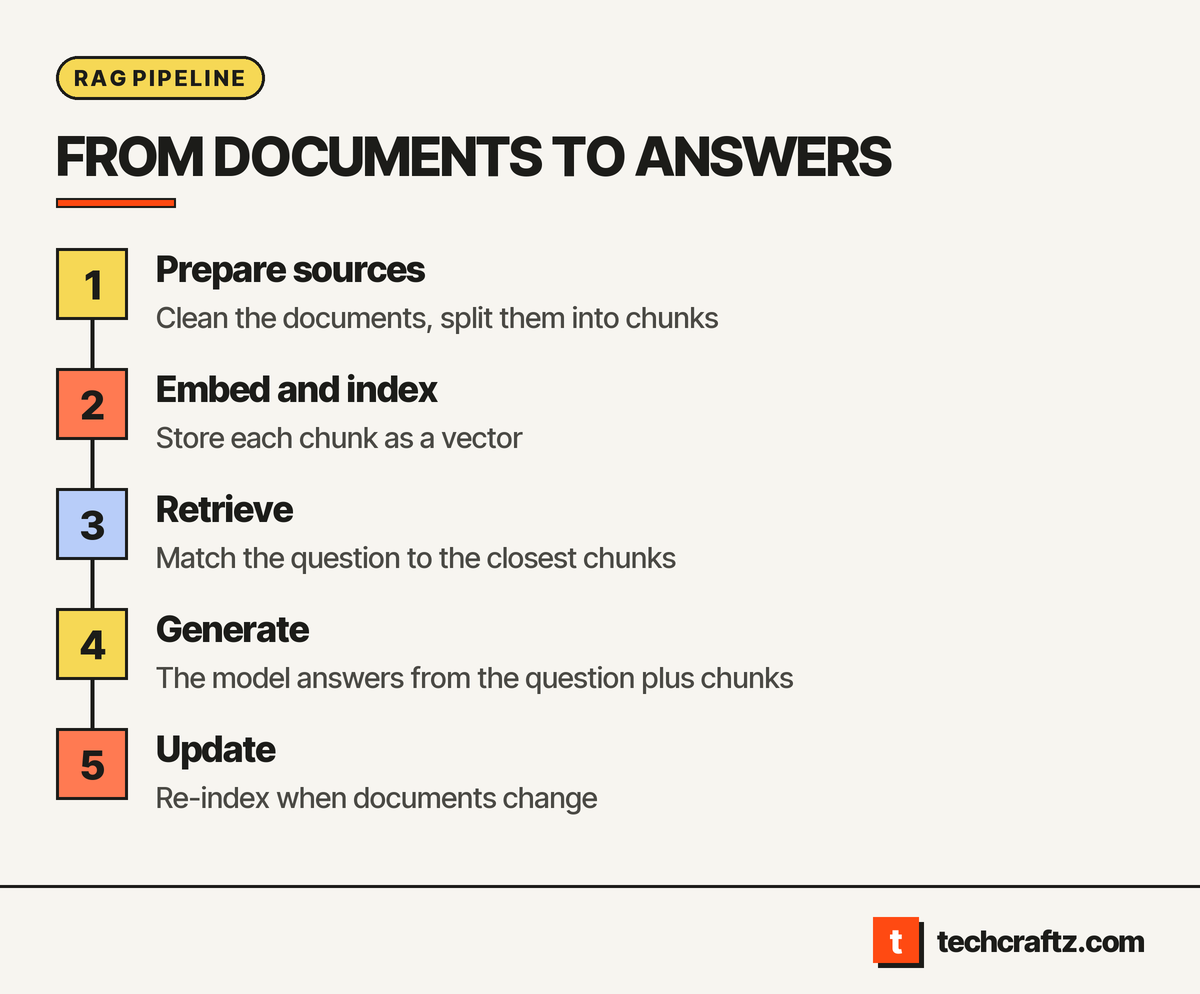
- Prepare the sources. Load the documents and split long ones into chunks. Anaconda’s example loads a PDF and splits it by characters. Meilisearch advises cleaning the data first, removing duplicates and irrelevant content.
- Embed and index. Each chunk is turned into a vector of numbers that captures meaning, and stored in a vector store. Google’s tutorial triggers this automatically whenever a new file lands in a storage bucket.
- Retrieve. The question is converted the same way and matched against the stored vectors. The closest chunks come back.
- Generate. The question and the retrieved chunks go to the language model together. Google’s chatbot is set to answer from the content of the uploaded files, and AWS notes that the answer can then carry source attribution.
- Update. AWS asks the question every owner asks: what if the data becomes stale? Its answer is to update documents and their embeddings, either in real time or in periodic batches.
That is the whole mechanism. The rest of RAG chatbot development is deciding what goes in and what comes out.
What RAG fixes, and what it does not
AWS lists problems RAG addresses, among them: a model that states false information when it lacks the answer, that gives out-of-date or generic answers, or that builds a reply from non-authoritative sources. Pointing it at your documents addresses all three, in part.
RAG chatbot development does not remove the failure modes that remain. A developer’s write-up on dev.to shows several in a small offline build. Asked about the phases of AI development, the bot retrieved passages about NLP techniques. The fix was more chunk overlap, a different embedding model and extra metadata. After the PDF was changed, the bot kept answering from the old version until the index was cleared and rebuilt. A one-word question, “Phases?”, returned irrelevant text until the builder expanded short queries with a prompt template.
Each of those is a retrieval problem, not a language problem. A good answer needs the right passage to be found first.
Two other points are worth knowing. OWASP’s guidance on prompt injection says that RAG and fine-tuning aim to make outputs more relevant and accurate, but research shows they do not fully mitigate prompt injection. And a competing guide, Meilisearch’s, lists fine-tuning the model on company data as a step in RAG, while AWS describes RAG as a way to avoid retraining. Read vendor guides with that in mind: terms are used loosely.
Six decisions that shape the build
Most competing pages are tutorials for a developer’s first prototype. Production RAG chatbot development turns on decisions a tutorial skips.
| Decision | What you settle | Source |
|---|---|---|
| Sources | Which documents, formats and owners; what is out of scope; who cleans duplicates | Meilisearch: clean the data first |
| Freshness | How a changed document reaches the index, and how fast | AWS: update documents and embeddings, in real time or in batches |
| Access | Who may retrieve which documents; whether one vector store serves several groups | AWS: restrict sensitive retrieval by authorization level; OWASP LLM08 |
| Answer rules | Cite sources or not; what to say when nothing relevant is found; when to hand off to a person | AWS: source attribution builds trust |
| Evaluation | A fixed set of real questions with known good answers, run after every change | dev.to: manual comparison with the source, tricky and vague questions |
| Security | Prompt injection, data poisoning, leakage between users | OWASP LLM01 and LLM08 |
The evaluation row is the easiest to skip. A bot that sounds fluent is not a bot that is right. Collect real questions from your support inbox or sales calls, write the correct answer and the document it comes from, and re-run the set whenever sources, chunking or the model change. This is our recommendation, not a quote from a source, and it is a low-effort quality control.
Access and security in RAG chatbot development
OWASP’s entry on vector and embedding weaknesses names the risks that RAG adds. Inadequate access controls can let the model retrieve and disclose personal or proprietary data. In a setup where several groups share one vector database, context can leak between them. Poisoned data, intentional or not, can manipulate outputs, and one of OWASP’s examples is a resume with hidden white text telling the system to recommend the candidate.
Its mitigations are concrete: permission-aware vector stores with strict partitioning, validation of knowledge sources, tagging and classifying data to control access, and detailed logs of retrievals. For you, that translates into questions to put to any builder:
- If an employee may not open a document, can the chatbot quote it to them?
- What checks a new document before it enters the index?
- Are retrievals logged, and who reads the logs?
- Where do prompts and documents travel, and who processes them? If a third-party model provider handles personal data, GDPR Article 28 requires a contract with that processor.
Our software requirements document guide shows how to write answers like these into the scope.
Build, buy or wire together
There are three routes into RAG chatbot development. A hosted chatbot platform is quick to start and usually limits your say over answer rules, the access model and where data lives. A prototype assembled from a tutorial, for example with LangChain, shows the idea quickly and usually needs much more before it can face customers. A custom build gives you control of sources, permissions, logging and evaluation in exchange for owning the code.
For a small team starting out, our article on AI automation for small businesses covers how to pick the first task and keep a human step in the loop. The same rule applies here.
A first version worth building
Keep it narrow and measurable.
- One audience, one document set. Internal policy questions or a single product’s support content, not “everything”.
- Sources with named owners and an agreed way to update them.
- A fixed question set from real inbox traffic, scored before launch and after each change.
- A fallback. When retrieval finds nothing relevant, the bot says so and routes to a person, instead of guessing.
- Logs. Questions, retrieved passages and answers, so you can see where it fails.
Grow from there once the failures you see are the ones you expected.
Send the brief, get a written scope
techcraftz writes scope and milestones before the first line of code, then hands over the code, the accounts and the keys. For RAG chatbot development we start with the sources, the access rules and the question set, in writing. See our AI automation services, our custom software development page and how we work. Get a written scope.
Last checked: October 15, 2026. Tools and security guidance change quickly; verify before you build.
Talk to us about your project
Tell us what you need. We help you scope the build, the milestones and a realistic estimate.
View services